Reinforcement Learning from Prompts: Iterative Refinement for LLM Quality
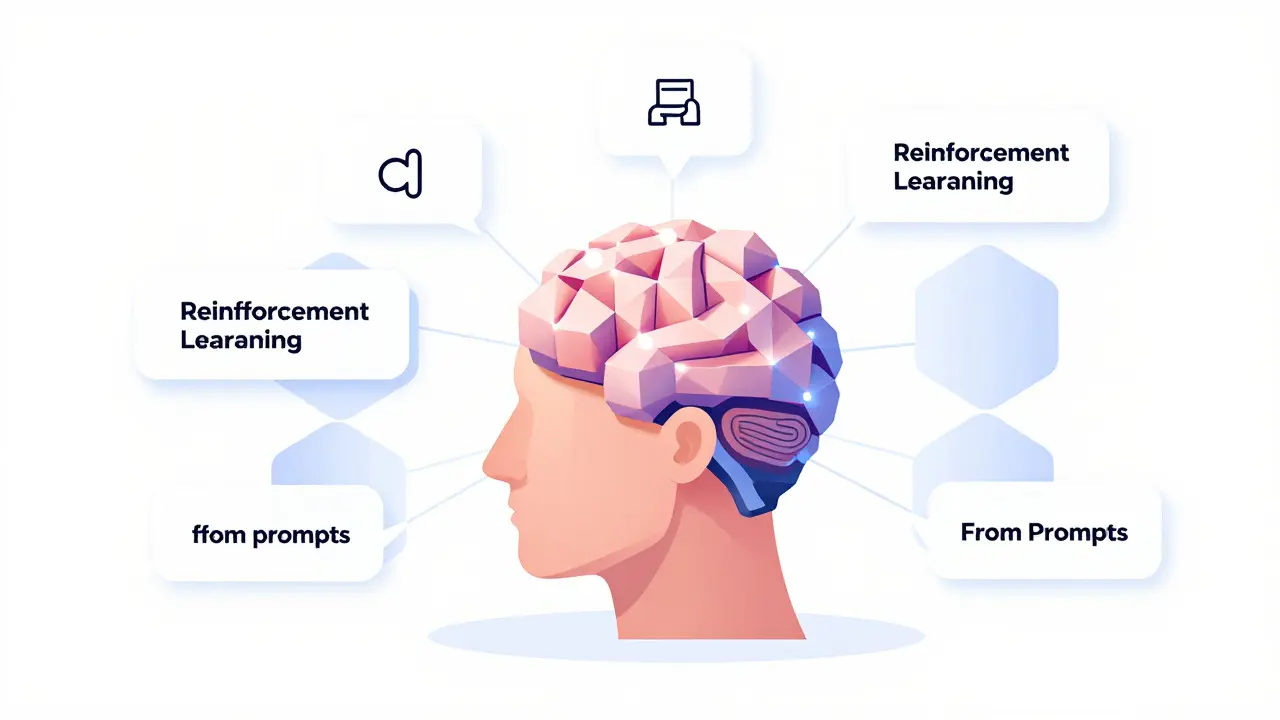
Stop guessing your prompts. That era is ending.
We’ve all been there. You tweak a sentence here, add a comma there, maybe throw in "think step-by-step," and hope the Large Language Model (LLM) gives you the right answer. It’s manual, it’s slow, and frankly, it’s hitting a ceiling. Enter Reinforcement Learning from Prompts, or RLfP. This isn’t just another buzzword; it’s a structural shift in how we interact with AI. Instead of relying on human intuition to craft the perfect instruction, RLfP uses algorithms to iteratively refine prompts based on performance rewards. The result? Accuracy gains that human engineers simply can’t see coming.
If you are managing enterprise AI pipelines or building high-stakes applications, understanding this technology is no longer optional. It is the difference between a model that works "well enough" and one that performs with clinical precision.
What Is Reinforcement Learning from Prompts?
Let’s strip away the jargon. Traditional prompt engineering is static. You write a prompt, you test it, you keep it. If the model fails, you rewrite it manually. It’s linear and limited by human perception.
Reinforcement Learning from Prompts (RLfP is an emerging AI paradigm that applies reinforcement learning techniques to automatically optimize and refine prompts for large language models through iterative reward-based cycles.) changes the game by treating prompt creation as a dynamic loop. Imagine a system that tries thousands of subtle variations of a prompt-adding a word, removing a phrase, changing the tone-and keeps only the ones that yield better results. It learns what works by doing, not by being told.
This approach was formalized in 2023-2024, with major contributions from Google Research and independent academic teams. The core idea is simple but powerful: use a policy function to generate prompt variants, evaluate them against ground-truth data, and update the strategy using algorithms like Proximal Policy Optimization (PPO). The system doesn’t just guess; it optimizes.
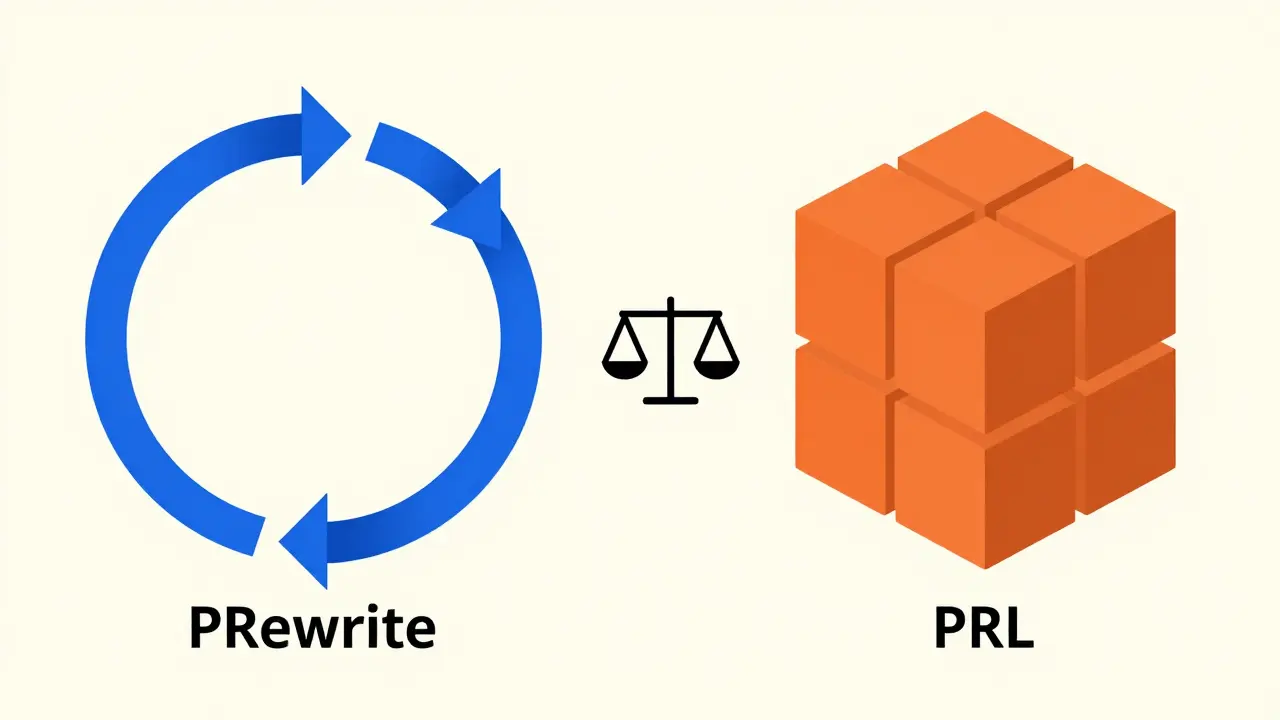
The Two Giants: PRewrite vs. PRL
When talking about RLfP, two frameworks dominate the conversation: Google’s PRewrite and the Prompts from Reinforcement Learning (PRL) approach developed by Paweł Batorski, Adrian Kosmala, and Paul Swoboda. Both aim to automate prompt refinement, but they take different paths.
| Feature | Google PRewrite | PRL (Batorski et al.) |
|---|---|---|
| Release Date | May 2024 | May 2025 |
| Core Mechanism | Fine-tunes an LLM to rewrite prompts | Direct reinforcement learning on prompt tokens |
| Evaluator Type | Adaptive (refines itself) | Static/Frozen evaluator |
| SST-2 Accuracy Gain | +10.3% (92.7% total) | Data varies by configuration |
| Resource Intensity | High (4x NVIDIA A100 GPUs) | High (similar GPU requirements) |
| GitHub Rating | 3.7/5.0 (849 stars) | 3.4/5.0 (512 stars) |
Google’s PRewrite stands out because it doesn’t use a frozen evaluator. It refines the LLM used to rewrite prompts, creating a feedback loop where the optimizer gets smarter as it goes. In tests on the SST-2 text classification benchmark, PRewrite achieved 92.7% accuracy compared to 82.4% for human-designed prompts. That 10.3 percentage point jump came from subtle, algorithmically derived modifications that humans would likely miss.
PRL, detailed in their May 2025 arXiv paper, offers a robust alternative, particularly excelling in complex reasoning tasks. On the GSM8K math reasoning benchmark, PRL hit 68.4% accuracy, beating the next-best method by nearly 10 points. However, both frameworks share a common trait: they are resource-heavy beasts.
The Hidden Cost: Why RLfP Isn't for Everyone
Here’s the hard truth. RLfP is not a plug-and-play solution for hobbyists. It demands serious computational muscle. Google’s internal benchmarks show that implementing PRewrite requires approximately 37 times more GPU hours than static prompt engineering methods. We’re talking about 72 hours of training on four NVIDIA A100 GPUs just to get started on the GLUE benchmark datasets.
For context, a mid-sized company implementing PRewrite reported spending $1,842 in AWS costs for a single three-day training cycle. While the accuracy gain of 7.2% on customer service intent classification was significant, the cost-benefit analysis isn’t always positive for smaller operations.
Moreover, there’s a risk of over-engineering. The PRewrite team noted that in certain configurations, automated methods failed to beat original human prompts on specific datasets. And then there’s the issue of "prompt architecture lock-in." Researchers at Bar Ilan University found that prompts optimized for Llama-3 performed 12.3% worse when transferred to Mistral-7B models. Your optimized prompt might be useless if you switch backbones.

How to Implement RLfP: A Realistic Roadmap
If you have the budget and the need for precision, here is how you actually do this. Based on user reports from early 2026, expect a steep learning curve of 80-120 hours to move from theory to production.
- Environment Setup (8.5 hours): Don’t underestimate this. You’ll need PyTorch or TensorFlow compatibility, CUDA drivers that don’t conflict, and substantial VRAM. Users report spending days resolving dependency issues alone.
- Reward Function Configuration (4.2 hours): This is the heart of RLfP. You must define what "success" looks like. Are you optimizing for Exact Match (EM)? F1 score? Perplexity? Google tested five distinct approaches. For example, a hybrid Perplexity+F1 score often yields the best balance between coherence and accuracy.
- Initial Prompt Seeding (2.1 hours): Start with a decent baseline. RLfP refines; it doesn’t create magic from chaos. A poor initial prompt leads to poor optimization.
- Iterative Refinement Cycles (72+ hours): Let the system run. The policy function will generate variants, execute them, calculate rewards, and update via PPO. Monitor for instability-61% of users reported reward function crashes during this phase.
Pro tip: Start with a narrow task. Don’t try to optimize a general-purpose chatbot. Focus on a specific, high-value output like medical QA or financial sentiment analysis. Maria Rodriguez, a data scientist, saw her medical QA system jump from 76.4% to 85.1% accuracy using PRewrite. That’s the kind of targeted win that justifies the cost.
Regulatory Headwinds and Future Trends
As RLfP enters the mainstream, regulators are watching. The EU AI Office issued guidance in January 2026 stating that RL-optimized prompts used in high-risk applications must undergo human review before deployment. This affects 68% of potential enterprise use cases. You can’t just let the algorithm run wild in healthcare or finance; someone needs to sign off on the logic.
Looking ahead, the industry is moving toward efficiency. DeepMind released a preprint in January 2026 detailing a "lightweight RLfP" approach that cuts GPU requirements by eightfold. Meanwhile, Google’s PRewrite v1.3 introduced multi-objective reward balancing, optimizing for accuracy, speed, and safety simultaneously. By 2028, Forrester predicts RLfP will be standard in enterprise pipelines, but it will remain niche for individual developers due to persistent hardware barriers.
The bottom line? RLfP is powerful, precise, and expensive. Use it where every percentage point of accuracy matters. For everything else, stick to good old-fashioned prompt engineering.
Is Reinforcement Learning from Prompts (RLfP) worth the cost for small businesses?
Generally, no. RLfP requires significant computational resources, such as multiple NVIDIA A100 GPUs, and can cost thousands of dollars in cloud computing fees per training cycle. Small businesses should focus on simpler prompt engineering techniques unless they have a high-stakes application where even a 1-2% accuracy gain translates to substantial revenue or safety improvements.
What is the difference between PRewrite and PRL?
PRewrite, developed by Google, uses an adaptive evaluator that refines the LLM responsible for rewriting prompts, allowing for continuous improvement. PRL, created by Batorski et al., uses a more direct reinforcement learning approach on prompt tokens. PRewrite tends to perform better on semantic understanding tasks, while PRL shows strong results in complex reasoning benchmarks like GSM8K.
Can I use RLfP-optimized prompts across different LLM models?
Be cautious. Research indicates "prompt architecture lock-in," where prompts optimized for one model (e.g., Llama-3) may perform significantly worse on another (e.g., Mistral-7B). It is recommended to re-optimize prompts when switching LLM backbones to ensure consistent performance.
What are the regulatory requirements for using RLfP in Europe?
According to EU AI Office guidance from January 2026, RL-optimized prompts used in high-risk applications must undergo human review before deployment. This ensures that automated optimizations do not introduce biases or errors that could impact critical sectors like healthcare or finance.
How long does it take to implement RLfP in a production environment?
Expect a learning curve of 80-120 hours for practitioners to move from basic understanding to production deployment. The actual training cycle for a single optimization run can take 72 hours or more, depending on the complexity of the task and the computational resources available.
- May, 22 2026
- Collin Pace
- 0
- Permalink
Written by Collin Pace
View all posts by: Collin Pace