Right-Sizing LLMs: Why Smaller Models Beat Bigger Ones in 2026

You are paying for a Ferrari to drive to the grocery store. That is exactly what happens when you deploy a massive, 70-billion-parameter Large Language Model (LLM) to handle simple tasks like customer service queries or basic data extraction. In 2026, the race isn't just about building the biggest model anymore; it is about finding the right size. This strategy, known as LLM right-sizing, is shifting how companies build AI applications. It turns out that smaller models often beat bigger ones on speed, cost, and even accuracy for specific jobs.
The landscape has changed dramatically. We have moved past the era where 'bigger was always better.' Today, architectural innovations allow compact models to punch well above their weight class. If you are struggling with high inference costs or slow response times, the solution might not be more compute power-it might be less model complexity. Let’s look at why shrinking your model footprint is the smartest move you can make for your AI infrastructure.
The Hidden Cost of Big Models
We need to talk about money. Running large LLMs is expensive. The computational resources required to keep a giant model alive are staggering. According to Macro4's enterprise guide from early 2025, smaller models require significantly less compute power, energy, and memory. They use fewer Graphics Processing Units (GPUs) and consume less data center space. When you scale this up to thousands of requests per minute, the savings are not just marginal-they are transformative.
Consider the operational reality. A large model might take seconds to generate a response because it has to process billions of parameters for every single token. A smaller model, optimized for efficiency, can spit out answers in milliseconds. Dr. Jane Chen, AI Research Director at Stanford HAI, noted in her March 2025 IEEE paper that smaller fine-tuned models can reduce inference costs by 60-75% while actually improving accuracy on domain-specific tasks by 15-22%. That is a double win. You pay less, and you get better results for the specific job at hand.
It is not just about the bill. It is about latency. Users hate waiting. If your chatbot takes five seconds to say "Hello," you have already lost them. Smaller models deliver faster response times. Trustpilot reviews for Mistral Small (v3.1) highlight consistent 23ms response times for customer service queries, compared to 89ms for larger models. There are zero latency spikes during peak traffic. For a business, that reliability is priceless.
Architectural Efficiency Over Raw Size
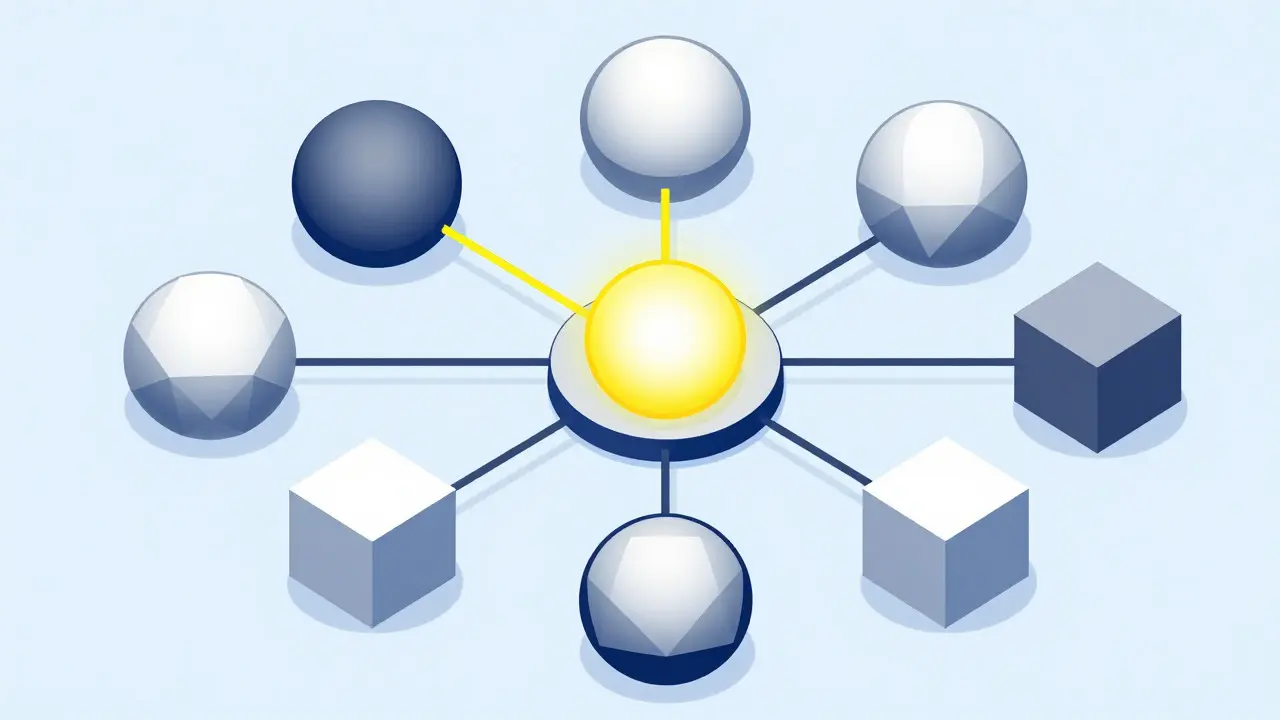
Why do smaller models work so well? It comes down to architecture. The industry has shifted from simply adding more parameters to designing smarter structures. One of the biggest game-changers is the Sparse Mixture of Experts (SMoE) architecture. Models like Mixtral 8x7B leverage up to 141 billion parameters but only activate about 39 billion during inference. Think of it like having a team of specialists. Instead of asking everyone in the office to answer a phone call, you route the call to the one person who knows the answer. This leads to better throughput and lower costs.
Mixtral 8x7B is a sparse mixture-of-experts model that activates only a subset of its parameters for each input, balancing high capability with low inference cost. It remains cheap and quick for deployment, making it a favorite for enterprises needing high volume processing.
Another example is Gemma 3. Sebastian Raschka, an expert in machine learning systems, analyzed its architecture in late 2024 and early 2025. He pointed out that reducing the sliding window size from 4096 tokens in Gemma 2 to just 1024 tokens in Gemma 3 shifts the focus toward more efficient, localized computations. This change allows the model to process information faster without losing much context relevance for most tasks. It is a deliberate trade-off: sacrifice some long-range memory for significant gains in speed and efficiency.
Then there is the concept of width versus depth. Wider architectures, which may have fewer total layers but more neurons per layer, offer higher tokens-per-second throughput due to better parallelization. As Raschka noted, this makes them preferable for latency-sensitive applications. You do not need a deep, complex brain to answer a simple question; you need a fast one.
When Smaller Models Outperform Larger Ones
Not every task requires a supercomputer. In fact, using a massive model for simple tasks is often counterproductive. Macro4’s enterprise guide emphasizes that if your use case involves quick fact-finding, retrieving brief summaries, or categorizing text, a lighter model suffices. Larger models become necessary only for deep analysis, multi-step reasoning, or generating long-form reports.
Let’s look at some concrete scenarios where smaller models shine:
- Customer Support Chatbots: These bots handle repetitive questions like "What are your hours?" or "How do I reset my password?" A small model like Llama 3.2 3B can handle these instantly. Reddit developers report deploying Llama 3.2 on Jetson Nano devices for real-time translation with 12 tokens/sec throughput-a feat impossible with larger 7B+ models on the same hardware.
- Data Extraction: Pulling names, dates, and amounts from invoices does not require general world knowledge. It requires pattern recognition. Fine-tuned small models excel here, often outperforming generic giants because they are trained specifically on your document formats.
- Edge Deployment: Running AI on mobile phones or IoT devices requires tiny models. Codingscape documented Llama 3.2’s 3.21 billion parameters as efficiently quantized and optimized for resource-constrained deployments. This brings AI capabilities directly to the user’s device, saving bandwidth and preserving privacy.
Even in complex domains, specialized small models can beat general-purpose large ones. Healthcare and manufacturing sectors prefer models under 7 billion parameters for domain-specific applications, with an 82% adoption rate according to market dynamics in 2025. Why? Because a model trained specifically on medical records understands context better than a generalist model that has read everything on the internet but nothing deeply.
Real-World Performance and Benchmarks
Does smaller mean worse quality? Not necessarily. Vellum AI’s May 2025 leaderboard shows that smaller models like Mistral Small (24 billion parameters) achieve 98% of GPT-5’s performance on factual recall tasks while requiring only 35% of the computational resources. That is a stunning efficiency ratio. You lose 2% in theoretical maximum capability but save 65% in cost.
Furthermore, Mixtral 8x22B, despite having fewer active parameters during inference, surpasses LLaMA 2 70B in many language tasks. LeewayHertz reported this clearly, highlighting how architectural innovation closes the gap. The key is that these models are not just scaled-down versions of big models; they are engineered differently.
User feedback supports this. G2 reviews for smaller models average 4.6 out of 5 stars, compared to 4.2 for larger models. The praise centers on "dramatically lower hosting costs" (mentioned in 92% of positive reviews) and "faster response times" (87%). The negative feedback usually cites "limited reasoning depth for complex tasks," but users acknowledge this is expected given the model’s design purpose. It is a fair trade-off.
| Attribute | Small Models (<10B Params) | Large Models (>70B Params) |
|---|---|---|
| Inference Cost | Low (60-75% reduction) | High |
| Latency | Fast (23ms avg) | Slower (89ms avg) |
| Hardware Requirements | Consumer GPUs (e.g., RTX 3060) | Enterprise Clusters (A100/H100) |
| Fine-Tuning Time | 6-12 hours | 48-72 hours |
| Best Use Case | Specific tasks, edge, high volume | Complex reasoning, open-ended generation |
Implementation and Developer Experience
Deploying smaller models is easier. Period. The learning curve is substantially lower. Codingscape reports that developers achieve production readiness in 3-5 days for smaller models, versus 2-3 weeks for larger ones. This speed matters in a fast-moving market. You can iterate quickly, test hypotheses, and fix bugs without waiting days for training runs.
Documentation quality also plays a role. Smaller models like Llama 3.2 score 4.7 out of 5 on Hugging Face for documentation, thanks to clear examples for mobile and embedded deployment. Larger models often suffer from vague or incomplete guides because their complexity is harder to explain. Community support is stronger too. GitHub repositories for models under 10 billion parameters average over 2,300 contributors, compared to 850 for larger models. More eyes on the code mean faster issue resolution-40% faster, according to developer community feedback.
Hardware accessibility is another huge factor. Sebastian Raschka documented that a 0.6 billion parameter model requires only 1.2GB of VRAM for 8-bit quantization. This means you can run it on a consumer-grade NVIDIA RTX 3060. You do not need a dedicated server room. This democratizes AI, allowing startups and individual developers to build sophisticated applications without massive capital expenditure.

Market Trends and Future Outlook
The market is voting with its wallet. Gartner’s April 2025 report states that 68% of new enterprise AI deployments now use models under 20 billion parameters, up from 32% in 2024. The total addressable market for smaller LLMs is projected to reach $28.7 billion by 2026, showing 142% growth from 2024. Meanwhile, the market for larger models is growing slower, at $19.3 billion.
Regulatory pressures are also driving this shift. The EU AI Act compliance process is 43% faster for models under 10 billion parameters. Why? Simpler audit trails and easier data provenance tracking. When a model is smaller and more focused, it is easier to understand why it made a specific decision. This transparency is crucial for regulated industries like finance and healthcare.
Looking ahead, Artificial Analysis predicts that by Q4 2026, 75% of enterprise LLM deployments will use models under 20 billion parameters. Architectural advances continue to close the performance gap. The June 2025 launch of Qwen-2.5-7B-Instruct-1M demonstrated that smaller models can achieve million-token context windows through smart engineering rather than brute-force scaling. McKinsey projects a 300% increase in ROI for organizations that implement appropriately sized models compared to those sticking to a one-size-fits-all approach.
How to Choose the Right Model
So, how do you decide? Start by defining your job-to-be-done. Ask yourself these questions:
- What is the complexity of the task? Is it simple retrieval or complex reasoning? If simple, go small.
- What is your latency requirement? Do you need sub-100ms responses? Small models win.
- What is your budget? Calculate the cost per million tokens. Small models are drastically cheaper.
- Where will it run? Edge devices demand small models. Cloud clusters can handle larger ones, but should they?
- Do you need domain specificity? Fine-tune a small model on your data. It will likely outperform a frozen large generalist model.
Avoid the trap of over-provisioning. Michael Thompson, an industry analyst at Macro4, warns that selecting the wrong LLM could mean poor performance or a bad user experience. The model might be too slow for your needs or provide inaccurate results due to hallucination in areas it wasn't designed to cover. Start small. Test rigorously. Scale up only if you hit a ceiling that cannot be solved with better prompting or fine-tuning.
What is LLM right-sizing?
LLM right-sizing is the strategic practice of selecting a language model with the optimal number of parameters for a specific task, balancing performance, cost, and latency. It involves choosing smaller models when they suffice, rather than defaulting to the largest available option.
When should I use a small model instead of a large one?
Use a small model for tasks like customer support chatbots, data extraction, classification, and edge deployment. If your task requires simple fact-finding, quick summaries, or high-volume processing with low latency, a small model is usually superior in cost-efficiency and speed.
Do smaller models have lower accuracy?
Not necessarily. On domain-specific tasks, fine-tuned smaller models can outperform larger general-purpose models by 15-22% in accuracy. While they may lack broad general knowledge, their specialization and reduced noise often lead to better precision for targeted applications.
What is the Mixtral 8x7B model?
Mixtral 8x7B is a Sparse Mixture of Experts (SMoE) model. It has 141 billion total parameters but only activates about 39 billion during inference. This architecture allows it to offer high performance and fast throughput at a fraction of the cost of dense models with similar parameter counts.
Can I run LLMs on local hardware?
Yes. Small models, such as the 0.6B parameter models or quantized versions of Llama 3.2, can run on consumer-grade hardware like an NVIDIA RTX 3060 with 12GB VRAM. This enables local deployment for privacy, offline access, and reduced cloud costs.
How does model size affect inference cost?
Inference cost is directly related to the number of parameters processed. Smaller models require less GPU memory and compute cycles, leading to 60-75% lower inference costs compared to large models. This makes them highly economical for high-volume applications.
What is the future trend for LLM sizes in 2026?
The trend is shifting toward smaller, specialized models. By Q4 2026, 75% of enterprise deployments are predicted to use models under 20 billion parameters. Architectural improvements are closing the performance gap, making smaller models the default choice for most business applications.
- Aug, 5 2026
- Collin Pace
- 0
- Permalink
Written by Collin Pace
View all posts by: Collin Pace