Safety-Aware Decoding for LLMs: How Inference-Time Guardrails Work in 2026

You’ve probably seen it happen. You ask a large language model to help you with something routine, and instead of giving you the answer, it launches into a lecture about why it can’t do that. Or worse, someone figures out a clever trick-a "jailbreak"-and suddenly the same model is spitting out dangerous instructions. The problem isn’t just that models are imperfect; it’s that traditional safety training happens *before* the model ever sees your prompt. By the time the model starts generating text, its safety filters are already baked in, often too rigid or easily bypassed.
That’s where safety-aware decoding comes in. Instead of relying solely on pre-training or expensive reinforcement learning cycles, this approach puts guardrails directly into the generation process itself. It checks, adjusts, and steers the output token by token, in real time. As of mid-2026, this has shifted from academic theory to a critical component of AI infrastructure. Companies aren’t just asking if their models are safe; they’re demanding proof that safety mechanisms work during inference without killing performance.
What Is Safety-Aware Decoding?
At its core, safety-aware decoding is any technique that modifies how a large language model selects the next word (token) during generation to ensure the output stays within safety boundaries. Standard decoding methods like greedy search or top-k sampling pick tokens based purely on probability. Safety-aware decoding adds a layer of logic on top of that probability distribution.
Think of it like a co-pilot who doesn’t just drive but also watches the road signs. If the car (the model) starts drifting toward a cliff (harmful content), the co-pilot (the decoder) gently steers back. This intervention happens at inference time-the exact moment the user is waiting for a response-rather than during the weeks-long training phase.
The goal is simple: lower the success rate of jailbreak attacks and reduce harmful outputs while keeping the model helpful for normal queries. The challenge? Doing it fast enough that users don’t notice a delay.
How Major Techniques Work Under the Hood
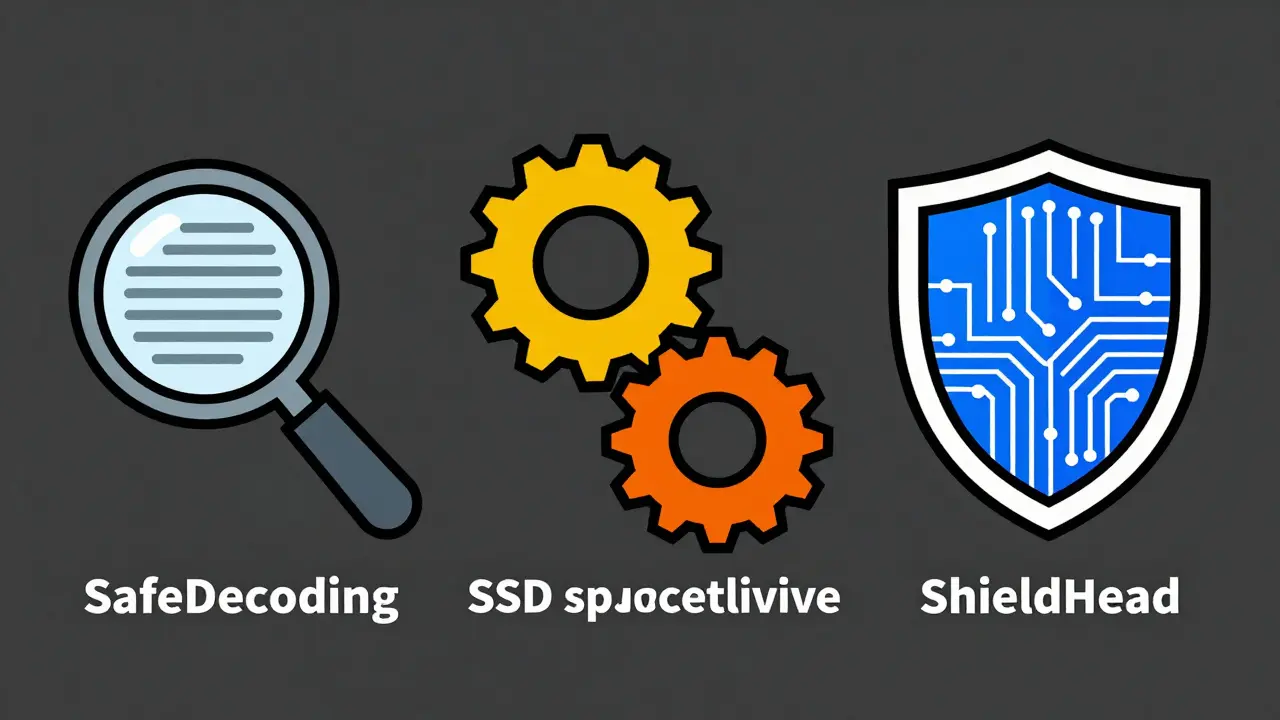
There isn’t one single way to implement safety-aware decoding. Different research teams have developed distinct architectures, each with trade-offs in complexity, speed, and effectiveness. Here are the three most prominent approaches dominating the landscape in 2026.
1. Token Reweighting: SafeDecoding
SafeDecoding operates on a surprisingly simple insight. Even when a model is being pushed to generate harmful content, it often still considers safe refusal phrases as plausible options. These "safety disclaimer" tokens appear in the list of probable next words, just buried under more dominant harmful tokens.
The algorithm scans the sorted list of token probabilities at every step. When it spots these safety-related tokens, it boosts their probability scores and penalizes the harmful ones. The result? The model is statistically nudged toward saying, "I can’t help with that," rather than complying with a malicious request. It requires no changes to the model’s weights, making it easy to deploy on existing systems.
2. Speculative Sampling: SSD (Speculative Safety-Aware Decoding)
Published in late 2025, SSD takes a different route. It uses two models: a small, highly aligned "safety model" and the larger, powerful target model. The small model generates tentative sequences of tokens quickly. The large model then evaluates them.
If the large model agrees with the small model’s safe suggestions (a high "match ratio"), it accepts them instantly, speeding up generation. If there’s a disagreement-suggesting potential risk-it falls back to a more conservative decoding mode. This method is unique because it aims to improve safety *and* speed simultaneously, countering the usual assumption that safety checks always slow things down.
3. Integrated Moderation Heads: ShieldHead
ShieldHead, introduced in July 2025, embeds safety directly into the model architecture. It attaches an auxiliary classification head parallel to the standard next-token prediction head. While the main head predicts the next word, this secondary head analyzes the hidden states to flag risks in real time.
This turns the decoder into a joint generator-moderator. It can terminate or reroute generation the moment a harmful trajectory is detected, offering granular, token-wise control without needing external API calls for moderation.
Inference-Time Guardrails vs. Training-Time Alignment
Why bother with decoding tricks when we already have Reinforcement Learning from Human Feedback (RLHF)? The short answer is agility and cost. Retaining an LLM with RLHF takes weeks and millions of dollars in compute. If a new type of attack emerges tomorrow, you can’t wait a month to patch the model.
Inference-time guardrails solve this by operating as inline runtime checks. They inspect prompts and responses as they pass through the system. According to industry data from Guardrails AI (updated July 2026), a well-configured guard can run in under 10 milliseconds. Even complex validators add only about 100 ms of latency. Compared to the hundreds of milliseconds or seconds an LLM takes to generate a full response, this overhead is negligible for most applications.
| Feature | Training-Time (RLHF) | Safety-Aware Decoding | External Post-Hoc Filters |
|---|---|---|---|
| Latency Impact | None (pre-computed) | Low (10-100ms) | High (API round-trips) |
| Update Speed | Weeks/Months | Minutes/Hours | Minutes |
| Context Awareness | Static | Dynamic (per token) | Variable |
| Cost | Very High | Moderate | Low-Moderate |
As F5 noted in early 2026, enterprise security vendors are shifting focus from static classifiers to LLM-driven guardrails that understand intent and conversation history. This allows for nuanced policy enforcement that simple keyword blocking can’t achieve.
The Latency Trade-Off: Is It Worth It?
The biggest hesitation developers have regarding inference-time interventions is speed. Every millisecond counts in interactive chatbots or real-time coding assistants. However, the data suggests the impact is manageable.
Guardrails AI reports that individual guards run in sub-10 ms ranges. The bulk of the latency usually comes from calling external APIs or heavy validation models, not the safety logic itself. For SSD, the speculative nature means it can actually *reduce* total inference time by accepting batches of tokens faster than standard autoregressive generation.
However, there is a risk of "over-refusal." If the safety constraints are too tight, the model might reject benign queries that sound slightly ambiguous. DeAL (Decoding-time Alignment for LLMs), a framework emerging in 2025, addresses this by treating safety as one objective among many-like politeness or task adherence. This allows developers to tune the "safety knob" dynamically based on the specific use case, balancing strictness against usability.
The Adversarial Arms Race: CRA and Beyond
Safety is not a destination; it’s a moving target. Just as robust decoding methods matured, adversarial techniques evolved to counter them. In April 2026, researchers published Contextual Representation Ablation (CRA). This method doesn’t just try to trick the model with text; it targets the internal representations. CRA identifies low-rank subspaces in the model’s hidden states that mediate refusal behaviors and suppresses them during decoding.
CRA demonstrated significant success in jailbreaking multiple open-source LLMs protected by earlier guardrails. This signals a critical shift: future safety-aware decoding must be robust against representation-level attacks, not just surface-level token manipulation. It implies that shallow reweighting won’t be enough forever. We’ll likely see more hybrid approaches combining architectural changes (like ShieldHead) with dynamic alignment frameworks (like DeAL).

Implementing Guardrails in Production
If you’re building an LLM application in 2026, skipping inference-time guardrails is risky. Here’s how to get started:
- Select Your Base Model: Ensure your model supports custom decoding hooks. Most major open-weight models (Llama, Mistral) allow this via libraries like Hugging Face Transformers.
- Choose a Strategy: For quick wins, implement SafeDecoding-style token reweighting. For higher performance needs, explore SSD if you can manage a smaller safety model alongside your main one.
- Integrate Middleware: Use frameworks like Guardrails AI to wrap your API endpoints. Configure policies for PII detection, hate speech, and domain-specific constraints.
- Monitor Latency: Track the end-to-end response time. Aim to keep guardrail overhead under 10% of the total generation time. If it spikes, consider optimizing the validator model or using asynchronous checking for non-critical fields.
- Test for Over-Refusal: Run benign query sets through your pipeline. If legitimate requests are blocked frequently, adjust the sensitivity thresholds in your decoding parameters.
The skills required here blend machine learning engineering with operational competence. You need to understand transformer internals to tweak decoding loops, but also DevOps practices to deploy microservices that intercept traffic efficiently.
Conclusion: The Future of Real-Time Safety
Safety-aware decoding is no longer optional for serious LLM deployments. It bridges the gap between static training and dynamic real-world usage. As adversarial attacks grow more sophisticated, relying solely on pre-trained alignment leaves systems vulnerable. By embedding safety into the inference loop, organizations gain the agility to respond to new threats instantly.
The technology is maturing rapidly. From the token-reweighting simplicity of SafeDecoding to the speculative efficiency of SSD and the architectural integration of ShieldHead, the tools are available. The key is finding the right balance between security, speed, and user experience. In 2026, the best AI systems won’t just be smart; they’ll be safely aware, every single token of the way.
What is the difference between safety-aware decoding and RLHF?
RLHF (Reinforcement Learning from Human Feedback) trains the model’s weights during the pre-training or fine-tuning phase, which is slow and expensive. Safety-aware decoding intervenes during inference (generation time) by modifying token selection probabilities or adding real-time checks. It allows for immediate updates to safety policies without retraining the entire model.
Does safety-aware decoding significantly slow down LLM responses?
Generally, no. Modern guardrails and decoding strategies like SSD are designed to be lightweight. Typical latency additions range from 10 ms to 100 ms per request. Since LLM generation itself often takes hundreds of milliseconds or seconds, this overhead is usually imperceptible to users. Some methods, like speculative sampling, can even speed up inference.
Can safety-aware decoding stop all jailbreak attacks?
No single method guarantees 100% protection. As shown by recent adversarial techniques like Contextual Representation Ablation (CRA), attackers constantly evolve. Safety-aware decoding significantly reduces success rates and provides a robust layer of defense, but it should be part of a multi-layered security strategy including input filtering and output monitoring.
What is SSD (Speculative Safety-Aware Decoding)?
SSD is a technique that uses a small, safety-aligned model to generate tentative token sequences, which are then verified by a larger target model. If they match, the tokens are accepted quickly. This method enhances safety by leveraging the small model’s alignment while maintaining or improving inference speed through speculative sampling.
How does SafeDecoding work?
SafeDecoding analyzes the probability distribution of next tokens at each decoding step. It identifies tokens associated with safety disclaimers or refusals, even if they aren't the highest probability choice, and boosts their likelihood while suppressing harmful tokens. This steers the model toward safe responses without changing its underlying weights.
- Jul, 13 2026
- Collin Pace
- 6
- Permalink
- Tags:
- safety-aware decoding
- inference-time guardrails
- LLM safety
- SafeDecoding
- SSD speculative sampling
Written by Collin Pace
View all posts by: Collin Pace