Securing AI-Generated Code: Comparing SAST, DAST, and SCA Tools

Imagine this: your developers are shipping code ten times a day thanks to AI assistants. It sounds like a productivity dream, but for security teams, it's a nightmare. When a tool like GitHub Copilot writes a function in seconds, it doesn't always follow security best practices. In fact, current data shows that up to 30% of production code in top tech firms is now AI-generated. The real problem is that the tools we've used for decades to find bugs weren't built for this kind of speed or these specific patterns. If you're still relying on a weekly security scan while your AI is deploying hourly, you're basically trying to photograph a speeding train with a camera that takes eight hours to focus.
The Modern AppSec Toolkit for AI Code
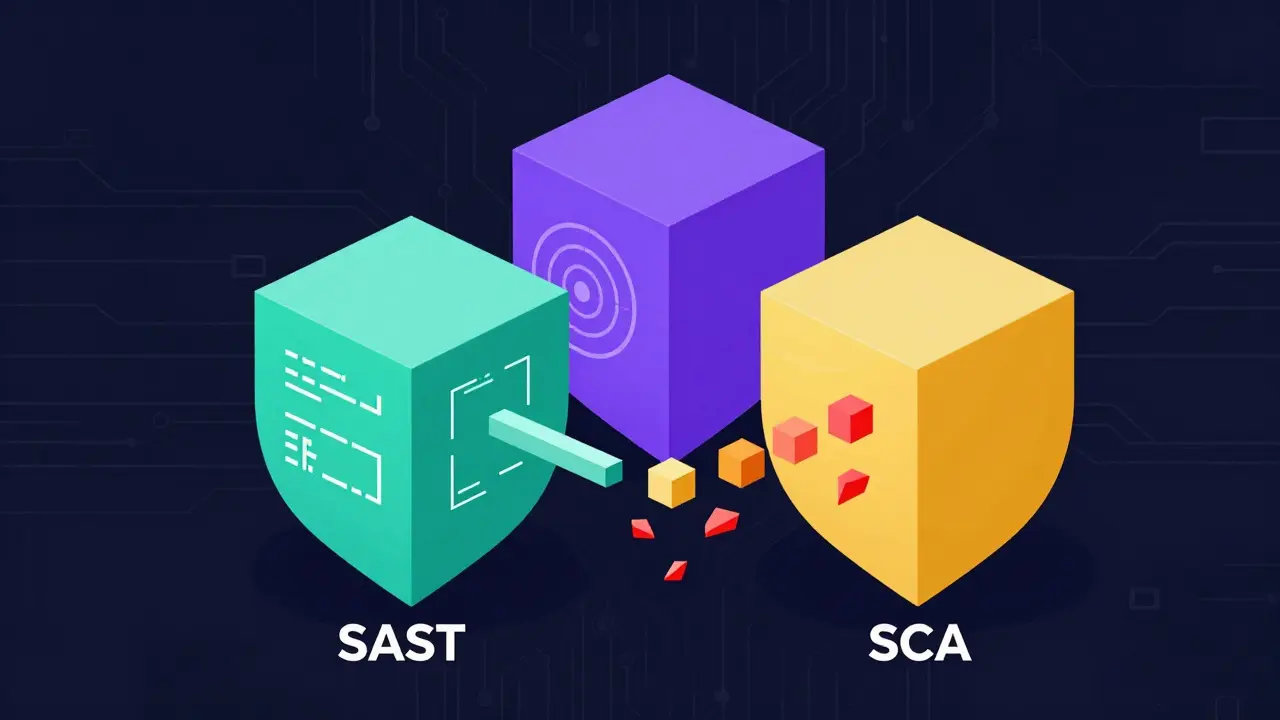
To keep up with AI, you need to understand the three pillars of Application Security (AppSec) and how they're changing. We aren't talking about a brand new philosophy, but rather an evolution of SAST is Static Application Security Testing, a white-box method that analyzes source code without executing it to find structural flaws. . Traditionally, SAST was plagued by false positives, but AI-enhanced engines are now cutting those rates down significantly. For example, modern tools can now analyze data flow across multiple functions to spot a complex injection flaw that a human-or a basic scanner-would miss.
Then there's DAST is Dynamic Application Security Testing, a black-box approach that tests the running application from the outside to find runtime vulnerabilities. . DAST is great because it finds things only visible when the app is actually live, but it's slow. In an AI-driven workflow, a traditional 8-hour DAST scan is almost obsolete because the code has changed a dozen times before the scan even finishes.
Finally, we have SCA is Software Composition Analysis, a process that scans third-party libraries and dependencies for known vulnerabilities and license risks. . This has become critical because AI assistants love to suggest third-party libraries. Research shows AI-generated code often includes 40% more third-party libraries than human-written code, which opens a massive door for supply chain attacks.
Comparing the Three Approaches
Choosing one tool isn't enough. You need to know where each one fails so you can plug the gaps. SAST is your first line of defense, catching issues in the IDE before the code is even committed. DAST is your safety net for runtime issues, though it's increasingly being replaced by continuous runtime monitoring. SCA is your gatekeeper for the external code you didn't write but are still responsible for.
| Feature | SAST | DAST | SCA |
|---|---|---|---|
| Analysis Type | White-box (Source) | Black-box (Runtime) | Dependency Scan |
| Timing in SDLC | Very Early (IDE/Commit) | Late (Staging/Prod) | Early to Mid (PR/Build) |
| AI-Code Strength | Fast, catches logic errors | Finds live vulnerabilities | Identifies risky libraries |
| AI-Code Weakness | Can miss AI anti-patterns | Too slow for AI velocity | Misses 22% of AI-suggested flaws |
Why AI Code Breaks Traditional Tools
You might be wondering why you can't just use your existing tools. The issue is that AI coding assistants like GitHub Copilot or Amazon CodeWhisperer don't write code exactly like humans do. They often introduce "AI anti-patterns," such as an over-reliance on outdated or insecure libraries that were prevalent in their training data.
Traditional rule-based SAST tools look for specific patterns. If the AI writes a vulnerability in a way the tool hasn't seen before, it sails right through. This is why we're seeing a shift toward AI-powered security tools. For instance, some new platforms are reducing false positives by over 94% by using deep cross-file analysis to understand the AI-generated code security context rather than just flagging a keyword.
The DAST mismatch is even more glaring. If your team deploys 10 times a day, but your DAST scan takes 8 hours, you have a massive security gap. You could have 70 deployments occur between two weekly scans. This is why the industry is moving toward "Runtime Security"-tools that monitor the app in real-time rather than running a scheduled scan.
Implementing a Layered Strategy
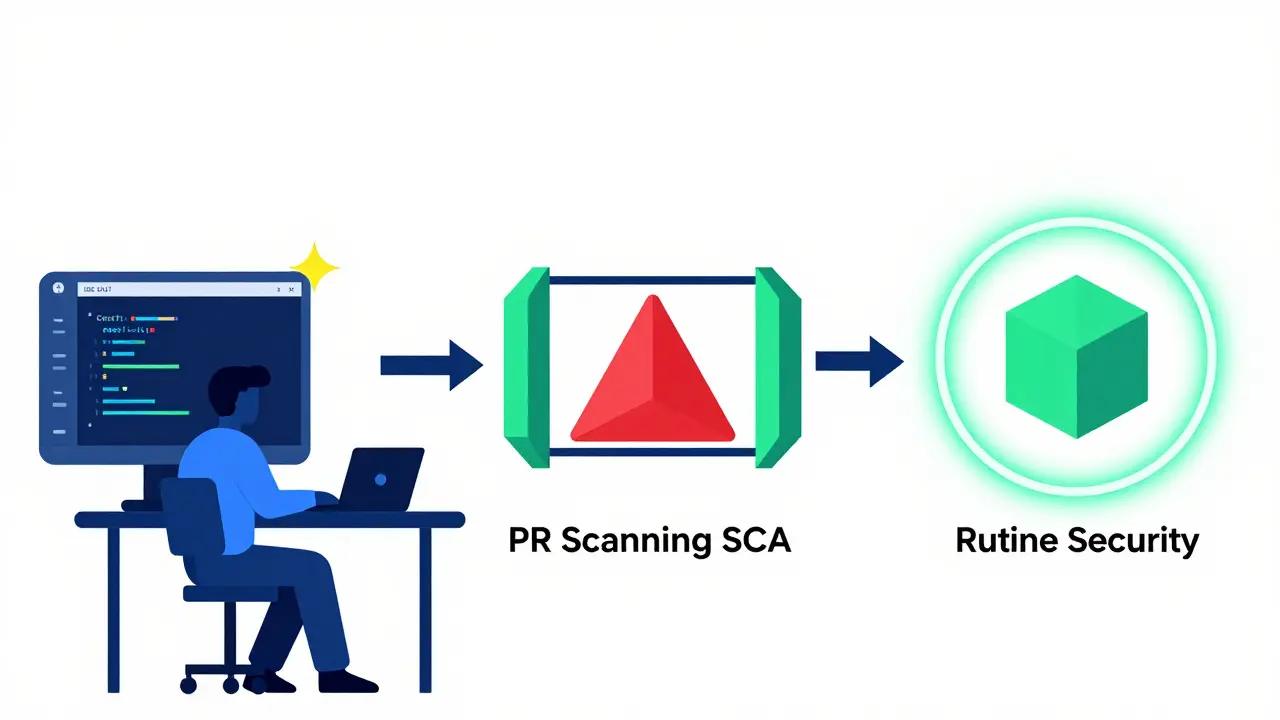
The most successful teams are adopting a "shift-left" strategy. This means moving security as close to the developer as possible. Instead of waiting for a security review at the end of the sprint, security checks happen while the developer is typing.
Here is a practical workflow for handling AI-generated code:
- IDE Integration: Use AI-optimized SAST inside VS Code or JetBrains. This gives the developer immediate feedback on a Copilot suggestion.
- PR Scanning: Run SCA during every pull request. If the AI suggests a library with a known CVE (Common Vulnerabilities and Exposures), the build should fail immediately.
- Continuous Monitoring: Replace traditional DAST with runtime protection that analyzes AI code patterns as they execute in production.
Don't expect this to be perfect on day one. Many organizations report a spike in false positives during the first month. It usually takes about 4 to 6 weeks of tuning the AI models to your specific codebase before the noise dies down. If you're using a tool like Cycode or Mend, focus on training the model with your specific patterns to stop the "crying wolf" effect.
The Risk of False Confidence
There is a dangerous trend emerging: the belief that because we have an AI security tool, the AI-generated code is inherently safe. This is a mistake. Some researchers warn that automated tools still miss up to 37% of logic vulnerabilities specific to AI patterns.
Logic flaws are different from syntax flaws. A tool can tell you that you're missing a semi-colon or using an insecure function, but it might not realize that the AI has fundamentally misunderstood the business logic, creating a backdoor that looks perfectly valid to a scanner. Human oversight-specifically a security-focused code review-remains non-negotiable.
To get this right, your security team needs a bit of a skill upgrade. According to recent industry reports, teams need about 30% AI-specific training to effectively manage these new tools. They need to know not just how to read a vulnerability report, but how AI models typically hallucinate or misconfigure security settings.
Can SAST alone secure AI-generated code?
No. While SAST is great for catching structural flaws early, it cannot find runtime issues or identify vulnerabilities in third-party libraries that SCA handles. Organizations using all three (SAST, DAST/Runtime, and SCA) see 63% fewer production incidents than those using only one.
Is traditional DAST obsolete for AI workflows?
Not obsolete, but insufficient. The speed of AI deployments (often multiple times per day) makes long-running DAST scans impractical. The trend is to move toward runtime security platforms that provide continuous monitoring instead of point-in-time scans.
Why does AI code have more dependency risks?
AI coding assistants suggest libraries based on patterns found in massive datasets. This often leads to the inclusion of more third-party libraries (up to 40% more than human code) and sometimes suggests outdated or unmaintained packages that have known security holes.
How do I reduce false positives in AI-SAST?
Expect a 4-6 week tuning period. The best way to reduce noise is to integrate the tool into the IDE, provide feedback on false positives, and use platforms that allow you to train the AI model on your organization's specific coding patterns.
Which tools are best for AI-generated code in 2026?
AI-native companies like Cycode and Mend are currently leading in accuracy for AI code detection. Look for tools that offer IDE integration, low false-positive rates (under 6%), and specific capabilities to detect AI-generated anti-patterns.
Next Steps for Your Team
If you're just starting, don't try to boil the ocean. Start by integrating an AI-optimized SCA tool into your pull request pipeline. This is the quickest win because it stops the most common AI mistake: importing a dangerous library. Once that's stable, move to IDE-based SAST to help your developers learn as they go. Finally, look into replacing your legacy DAST scans with a runtime security platform to cover the gaps created by your deployment velocity.
- Apr, 7 2026
- Collin Pace
- 10
- Permalink
Written by Collin Pace
View all posts by: Collin Pace