Stepwise Prompting with Feedback Loops: How to Iterate Toward Correct Code

You ask an AI to write a function. It spits out 50 lines of Python. You paste it in, hit run, and get a wall of red errors. Now what? Do you rewrite the whole prompt? Try to debug code you didn't write? This is where most developers lose their minds-and their time.
Here’s the truth: asking for the final answer rarely works for complex logic. The fix isn’t better luck; it’s stepwise prompting combined with tight feedback loops. Think of it less like ordering dinner and more like cooking with a sous-chef who needs constant supervision. You break the task down, check each step, and correct course immediately. This method turns chaotic code generation into a predictable, debuggable process.
Why One-Shot Prompts Fail on Complex Logic
When you ask a Large Language Model (LLM) to generate a complete algorithm in one go, you’re betting that its internal reasoning aligns perfectly with your requirements from start to finish. It often doesn’t. LLMs are probabilistic engines. They predict the next token based on patterns, not by executing logic in a virtual machine.
This leads to "hallucinated" logic-code that looks syntactically correct but fails semantically. For instance, if you ask for a data parser, the model might skip edge cases like empty inputs or malformed dates because it prioritized the happy path. A 2023 study from Stanford University showed that direct code generation had a 63% higher error rate compared to stepwise approaches on multi-step tasks. Why? Because the model has no chance to self-correct mid-process. It commits to a path early, and once it’s wrong, everything downstream breaks.
Chain-of-Thought (CoT) prompting addresses this by forcing the model to explain its reasoning before writing code. But CoT alone isn’t enough. You need verification. That’s where the feedback loop comes in.
The Anatomy of a Stepwise Feedback Loop
A feedback loop in programming isn’t new. Agile development and Test-Driven Development (TDD) have relied on them for decades. What’s different now is integrating these loops directly into your interaction with the AI. Instead of waiting until the end to test, you test after every micro-step.
Jason Swett, author of *How to Program in Feedback Loops*, defines the core cycle simply: decide a goal, devise a test, perform the test, write code, repeat until it passes. When applied to AI prompting, this becomes:
- Define a Micro-Goal: Don’t ask for the whole feature. Ask for one specific component, like "Write a function to validate email format using regex."
- Request Reasoning: Add "Explain your logic for handling uppercase letters and special characters."
- Generate Code: Get the snippet.
- Validate Immediately: Run a unit test or a simple print statement against known inputs.
- Feed Back Results: If it fails, paste the error and the failing input back into the chat. Ask the model to fix it based on the failure.
This structure reduces cognitive load. You aren’t debugging 50 lines at once; you’re checking five lines. If the validation fails, you know exactly which part of the prompt caused the issue.
Implementing the 3C Framework for Better Prompts
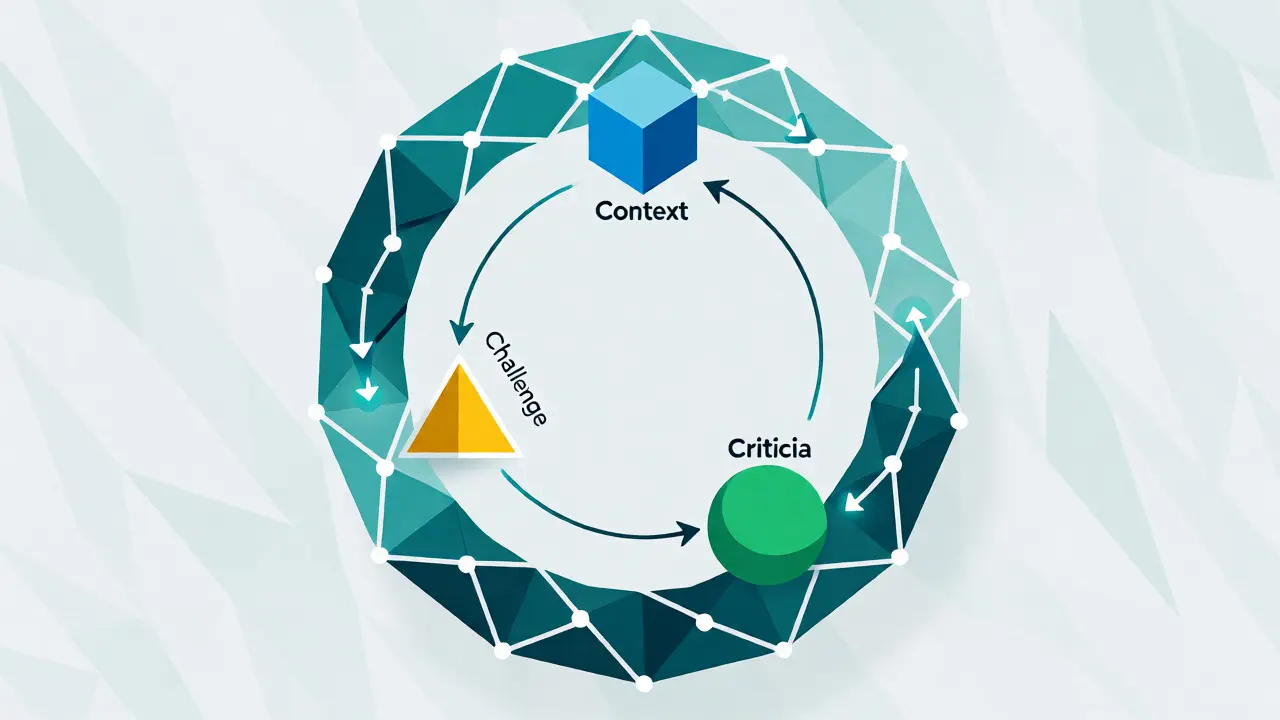
Not all stepwise prompts are created equal. Vague steps lead to vague code. To standardize this, many practitioners use the 3C Framework: Context, Challenge, Criteria. This ensures the model has all the constraints needed to succeed in each iteration.
| Component | Definition | Example Prompt Snippet |
|---|---|---|
| Context | Project details, language version, existing dependencies. | "We are using Python 3.11 and pandas 2.0. No external libraries allowed." |
| Challenge | The specific subtask for this iteration. | "Create a function that filters rows where 'date' is within the last 7 days." |
| Criteria | Acceptance tests or success metrics. | "Include a test case asserting that a date from 8 days ago is excluded." |
By embedding criteria into the prompt, you force the model to consider edge cases upfront. In a recent analysis by DataCamp, models using structured templates with explicit criteria showed a 30-40% reduction in logical errors compared to those using open-ended instructions.
Practical Example: Building a Parser Step-by-Step
Let’s look at a real-world scenario. Imagine building a custom CSV parser that handles quoted fields containing commas. Asking for the full parser often results in broken quote-handling logic.
Step 1: Tokenization Logic
Prompt: "Write a Python function that splits a string by commas, but ignores commas inside double quotes. Explain how you track quote state."
Result: The model provides a basic loop tracking a boolean `in_quotes`. You test it with `"hello, world",test`. It passes.
Step 2: Escaped Quotes
Prompt: "Extend the previous function to handle escaped quotes (`\"`) inside strings. Update the logic to recognize escape sequences."
Result: The model adds logic for backslashes. You test with `"he said \"hi\"",test`. It fails because the model forgot to reset the state correctly after the closing quote. You paste the error and the expected output. The model fixes it in one turn.
Step 3: Integration
Prompt: "Combine the validated tokenizer into a main parse function that returns a list of lists. Add type hints."
Compare this to asking for the whole parser at once. You’d likely spend hours debugging why nested quotes broke the row count. With stepwise prompting, you caught the bug in Step 2, when the surface area was small.
Overcoming Common Pitfalls
This method isn’t magic. It has friction points. The biggest complaint is the "prompt tax"-the extra time spent crafting precise instructions. For simple CRUD apps or basic syntax tasks, this overhead outweighs the benefits. A developer might take 2.3 times longer to set up the loop than to just write the code manually if the task is trivial.
Another challenge is context length. Long chains of reasoning can fill up the model’s context window, causing it to forget earlier constraints. To mitigate this, keep iterations short. Summarize previous steps rather than pasting entire code blocks unless necessary. Tools like GitHub Copilot Workspaces are starting to automate some of this summarization, but manual discipline remains key.
Also, beware of over-decomposition. Breaking a task into too many tiny steps creates administrative bloat. Aim for chunks that are independently testable but meaningful. If a step takes less than two minutes to verify, it’s probably too small.

When to Use Stepwise vs. Direct Generation
Knowing when to apply this methodology saves time. Here’s a quick decision guide:
- Use Stepwise Prompting When:
- The task involves complex algorithms or multi-step logic.
- You are working in a regulated industry (like healthcare or finance) requiring audit trails.
- The codebase has strict performance or security constraints.
- You are unfamiliar with the domain or library being used.
- Use Direct Generation When:
- Writing boilerplate code (e.g., API endpoints, class structures).
- Tasks are simple and self-contained (e.g., sorting a list).
- Speed is critical and the cost of a minor bug is low.
Senior developers are 2.7 times more likely to use rigorous feedback loops than juniors, largely because they’ve learned that "fast" code that doesn’t work is actually slow. Junior devs often skip the loop to save time, then spend triple that time debugging.
The Future of Iterative AI Coding
We’re moving toward tighter integration between IDEs and AI feedback mechanisms. Microsoft’s roadmap for GitHub Copilot includes automatic detection of when a prompt would benefit from decomposition. Anthropic’s Claude models now support longer context windows, allowing for deeper reasoning chains without losing thread.
But tools won’t replace the skill. The ability to break down problems and design effective tests is a human strength. As AI models get smarter, the bottleneck shifts from "can the AI write code?" to "can the developer define the problem clearly enough for the AI to solve it iteratively?"
Start small. Pick one complex function today. Break it into three parts. Test each part. Watch how much faster you converge on a solution compared to the old copy-paste-debug cycle.
Does stepwise prompting work with all AI models?
Yes, but effectiveness varies. Models with stronger reasoning capabilities, like GPT-4 or Claude 3, handle multi-turn feedback loops better than smaller, local models. However, even smaller models like CodeLlama benefit significantly from explicit step-by-step instructions and immediate test feedback, provided the context window allows for the conversation history.
How do I handle context limits during long feedback loops?
To manage context limits, summarize previous successful steps instead of pasting full code blocks. For example, say "Using the validated tokenizer from Step 1," rather than reposting the entire function. Additionally, restart the session periodically with a fresh context that includes only the current state and immediate goals.
Is this method slower than traditional coding for beginners?
Initially, yes. Beginners often find crafting precise prompts and designing tests tedious. Studies show novices take about 2.3 times longer to implement this effectively compared to experienced users. However, proficiency improves rapidly with practice, and the reduction in debugging time eventually offsets the initial learning curve.
What is the best way to provide feedback to the AI when code fails?
Be specific. Paste the exact error message, the failing input, and the expected output. Avoid vague comments like "it doesn't work." Instead, say "For input [X], I expected [Y] but got [Z]. Fix the logic for handling edge case [W]." This gives the model precise data to adjust its reasoning.
Can I automate the feedback loop?
Partially. Tools like pytest or Jest can automatically run tests on generated code snippets. Some advanced setups use scripts to send failed test outputs back to the LLM via API calls, creating a semi-autonomous loop. However, human review is still crucial to ensure the generated tests themselves are valid and comprehensive.
- Nov, 19 2026
- Collin Pace
- 0
- Permalink
Written by Collin Pace
View all posts by: Collin Pace