Supervised Fine-Tuning for Large Language Models: A Practical Guide for Real-World Use
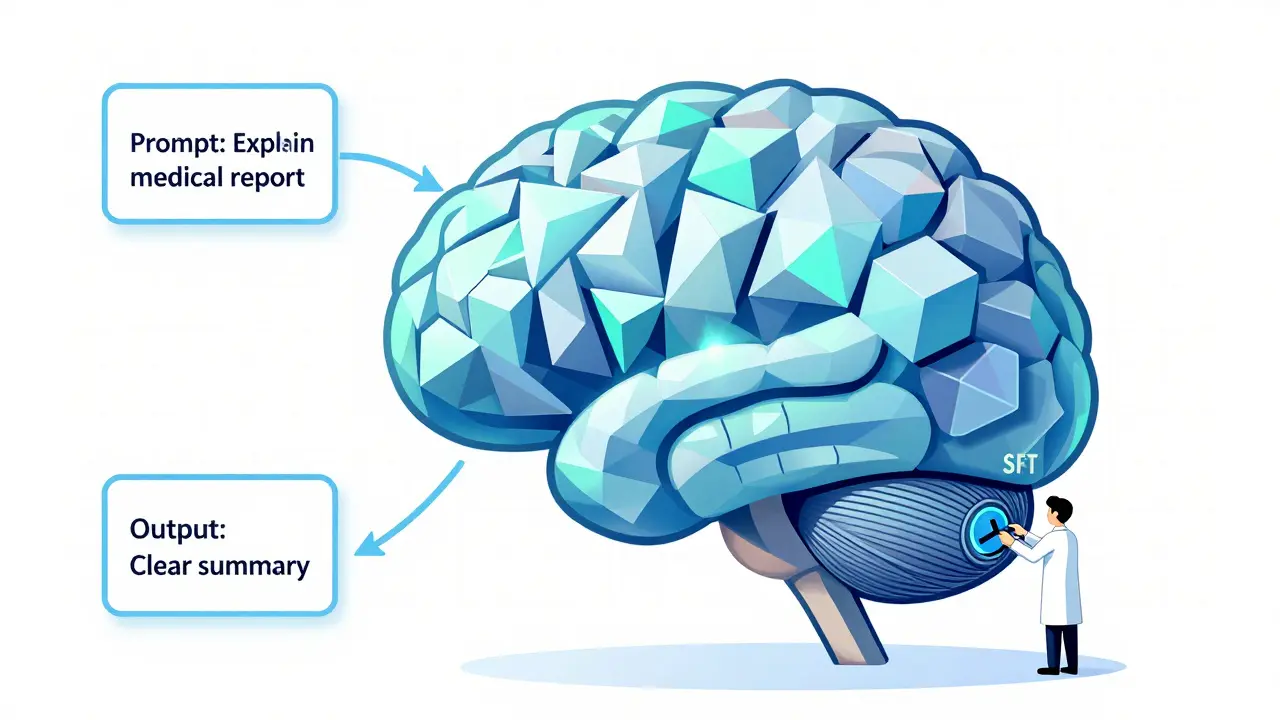
Most people think large language models are either magic or broken. But the truth? They’re just raw talent that needs coaching. Supervised fine-tuning is that coaching. It’s not about retraining the whole model from scratch. It’s not about guessing prompts until something works. It’s about showing the model exactly what you want - step by step - using real examples. And when done right, it turns a general-purpose LLM into a sharp, reliable tool for your specific job.
What Supervised Fine-Tuning Actually Does
Think of a pre-trained LLM like a college grad with a broad education - they can talk about anything, but they don’t know how to do your job. Supervised fine-tuning (SFT) is the on-the-job training. You give the model hundreds or thousands of input-output pairs: a prompt (like "Explain this medical report") and the perfect answer you want it to give. The model learns to map inputs to outputs. That’s it.
It’s not reinforcement learning. It’s not prompting. It’s simple, direct learning. Google’s T5 paper in 2020 and OpenAI’s InstructGPT in late 2022 proved this works. You don’t need to be an AI researcher. You just need good examples.
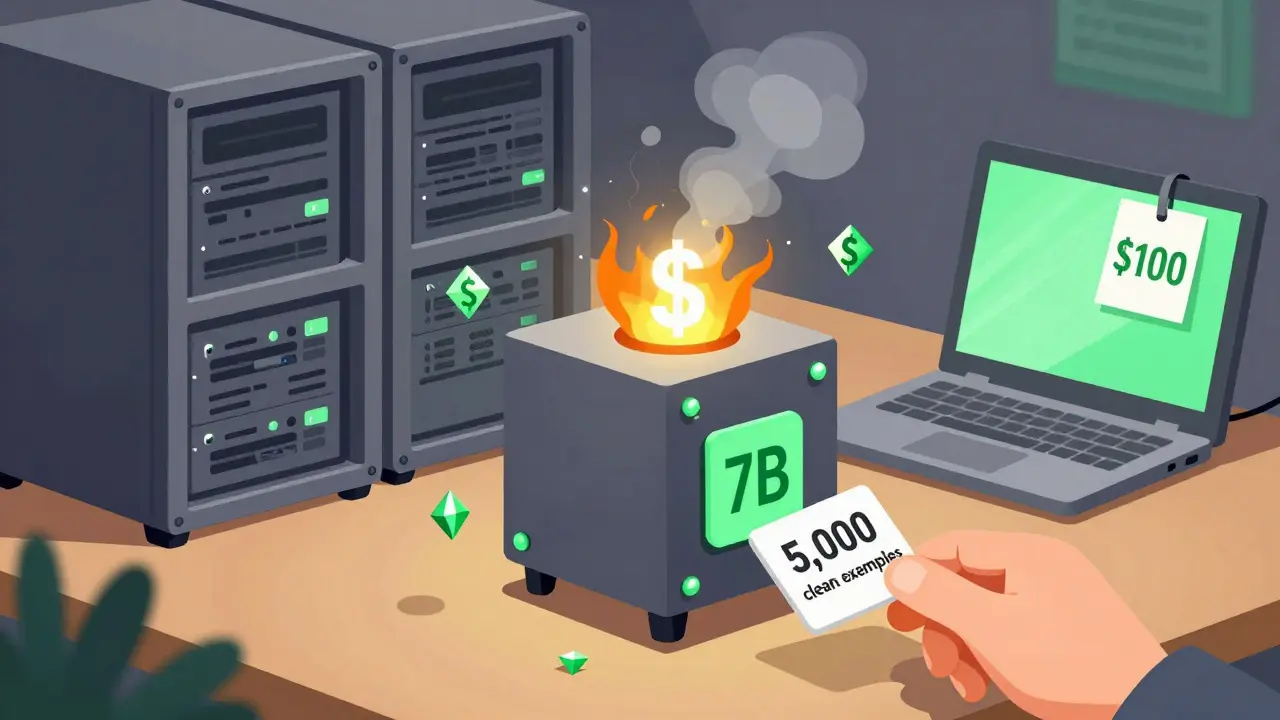
The magic? You get huge gains with tiny costs. Pre-training a model like LLaMA-3 8B costs millions in compute. Fine-tuning it? Often under $100 in cloud credits. You’re not rebuilding the engine. You’re calibrating the steering.
Why SFT Beats Prompt Engineering
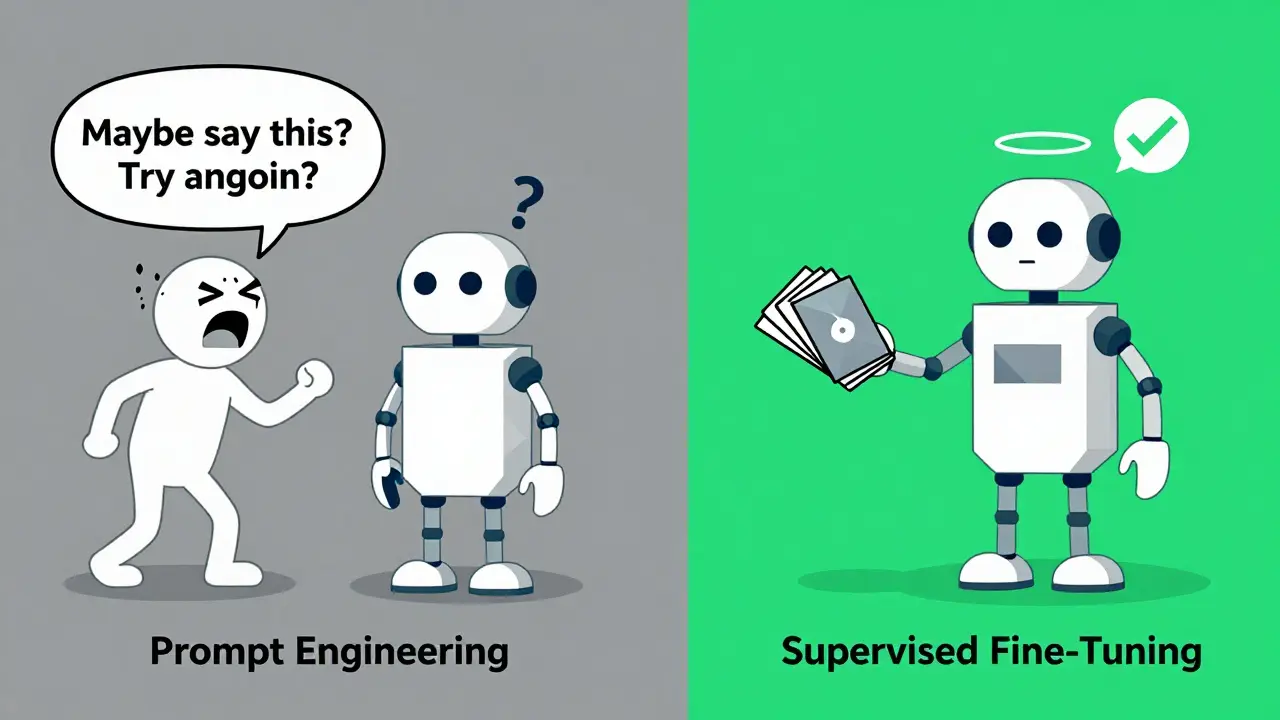
Prompt engineering feels like magic. Write a clever prompt, and suddenly the model does what you want. But it’s fragile. Change one word? The output breaks. Add a new user? The model stumbles. It’s like teaching someone to drive by yelling instructions from the passenger seat - it works sometimes, but you’re always holding your breath.
SFT is different. It’s like giving them a driver’s license. You show them 5,000 examples of how to handle stop signs, merges, and parking. Now they can handle new situations without you yelling. Meta AI found SFT improves accuracy on domain tasks by 25-40% over prompt engineering alone. That’s not a small edge. That’s the difference between a tool you can trust and one you have to babysit.
And here’s the kicker: SFT works even when prompts fail. If your task needs structure - like filling out forms, summarizing legal docs, or generating code with exact syntax - prompts can’t enforce that consistently. SFT can. Because the model learns the pattern, not just the phrasing.
The 6-Step Playbook for Real Results
Here’s how you actually do it - no theory, just steps that work.
- Pick your base model. Start with something small and efficient. LLaMA-3 8B at 4-bit quantization runs on a single 24GB GPU. Avoid huge models unless you have a cluster. Google’s text-bison@002 works too, but only if you’re on Vertex AI. For most, open-source is faster and cheaper.
- Gather your data. You need at least 500 clean examples. But 5,000 is where things start to click. Don’t scrape Reddit. Don’t use crowd-sourced labels. Use experts. A medical team at a hospital fine-tuned LLaMA-2 on 2,400 physician-verified Q&A pairs and hit 89% accuracy on MedQA. The base model? 42%. That’s not luck. That’s data quality.
- Format everything the same way. This is where 70% of people fail. If one example says "Answer this: ..." and another says "Respond to: ...", the model gets confused. Use one template. Example: "<|im_start|>user\n{prompt}<|im_end|>\n<|im_start|>assistant\n{response}<|im_end|>". Consistency matters more than quantity. One user on Stack Overflow said 500 perfectly formatted examples beat 10,000 messy ones for legal contract analysis.
- Split your data. 70% train, 15% validation, 15% test. Skip this, and you’ll think your model is working when it’s just memorizing. Overfitting is silent. It doesn’t crash. It just gives confident, wrong answers.
- Use LoRA or similar PEFT. Full fine-tuning needs 14GB of VRAM for a 7B model. LoRA modifies less than 1% of weights. You can run it on a 12GB GPU. Hugging Face’s TRL library has SFTTrainer built-in. Enable packing=True to combine short examples and save memory. Set max_seq_length=2048. Too high? Slows training. Too low? Cuts context.
- Train smart. Learning rate: 2e-5 to 5e-5. Too high? You erase everything the model learned during pre-training. Too low? Nothing changes. Train for 1-3 epochs. More than that? You start hallucinating. Use batch size 4-8 if you’re on a single GPU. Gradient accumulation lets you simulate larger batches without more memory.
What to Watch Out For
It’s not all smooth sailing. Here’s what breaks people.
- Catastrophic forgetting. After fine-tuning, your model forgets how to answer "What’s the capital of France?" That happens when you use learning rates above 3e-5. Fix it by mixing in a small set of general knowledge examples during training.
- Bad data = bad model. If your examples are inconsistent, biased, or wrong, the model learns that. JPMorgan Chase found 28% hallucination rates in financial advice after SFT - not because the model was broken, but because the training data had gaps. Human review is non-negotiable.
- Validation blindness. Don’t just look at loss numbers. Run real tests. Ask your model 50 unseen questions. Rate the answers. Is it coherent? Safe? Accurate? If you’re not measuring human judgment, you’re flying blind.
- Tokenizer mismatch. If you use a new tokenizer or forget to set padding_side=left for decoder models, attention breaks. Hugging Face docs say this explicitly. Don’t ignore it.
How SFT Compares to Other Methods
People compare SFT to RLHF and prompt engineering. But they’re not rivals - they’re stages.
| Method | Effort Required | Accuracy Gain | Best For | Limitations |
|---|---|---|---|---|
| Prompt Engineering | Low | 5-15% | Quick tests, simple tasks | Unreliable, doesn’t scale |
| Supervised Fine-Tuning (SFT) | Medium | 25-72% | Instruction following, structured outputs | Needs labeled data; can’t optimize for "helpfulness" |
| RLHF | High | 70-85% | Complex preferences, safety, tone | Requires human preference data; complex to implement |
SFT is the foundation. RLHF is the polish. You don’t skip SFT to jump to RLHF. That’s like trying to paint a house before you fix the walls.
And LoRA? It’s the game-changer. Microsoft Research showed LoRA achieves 95-98% of full fine-tuning accuracy but cuts memory use from 14GB to 0.5GB for a 7B model. That’s not a tweak. That’s a revolution for small teams.
Real-World Wins (and Failures)
Here’s what’s working out there.
Walmart Labs used SFT on 12,000 retail Q&A examples. Customer service response time dropped 63%. No new hires. No new software. Just better AI.
Healthcare providers are using it to auto-generate clinical notes from doctor-patient chats. A JAMA study found 62% adoption in U.S. hospitals. Accuracy? Above 85% when trained on expert-annotated data.
But it’s not perfect. One user on Reddit spent 72 hours tuning LLaMA-2 on medical data. Got 89% accuracy. Then they tried it on a new hospital’s notes - and the model failed. Why? The training data was from one institution. The new data used different terminology. SFT doesn’t generalize beyond its training. You need diverse examples.
And then there’s the dark side: companies using SFT to automate compliance checks. The EU AI Act now requires you to prove you controlled your training data. If you scraped public forums without consent? You’re violating the law. Data provenance isn’t optional anymore.
What’s Next for SFT
The field is moving fast. Google’s Vertex AI now auto-scores data quality and blocks bad examples before training. That cuts curation time by 65%. Hugging Face’s TRL v0.8 adds dynamic difficulty - it starts with simple examples, then slowly adds harder ones. Accuracy jumped 12-18% on complex tasks.
But the biggest shift? Synthetic data. Anthropic is now using AI to generate training examples for Claude. It’s not replacing humans - it’s augmenting them. You give the AI a template, it generates 10,000 variations, and you pick the best 500. That’s the future.
Still, experts warn: human annotation is becoming the bottleneck. Stanford’s HAI lab says expert labeling costs may stop SFT adoption after 2027. That’s why tools that automate curation - not replace it - are the next big thing.
Should You Use SFT?
If you’re using LLMs for anything beyond casual chat - customer support, legal docs, code generation, medical summaries, financial reports - then yes. SFT is the minimum viable step to make your AI useful.
You don’t need a PhD. You don’t need a $100K GPU cluster. You need:
- A base model (LLaMA-3 8B or similar)
- 500-5,000 clean, consistent examples
- One weekend to train it
- One hour to test it with real users
That’s it. The rest is noise.
Don’t wait for perfect data. Start with what you have. Fix it as you go. The model won’t be perfect on day one. But it will be better than a prompt. And that’s enough to start.
- Jul, 18 2025
- Collin Pace
- 6
- Permalink
Written by Collin Pace
View all posts by: Collin Pace