Sustainable AI Coding: Balancing Energy, Cost, and Efficiency

The Hidden Carbon Cost of AI-Assisted Development
There is a jarring gap between how we perceive AI and its actual environmental impact. You might think using an AI to write a function is faster and therefore more efficient. However, a June 2025 study from Nature Communications revealed that AI models emit up to 19 times more CO2eq than human programmers during the development process . This creates a massive trade-off: we gain individual productivity at the cost of a significant atmospheric penalty. When we look at the tools we use daily, the results are sobering. Research from arXiv in May 2025 tested the big three-ChatGPT, BARD, and GitHub Copilot-against sustainability benchmarks. The findings? About 87% of AI-generated code failed to use energy-efficient design patterns, and 73% struggled with inefficient memory allocation. Essentially, AI is trained to provide the most likely answer, not the most sustainable one. If the training data is full of "quick and dirty" code, the AI will replicate that inefficiency, scaling it across millions of applications.Energy Consumption and the Efficiency Trade-Off
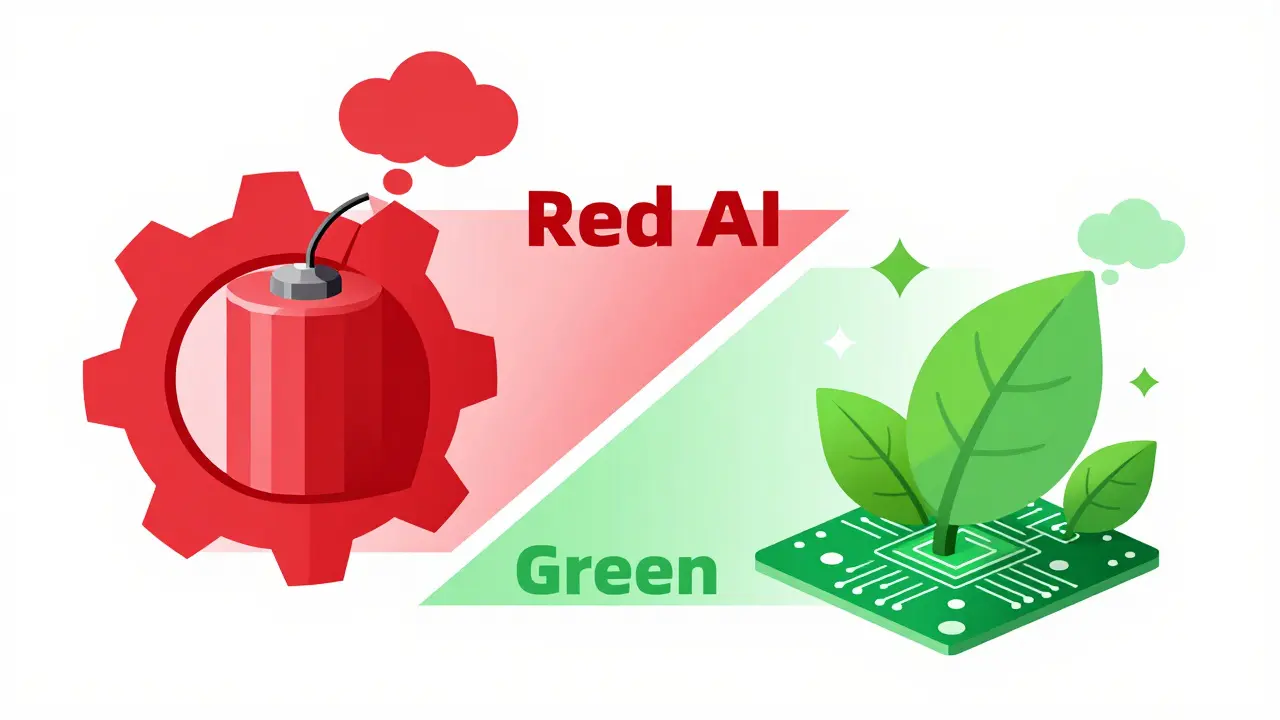
To understand the scale, consider that AI currently accounts for roughly 0.1% of global greenhouse gas emissions. While that sounds small, it's equivalent to the entire annual emissions of Sweden-about 50 million tons of CO2e. As we move toward 2026, the cumulative effect of billions of AI queries is staggering. But here is where it gets interesting: the trade-off isn't always negative. We are seeing a divide between "Red AI" (focused on raw accuracy/power regardless of cost) and "Green AI" (focused on efficiency). By switching to Sustainable Green Coding practices, developers can reduce energy consumption by up to 63% without losing performance. This means the problem isn't the AI itself, but how we prompt it and the patterns we allow it to implement.| Metric | Standard AI-Generated Code | SGC-Compliant Human Code | Impact Difference |
|---|---|---|---|
| Carbon Emission (CO2eq) | High (up to 19x more) | Low | Severe Trade-off |
| Energy-Efficient Patterns | 13% Implementation Rate | High Implementation | + 63% Energy Savings |
| Memory Allocation | 27% Efficiency Rate | Optimized | Lower Hardware Load |
Practical Steps for a Green AI Revolution
If you're wondering how to actually implement this without slowing down your sprint, you need to move beyond generic "clean code" and start using specific energy metrics. The first step is measurement. Tools like CodeCarbon is a lightweight Python package that estimates the amount of carbon dioxide produced by the computations of a machine learning model and CarbonTracker allow you to see the actual cost of your training runs. When developers start seeing numbers-like 156kg of CO2e for a single model-their behavior changes. To truly optimize, focus on these six key pillars identified in recent research:- Design Patterns: Avoid "energy-hungry" loops and redundant calls.
- Memory Management: Optimize how your app allocates RAM to reduce CPU cycles.
- Inference Caching: Stop recalculating the same AI responses; store and reuse them.
- Resource-Aware Programming: Write code that adjusts its intensity based on available hardware.
- Algorithmic Optimization: Choose algorithms with lower computational complexity (e.g., O(n log n) over O(n²)).
- Structural Improvements: Simplify the code architecture to reduce the number of operations per request.

Organizational Strategies: Right-Sizing and Vendor Choice
For leaders, the strategy isn't just about the lines of code-it's about the architecture. One of the biggest mistakes companies make is defaulting to the largest available model for every task. This is the equivalent of using a semi-truck to deliver a single envelope. Right-sizing is the process of choosing the smallest model that can reliably perform the task. PwC’s framework suggests four specific actions for enterprises:- Demand Management: Use AI to optimize the energy demand of your other business processes.
- Emission Tracking: Implement mandatory carbon reporting for every major AI project.
- Model Right-Sizing: Match the model complexity to the actual business need.
- Sustainable Procurement: Choose AI vendors based on their energy transparency and use of renewable energy.
The Big Picture: Can AI Actually Save the Planet?
There is a legitimate debate about whether AI's own footprint is a price worth paying. On one hand, the Nature study warns of a looming sustainability crisis if we don't change our coding habits. On the other, researchers from PwC and RISE suggest that AI could be a net-positive. Why? Because while an LLM consumes energy, the code it helps create can optimize a city's power grid, reduce waste in manufacturing, or discover new carbon-capture materials. The projection is that widespread, strategic AI adoption could actually lower total global emissions by 0.3% to 1.9% by 2035 compared to a world without AI. However, this "net-positive" outcome only happens if we prioritize Sustainable Green Coding now. If we continue to let AI generate bloated, inefficient code, we are simply trading one environmental problem for another. The goal is to combine intelligent algorithms with the most efficient use of computing power possible.Does AI-generated code always use more energy?
Not necessarily in execution, but in creation. The process of generating the code via an LLM is significantly more energy-intensive than a human typing. Furthermore, current AI models often produce code that isn't optimized for energy efficiency, meaning the resulting software may consume more power during its lifecycle than human-optimized code.
What are the best tools for measuring AI carbon footprints?
CodeCarbon is currently one of the most popular and well-documented tools for tracking CO2 emissions during model training. CarbonTracker is another strong alternative, though it has a steeper learning curve. For enterprise-level tracking, many are now integrating the Green Software Foundation's Software Carbon Intensity (SCI) specification.
How can I make my AI prompts more sustainable?
You can use prompt engineering to explicitly request sustainable practices. Instead of just asking for a function, ask the AI to "optimize for energy efficiency and minimal memory allocation." This forces the model to prioritize green coding patterns over the most common (and often inefficient) ones.
Is there a performance penalty for green coding?
In most cases, no. In fact, energy efficiency often correlates with performance improvements, such as faster execution times and lower latency. While there are some niche cases where extreme energy saving might limit throughput, research shows that most sustainable interventions reduce energy use by up to 63% without sacrificing functionality.
Which industries are leading the way in sustainable AI?
Financial services are currently leading with a 38% implementation rate of sustainability tracking, followed by the tech sector at 29%. This is largely driven by ESG (Environmental, Social, and Governance) reporting requirements for large public companies.
- Apr, 10 2026
- Collin Pace
- 5
- Permalink
- Tags:
- Sustainable Green Coding
- AI energy consumption
- carbon footprint of AI
- green AI revolution
- AI efficiency trade-offs
Written by Collin Pace
View all posts by: Collin Pace