Vibe Coding and Open Source: Licenses to Allow and Avoid
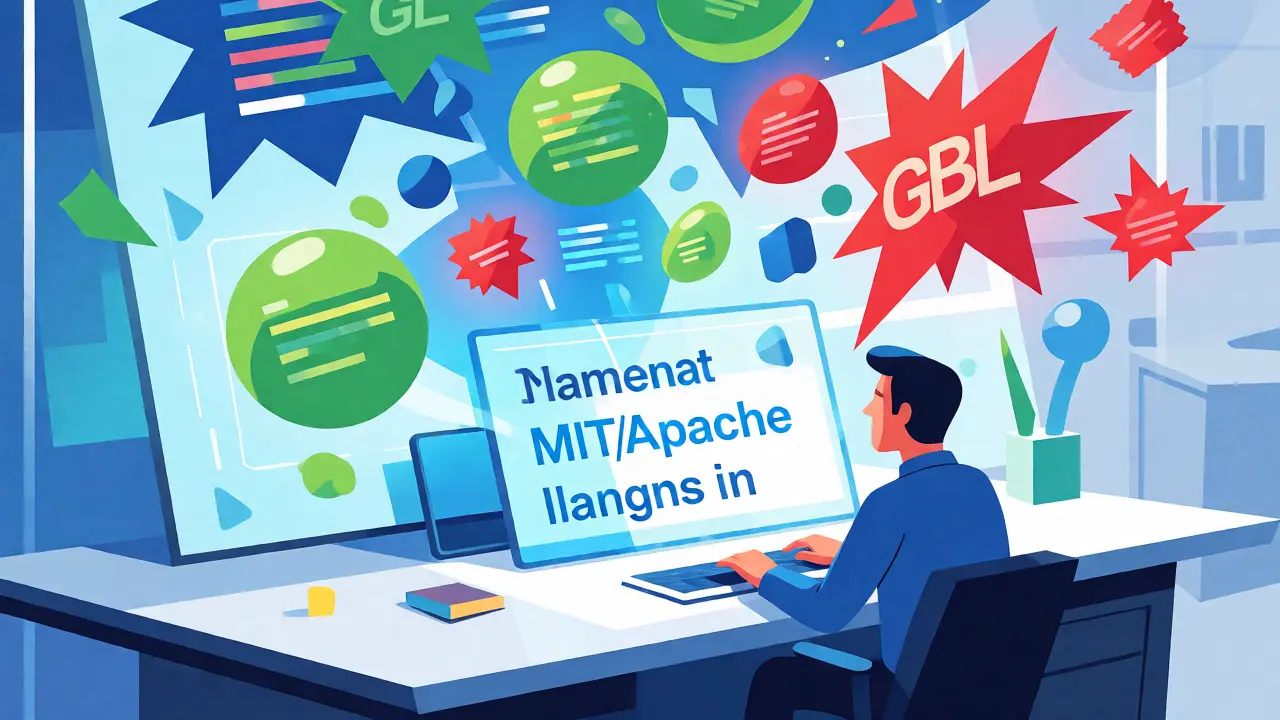
You just described your app idea in plain English, hit "generate," and watched Vibe Coding an AI-assisted programming paradigm where developers generate functional code from natural language descriptions rather than writing line-by-line spit out a working prototype. It feels like magic. But here is the catch nobody tells you at the hackathon: that code didn't come from nowhere. It was trained on millions of lines of open-source software, each with its own legal baggage. If you are building a commercial product, ignoring the license provenance of this AI-generated code is like buying a house without checking if the land has a hidden mortgage.
The stakes are real. A 2025 Stack Overflow survey found that 78% of developers use some form of AI assistance, yet 63% admit they don't fully understand the licensing implications. One developer on Reddit reported receiving a cease-and-desist letter because their VibeSDK-generated SaaS accidentally included GPL-licensed utility functions from the training data. This isn't hypothetical; it's happening now. To keep your startup from drowning in legal fees, you need to know which licenses are safe harbors and which ones are minefields.
Why License Compliance Matters More Than Ever
Traditional coding gave you control. You picked libraries, read their licenses, and knew exactly what you were shipping. Vibe coding blurs those lines. Large Language Models (LLMs) ingest vast repositories from GitHub and GitLab, learning patterns and sometimes reproducing verbatim snippets. Professor Emanuele Della Valle from Politecnico di Milano discovered that GitHub Copilot reproduced exact code snippets from training data nearly 40% of the time in his tests. When those snippets carry restrictive licenses, your "original" code might actually be derivative work.
This creates a compliance gap. Current AI models struggle to track where specific code segments came from. If an LLM pulls a function from a project licensed under the GNU General Public License (GPL), and you ship that function in a closed-source commercial app, you might inadvertently violate the GPL's requirement to open-source your entire application. The risk isn't just theoretical-legal analysts warn that we could see a wave of litigation similar to the SCO-Linux lawsuits if companies ignore these provenance issues.
The Safe List: Permissive Licenses
If you want sleep-at-night peace of mind, stick to permissive licenses. These allow you to use, modify, and distribute code in proprietary products with minimal strings attached. They are the backbone of modern commercial development for a reason.
| License | Risk Level (1-10) | Key Requirement | Commercial Use? |
|---|---|---|---|
| MIT License | 1 (Low) | Attribution only | Yes |
| Apache 2.0 | 2 (Low) | Attribution + Patent Grant | Yes |
| BSD 3-Clause | 1 (Low) | Attribution + No Endorsement | Yes |
MIT License a permissive free software license originating at the Massachusetts Institute of Technology is the gold standard here. Found in over 90% of open-source projects according to recent OSSRA reports, it essentially says, "Do whatever you want, just keep the copyright notice." Platforms like Cloudflare’s VibeSDK choose MIT for this exact reason-it removes friction for enterprise adoption. If your AI tool generates code derived primarily from MIT-licensed sources, you are generally in the clear, provided you maintain attribution records.
Apache 2.0 a permissive open-source license by the Apache Software Foundation that includes an explicit grant of patent rights is another favorite. It offers slightly more protection against patent trolls than MIT because it explicitly grants users a license to any patents held by the contributors. For vibe coders building complex systems, this extra layer of security is worth the minor administrative overhead of tracking contributions.

The Danger Zone: Copyleft Licenses
Copyleft licenses are viral. They require that any derivative work must also be released under the same license. This is great for keeping software free, but terrible for proprietary business models if you aren't prepared to open-source your entire codebase.
- GPL v2/v3: High risk (9/10). If your AI-generated code incorporates a GPL component, your whole application may need to be open-sourced. This is the "viral" nature that scares enterprises.
- AGPL v3: Extreme risk (10/10). Similar to GPL, but closes the "SaaS loophole." Even if you run the software on a server and users access it via a browser, you must provide the source code. This makes AGPL almost unusable for closed-source SaaS products generated via vibe coding.
- Mozilla Public License (MPL 2.0): Medium risk (5/10). It uses file-level copyleft. If you modify an MPL-licensed file, you must open-source that specific file. However, you can combine it with proprietary files in the same executable. It’s a middle ground, but requires careful architectural separation.
The problem with vibe coding is opacity. You often don't know if the AI pulled a snippet from a GPL project. If you are using a platform like Convex Chef or generic LLMs without license filtering, you might unknowingly inject GPL code into your proprietary stack. Once that happens, untangling it can require weeks of refactoring.
Platform Choices Matter
Not all vibe coding tools are created equal when it comes to licensing. The license of the tool itself doesn't always dictate the license of the output, but it signals how the company handles IP.
Cloudflare VibeSDK an open-source framework launched in January 2025 under the MIT license for building AI-driven applications is a prime example of a low-risk choice. Because it is MIT-licensed, developers feel confident deploying commercial apps. In contrast, some newer entrants use proprietary licenses for their core engines while claiming open-source components. Always check the Terms of Service. Does the provider claim ownership of your generated code? Do they warrant that the output is free from third-party license conflicts?
GitHub Copilot recently introduced "code referencing," showing the source repository and license for suggestions. This is a game-changer for transparency. Before accepting a suggestion, you can see if it came from a GPL-heavy repo. Ignoring this feature is a rookie mistake. Make it a habit to hover over suggestions and check the metadata before hitting tab.

Practical Steps to Protect Your Code
You don't need a law degree to stay compliant, but you do need a process. Here is a workflow to integrate into your vibe coding pipeline:
- Use License-Aware Tools: Consider enterprise-grade assistants like Tabnine Enterprise, which filter out GPL-licensed code from their training sets. This reduces the chance of contamination at the source.
- Automate Scanning: Run all AI-generated code through scanners like FOSSA, Snyk, or the open-source tool `licensee`. These tools compare your code against known patterns to flag potential matches with restricted licenses.
- Maintain Provenance Records: Keep logs of prompts and outputs. If a dispute arises, you need to show that you acted in good faith and attempted to verify origins.
- Audit Dependencies: Sometimes the risk isn't the generated code itself, but the libraries it imports. Ensure your package manager (npm, pip, etc.) enforces license policies during installation.
Remember, 27% of Copilot users actively use code referencing to check licenses. Join them. The extra ten seconds per feature saves hours of legal review later.
The Future: Standardization is Coming
The chaos won't last forever. The Open Source Initiative announced a new License Compatibility Framework for AI training data in early 2025, aiming to standardize how licenses apply to machine-generated works. Meanwhile, SPDX is developing an AI License Specification to provide machine-readable metadata for training datasets.
For now, however, you are navigating uncharted waters. The smartest move is to favor platforms and workflows that prioritize transparency. As Gartner predicts, 90% of enterprises will adopt AI coding tools by 2027, but those who fail to address license compliance first will face the brunt of the inevitable litigation wave.
Does MIT license mean I don't have to attribute anyone?
No. While MIT is very permissive, it strictly requires that you preserve the original copyright notice and license text in any copies or substantial portions of the software. Failing to do so is a breach of contract.
Can I use GPL code in my closed-source SaaS?
Generally, no. If your SaaS backend includes GPL-licensed code, you typically must offer the source code to your users. The AGPL specifically targets web services, making it even harder to keep proprietary.
Who owns the code generated by AI?
This varies by platform terms. Many providers assign ownership to the user, but copyright law regarding non-human authors is still evolving. Always read the specific EULA of your vibe coding tool.
What is the biggest risk with Apache 2.0?
The main complexity is handling patent grants and ensuring you include the NOTICE file if one exists in the original library. It is less risky than GPL but requires more diligence than MIT.
How do I check if AI code violates a license?
Use automated license scanning tools integrated into your CI/CD pipeline. Tools like FOSSA or Snyk can detect code snippets that match known open-source projects and flag their associated licenses.
- Nov, 20 2026
- Collin Pace
- 0
- Permalink
Written by Collin Pace
View all posts by: Collin Pace