Vibe Coding for IoT Demos: Simulating Devices and Building Cloud Dashboards
What Is Vibe Coding and Why It Matters for IoT
You know that feeling when you have a brilliant idea for an Internet of Things (IoT) project but get stuck staring at a blank code editor? That’s the "blank page problem," and it kills more demos than bad hardware ever will. Vibe coding is an AI-assisted software development methodology where human intent expressed in plain language is converted into executable code by large language models. Coined by Andrej Karpathy in February 2025, this approach lets you describe what you want in natural language-like "create a temperature sensor simulator"-and watch as tools like GitHub Copilot or Claude generate the actual code.
For IoT developers, this isn't just a nice-to-have; it's a game-changer. Traditional IoT development requires deep knowledge of embedded systems, network protocols, and cloud architecture. Vibe coding democratizes this process. According to Microsoft's 2025 analysis, it reduces the barrier to entry for non-traditional developers by 45%. You can now turn a concept into a working prototype in hours instead of days, cutting time-to-market by approximately 60-70% based on case studies from Riseup Labs.
Setting Up Your First IoT Simulation
To start vibe coding for IoT, you don't need a supercomputer. You need access to an LLM platform (GitHub Copilot leads with 58% market share in Q4 2025), your IoT platform credentials, and a basic understanding of how devices talk to each other. The magic happens in the prompt engineering phase.
Don't just ask for "code." Be specific. A good prompt includes context, protocol, frequency, and data range. For example:
- Bad Prompt: "Write Python code for a sensor."
- Good Prompt: "Create a Python script using the Paho MQTT client to simulate 10 temperature sensors sending JSON data to AWS IoT Core every 5 seconds. Include random values between 20-25°C, error handling for network interruptions, and TLS 1.3 encryption."
This level of detail helps the AI understand the architectural constraints. Dr. Elena Rodriguez, Principal IoT Architect at AWS, notes that embedding these requirements upfront yields significantly better results. The generated code will typically support Python, JavaScript, or Node-RED environments, making it compatible with major platforms like AWS IoT Core, Azure IoT Hub, and Google Cloud IoT Core.
Building Real-Time Cloud Dashboards
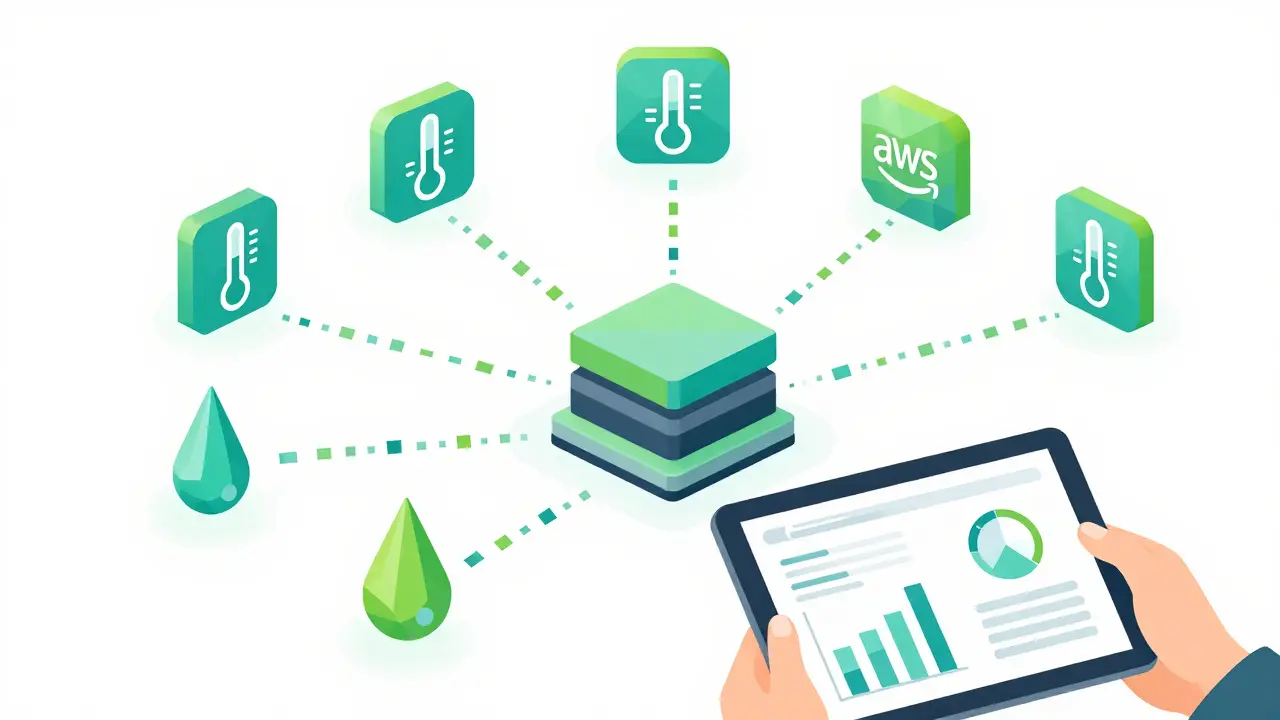
Once your simulated devices are sending data, you need somewhere to visualize it. This is where vibe coding truly shines. Instead of manually configuring Grafana panels or writing React components from scratch, you can prompt the AI to build your dashboard interface.
Users report high satisfaction with this step. Trustpilot reviews aggregated in December 2025 show GitHub Copilot scoring 4.6 out of 5 for generating Grafana dashboard configurations. You can ask the AI to create a dashboard that connects to InfluxDB or TimescaleDB, displaying real-time charts, gauges, and alert thresholds.
However, keep expectations realistic. While vibe coding excels at visualization logic (scoring 4.7/5 in implementation speed according to Joget's 2025 analysis), it struggles with complex state management. If your dashboard needs to handle intricate user permissions or offline data syncing, you’ll likely need to refine the AI-generated code manually. Always verify that the data flow matches your expected schema before deploying.
| Feature | Vibe Coding | Traditional Development |
|---|---|---|
| Prototype Creation Time | 4-8 hours | 40-60 hours |
| Customization Flexibility | High (40% greater than no-code) | Very High |
| Security Risk Level | Higher (requires strict governance) | Lower (controlled by developer) |
| Hardware Driver Support | Poor (2.3/5 score) | Excellent |
| Learning Curve | Low (8-10 hours training) | High (months/years) |
Critical Security Pitfalls to Avoid
Here’s the hard truth: AI-generated code is not production-ready out of the box. In fact, IAS Research documented that 63% of initial AI-generated IoT code samples contained hardcoded credentials or insufficient TLS implementation. This is a massive risk in IoT, where insecure devices can become entry points for larger network attacks.
When you vibe code, you must implement a rigorous review process. Never trust the AI to handle security keys. Always replace placeholder credentials with environment variables or secret managers like AWS Secrets Manager. Additionally, ensure that all MQTT connections use TLS 1.3 with certificate rotation. As GitHub Chief Product Officer Mario Rodriguez stated, "Vibe coding unlocks creativity and speed, but it really only delivers production value when paired with rigorous review, security and developer judgment."
If you’re working in regulated industries like healthcare or industrial manufacturing, be extra cautious. Gartner reports that only 41% of these sectors adopt vibe coding due to compliance concerns. In many cases, you should restrict its use to internal demos only until you’ve established formal prompt governance frameworks.
Where Vibe Coding Struggles
Vibe coding is powerful, but it has limits. It currently performs poorly in hardware-specific driver development. If you’re trying to write low-level firmware for an ESP32 microcontroller, the AI often generates code that exceeds memory limits. TechVerx found that 68% of generated firmware exceeded the 128KB memory limit common in constrained edge devices.
Another weak spot is complex protocol implementations. A December 2024 HackerNews poll showed that 78% of developers faced challenges with Bluetooth LE and Zigbee protocol implementations via AI. These protocols require precise timing and state management that current LLMs struggle to grasp accurately. For these tasks, stick to traditional coding or hybrid approaches where AI handles high-level logic while humans manage critical communication layers.
Best Practices for Success
To get the most out of vibe coding for IoT demos, follow these proven strategies:
- Use Prompt Chaining: Break complex functionality into sequential AI interactions. Instead of asking for one giant app, first generate the sensor simulator, then the database connector, and finally the dashboard.
- Embed Security in Prompts: Explicitly request security features in your prompts, such as "Implement TLS 1.3 with certificate rotation" or "Use parameterized queries to prevent injection attacks."
- Verify Asynchronous Operations: IoT involves lots of async events. Check that the AI properly handles callbacks and promises, especially for MQTT message processing.
- Maintain Human Oversight: Treat AI output as a draft. Review the code for logic errors, resource leaks, and inefficient loops. MIT’s Professor David Chen warns that over-reliance on vibe coding creates fragile systems, with 89% of demo projects failing stress tests beyond 72 hours without proper human refinement.
By combining the speed of AI with the judgment of experienced developers, you can create impressive IoT demos quickly without sacrificing quality or security.
Is vibe coding suitable for production IoT systems?
Not directly. While vibe coding accelerates prototyping, only 37% of Fortune 500 companies have deployed AI-generated code in production IoT systems due to security and reliability concerns. It is best used for demos and internal tools, with significant manual refinement required before production deployment.
Which AI tool is best for IoT vibe coding?
GitHub Copilot currently leads with 58% market share for IoT applications, followed by Amazon CodeWhisperer. Copilot scores higher (4.3/5) for IoT-specific assistance due to its strong contextual understanding of AWS services and broader ecosystem integration.
How long does it take to learn vibe coding for IoT?
According to Riseup Labs, developers need approximately 15-20 hours of training to effectively use vibe coding for IoT applications. Non-technical domain experts can create functional demos after just 8-10 hours of targeted training focused on prompt engineering and basic IoT concepts.
Can vibe coding generate code for Bluetooth or Zigbee?
It struggles significantly here. 78% of developers report challenges with Bluetooth LE and Zigbee implementations because these protocols require precise low-level hardware access and timing control that current LLMs do not handle well. Manual coding is recommended for these scenarios.
What are the main security risks of AI-generated IoT code?
The primary risks include hardcoded credentials, insufficient TLS implementation, and inadequate error handling. IAS Research found that 63% of initial AI-generated samples contained security vulnerabilities. Always implement strict governance protocols and never deploy AI-generated code without thorough security audits.
- May, 14 2026
- Collin Pace
- 8
- Permalink
Written by Collin Pace
View all posts by: Collin Pace