What Counts as Vibe Coding? A Practical Checklist for Teams
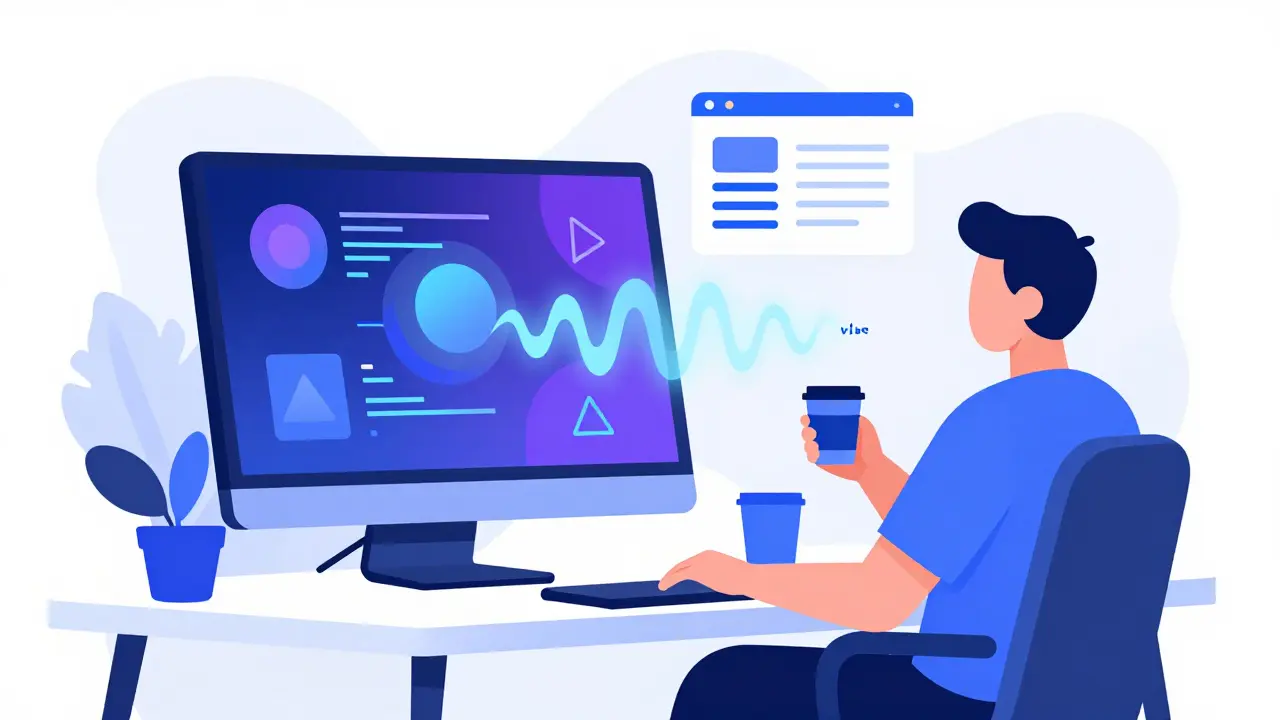
Have you ever stared at a screen, typed a sentence like 'build me a login page with dark mode,' and watched an AI spit out working code without you touching a single line of JavaScript? If so, you might be practicing vibe coding, an AI-assisted software development technique where developers describe projects in natural language and evaluate results through execution rather than reviewing the source code directly. It sounds almost too good to be true. But is it actually viable for your team, or are you just skipping necessary quality checks?
The term was coined by Andrej Karpathy, co-founder of OpenAI and former AI leader at Tesla who introduced the concept in February 2025 in early 2025. He described it as a shift where you "fully give in to the vibes" and stop worrying about how the code works under the hood. Since then, the industry has split. Some teams swear by it for rapid prototyping. Others warn it’s a fast track to security nightmares. The truth lies somewhere in between, but only if you know what actually counts as vibe coding versus just using AI autocomplete.
The Core Definition: No Code Review Allowed
To call yourself a vibe coder, you have to break one of the oldest rules in software engineering: never trust code you haven’t read. In traditional development, you write code, peer-review it, test it, and fix bugs. In vibe coding, that loop changes completely.
Wikipedia, the online encyclopedia that documented vibe coding in its February 2025 entry, defining it by the developer's refusal to review or edit generated code defines it clearly: the developer does not review or edit the code. You solely use tools and execution results to evaluate it. This means if you open the file, look at the function names, and tweak a variable because it looks ugly, you aren’t vibe coding. You’re doing standard AI pair programming.
This distinction matters because the value proposition of vibe coding is speed, not precision. A McKinsey report from June 2025 found that developers using these assistants complete tasks up to 56% faster. But that speed comes from removing the friction of syntax checking and architectural planning. If you add those steps back in, you lose the efficiency gain.
Essential Tools for the Vibe Workflow
You can’t vibe code effectively with a basic text editor and a separate chat window. The workflow requires tight integration between your intent and the output. This is why specific tools have become non-negotiable for serious practitioners.
| Tool Name | Key Feature | Release/Update Context | Best For |
|---|---|---|---|
| Cursor, an AI-powered IDE that integrates LLM capabilities directly into the development workflow, featuring a 'Composer' mode for vibe coding | Composer Mode (v2.3.1+) | April 2025 | Full-stack application generation |
| Windsurf, a specialized IDE integrating LLM capabilities for seamless AI-driven development workflows | Flow State Integration | 2025 | Rapid frontend prototyping |
| GPT-4, OpenAI's large language model released in June 2024, widely used for generating complex code structures | Natural Language Understanding | June 2024 | Complex logic prompts |
| Claude 3, Anthropic's large language model released in January 2025, known for safety and structured reasoning | Structured Reasoning | January 2025 | Secure code generation |
| SonarQube, a static code analysis tool essential for vibe coding to detect vulnerabilities without manual inspection | Vibe Coding Verification (v10.4) | July 2025 / Jan 2026 | Automated quality assurance |
The key here is the interface. With Cursor Composer, a feature within the Cursor IDE requiring version 2.5+ with 'vibe mode' enabled for authentic vibe coding workflows, for example, you describe the entire feature set in a chat pane. The tool writes the files, creates the directories, and installs dependencies. You hit run. If it works, you move on. If it crashes, you tell the AI what happened, and it fixes it. You never see the Python or React code unless something breaks badly.
The Practical Checklist: Is Your Team Doing It Right?
Many teams think they are vibe coding when they are just copy-pasting AI suggestions. To qualify as authentic vibe coding, your team must meet specific criteria. Use this checklist to audit your workflow.
- Natural Language Only: Do developers describe functionality exclusively in plain English? Check your IDE logs. If there’s any time spent editing raw code manually, you fail this point.
- Zero Inspection Time: Are you avoiding code inspection entirely? Metrics from tools like SonarQube should show 0% manual review time. If you’re reading the code to understand it, you’re slowing down the vibe.
- Result-Based Evaluation: Do you judge success by test results and UI behavior? Your CI/CD pipelines (like Jenkins) should show 100% test-driven validation. The code is black-boxed; only the output matters.
- AI-Driven Modifications: When things go wrong, do you ask the AI to fix them? GitHub commit history should show diffs generated by AI, not human edits. If you type `if (x > 0)` yourself, you’ve broken the flow.
- Outcome-Focused Documentation: Does your documentation explain what the feature does for the user, not how it’s built? Confluence pages should have 90%+ natural language descriptions. Technical implementation details are irrelevant if you don’t read the code.
If you check all five boxes, you are vibe coding. If you miss even one, you are likely just using AI as a fancy autocomplete, which is fine, but it doesn’t carry the same risks or rewards.

Speed vs. Security: The Real Trade-Off
Let’s talk about the elephant in the room: security. Vibe coding is incredibly fast. Garry Tan, CEO of Y Combinator, noted in March 2025 that tasks previously requiring "a whole army of software engineers" can now be handled by small teams. Tanium’s November 2025 case studies showed idea validation timelines shrinking from months to days.
But speed has a cost. A Pragmatic Engineer study from August 2025 found that vibe coding performs poorly for cryptographic implementations, with a 78% failure rate in generating secure encryption code compared to 12% for human developers. Why? Because the AI doesn’t "know" security best practices in the way a seasoned engineer does. It predicts the next token based on probability, not policy.
This is why Guillaume Sornin, CTO of SonarSource who emphasized in July 2025 that integrating tools like SonarQube is essential to address potential pitfalls of vibe coding insists that automated scanning is mandatory. His data showed a 43% increase in security vulnerabilities in unverified AI-generated code. Without manual review, you need machines to catch what humans aren’t looking for.
Here is the heuristic: Use vibe coding for front-end interfaces, internal tools, and prototypes. Avoid it for payment processing, user authentication, and data encryption unless you have robust automated security gates in place.
Prompt Engineering: The New Developer Skill
In vibe coding, your primary skill isn’t knowing Java or Python. It’s knowing how to talk to the AI. Replit’s January 2026 study found that teams with dedicated "prompt engineers" achieved 47% better results. What does that mean in practice?
It means moving away from vague requests like "make a website" to specific outcome descriptions. Instead of saying "write a function that validates email format using regex," you say "Create a user login system with email verification that sends a confirmation link and blocks invalid formats." The AI handles the regex; you handle the business logic.
Coding Temple’s November 2025 training program revealed that non-technical users need about 38 hours to become proficient in this style, while experienced developers adapt in just 19 hours. The learning curve is steep initially because you have to unlearn the habit of controlling every detail. You have to trust the process.

The Hybrid Future: Pure Vibe vs. Reality
Is pure vibe coding dead? Not exactly, but it’s evolving. The Pragmatic Engineer’s January 2026 analysis concluded that "pure vibe coding" is declining. Instead, 87% of high-performing teams now use a hybrid approach. They vibe code for prototyping and initial builds, then switch to traditional review for production deployment.
This makes sense. Dr. Sarah Chen, director of Stanford University’s AI Ethics Lab, warned in September 2025 that vibe coding represents "dangerous technosolutionism" when applied to critical systems. Bypassing code review safeguards can lead to catastrophic failures in regulated industries. With the EU’s draft AI Act in February 2026 requiring human oversight for critical system code, many enterprises are restricting vibe coding to non-critical paths.
However, for startups and indie hackers, the benefits remain undeniable. GitHub’s State of the Octoverse 2025 report showed that 41% of developers using AI tools engage in some form of vibe coding. Non-traditional coders-designers, product managers-now make up 34% of practitioners. This democratization is the real revolution. You don’t need to be a CS graduate to build a MVP anymore. You just need to know what you want.
Next Steps for Your Team
If you want to try vibe coding, start small. Pick a low-risk project, like an internal dashboard or a marketing landing page. Set up Cursor or Windsurf. Install SonarQube to automate your safety net. Write your prompts in natural language, focusing on outcomes. Resist the urge to look at the code. Run the tests. If they pass, ship it. If they fail, refine the prompt.
Remember, vibe coding isn’t about being lazy. It’s about shifting your cognitive load from syntax to strategy. It allows you to explore ideas faster than ever before. Just keep your eyes on the output, not the implementation, and let the AI handle the heavy lifting.
Is vibe coding safe for production environments?
Generally, no. While vibe coding accelerates development, it introduces significant security risks due to the lack of manual code review. Studies show a 43% increase in vulnerabilities in unverified AI code. It is safest for prototypes, internal tools, and non-critical front-end components. For production, especially involving payments or personal data, a hybrid approach with automated security scanning (like SonarQube) and eventual human review is recommended.
What is the difference between vibe coding and AI pair programming?
In AI pair programming, you still review, edit, and understand the generated code. You use AI as a helper. In vibe coding, you deliberately avoid inspecting the code. You evaluate the software solely by its execution results and test outputs. If you touch the source code manually, you are not vibe coding.
Do I need to know how to code to vibe code?
Not necessarily. Vibe coding has democratized development, allowing non-technical founders and designers to build functional prototypes. However, understanding basic technical concepts helps in writing effective prompts and interpreting error messages. Training programs suggest non-technical users need about 38 hours to become proficient.
Which tools are best for vibe coding?
The most popular tools include Cursor (specifically the Composer mode), Windsurf, and IDEs integrated with LLMs like GPT-4 or Claude 3. These tools allow for seamless natural language interaction and automatic file management, which are essential for the vibe coding workflow.
How does vibe coding affect debugging?
Debugging shifts from analyzing stack traces and logs to refining prompts. Traditional debugging might take 23 minutes per bug, whereas vibe coding reduces this to around 9 minutes by describing the error in natural language and letting the AI generate a fix. However, if the AI generates "magic code" that is difficult to trace, complex bugs can still arise.
- Jun, 1 2026
- Collin Pace
- 7
- Permalink
Written by Collin Pace
View all posts by: Collin Pace