Workload Placement Strategy: Matching LLM Tasks to Models and Infrastructure

Imagine you have a fleet of high-performance servers. Some are packed with massive GPUs for heavy lifting. Others have fast SSDs but modest processors. You also have a queue of tasks: some need raw compute power, others need quick data access, and many depend on each other finishing in order. If you just throw these tasks at random machines, your system chokes. Data moves back and forth unnecessarily. Jobs wait in line. Costs skyrocket.
This is the core problem of workload placement. It’s not just about picking the biggest model or the fastest server. It’s about matching specific Large Language Model (LLM) tasks to the right models and the right physical infrastructure. As we move into 2026, this isn't a niche technical detail anymore. It’s a strategic governance issue that determines whether an AI operation runs efficiently or burns cash.
The Shift from Generic DL to Foundation Model Workloads
To understand why placement matters now, you have to look at how workloads have changed. In the past, deep learning was a mix of everything. You had Convolutional Neural Networks (CNNs) for images, Long Short-Term Memory (LSTM) networks for sequences, and Graph Neural Networks (GNNs) for structured data. Each had different hardware needs. Scheduling them was messy but varied.
Today, the landscape has homogenized around one architecture: the Transformer. Whether it’s OpenAI’s GPT series or Meta’s LLaMA, almost all modern foundation models use this same underlying structure. Research from the Shanghai AI Laboratory’s Acme datacenter highlights this shift. They observed that LLM development follows a distinct paradigm compared to traditional deep learning. These are self-supervised training cycles running on massive curated datasets, often spanning six months.
This architectural uniformity creates a unique challenge. Because most jobs look similar to the scheduler-"run Transformer inference/training"-the system tends to treat them as interchangeable. But they aren’t. The result is a polarized GPU utilization pattern. Clusters sit at either 0% usage (idle) or 100% usage (fully saturated). There is rarely a middle ground. This "all-or-nothing" behavior makes resource allocation brittle. If you can’t fit a job perfectly, it waits. If you over-allocate, you waste money.
The Five Stages of LLM Development and Their Hardware Needs
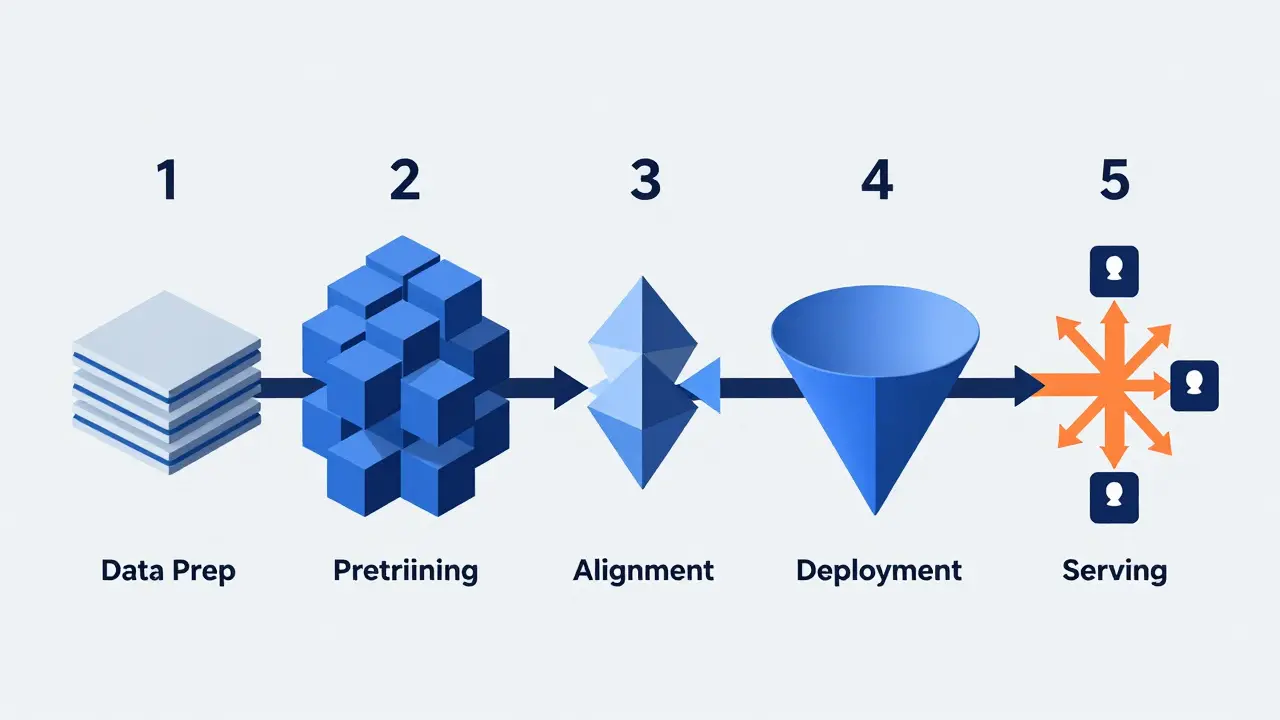
You can’t place a workload if you don’t know what it actually does. The LLM lifecycle isn’t a single step. It’s a pipeline with five distinct stages, each demanding different infrastructure profiles.
- Data Preparation: This involves gathering and preprocessing training data. You’re dealing with two types here. Pretraining data is huge-extensive unlabeled corpora. Alignment data is smaller but higher quality, consisting of labeled sets. This stage is I/O heavy. It needs fast storage and good CPU throughput for parsing, not necessarily top-tier GPUs yet.
- Pretraining: This is the brute force phase. You feed the model billions of parameters and vast amounts of text. This requires massive parallel compute. You need clusters of high-end GPUs connected with high-bandwidth networking (like NVLink or InfiniBand) to minimize communication latency between nodes.
- Alignment: Here, you adapt the general model to user intent. This happens through Supervised Fine-Tuning (SFT) or Reinforcement Learning from Human Feedback (RLHF). Unlike pretraining, this might happen on smaller subsets of data. It’s less about raw scale and more about precision. Sometimes, prompt engineering handles this without touching model parameters, requiring minimal infrastructure.
- Deployment: Moving the model from a training environment to a serving environment. This involves packaging the model, optimizing weights, and setting up the inference stack.
- Serving: This is where users interact with the model. Inference workloads differ significantly from training. They prioritize low latency and high throughput per token. Serving might happen on specialized inference chips or even edge devices, separate from the heavy GPU clusters used for training.
A key insight from recent studies is that the balance between pretraining and alignment infrastructure varies wildly across facilities. Some labs build massive pretraining rigs and do minimal fine-tuning. Others focus on rapid iteration with frequent alignment cycles. Your placement strategy must reflect your organization’s specific ratio of these activities.
Can LLMs Solve Their Own Scheduling Problems?
Here’s a twist. Since we’re using LLMs to do complex reasoning, why not ask an LLM to schedule the other LLMs? A comprehensive study published on arXiv tested exactly this. Researchers evaluated 21 publicly available LLMs on heterogeneous High-Performance Computing (HPC) workload mapping problems.
The setup was interesting. The models received textual descriptions of system nodes, task requirements, and scheduling objectives. No code. No mathematical formulas. Just natural language. They had to produce valid mappings, calculate the total time (makespan), and explain their reasoning.
Let’s look at a concrete scenario from that study. Imagine four tasks:
- Task 1: Needs 8 CPUs, 32GB RAM, GPU features. Duration: 3 hours. Output: 10GB data. No dependencies.
- Task 2: Needs 4 CPUs, 16GB RAM, CPU only. Duration: 2 hours. Output: 5GB data. Depends on Task 1.
- Task 3: Needs 16 CPUs, 64GB RAM, CPU + SSD features. Duration: 5 hours. Output: 20GB data. No dependencies.
- Task 4: Needs 8 CPUs, 32GB RAM, CPU only. Duration: 4 hours. Output: 15GB data. Depends on Task 2 AND Task 3.
The goal? Minimize the total time to finish all tasks while respecting dependencies and hardware constraints. The optimal solution recognizes that Task 1 should go to a GPU node, and Task 3 should go to a node with a fast SSD. Why? Because Task 3 generates 20GB of data. If you put Task 3 on a slow disk and Task 4 (which needs that data) on a different node, you create a bottleneck transferring that large file. Co-locating dependent tasks or placing them on nodes with compatible high-speed interfaces reduces data transfer overhead.
The study found that all 21 LLMs generated feasible schedules. They didn’t crash the system. However, there was a catch. Higher-performing models understood resource locality. They co-located dependent tasks and assigned workloads to appropriate accelerators. Weaker models ignored parallelism opportunities. They might have scheduled Task 2 immediately after Task 1, which is correct, but failed to realize Task 3 could run simultaneously on a different node, thus increasing the overall makespan.
Crucially, the research highlighted probabilistic variability. Identical prompts sometimes produced different schedules. For critical infrastructure, unpredictability is a risk. Traditional methods like Integer Linear Programming (ILP) or heuristics like Heterogeneous Earliest Finish Time (HEFT) offer guarantees of feasibility and optimality. LLMs offer interpretability-they can tell you *why* they made a choice-but they lack the mathematical certainty of classical algorithms.
| Approach | Strengths | Weaknesses | Best Use Case |
|---|---|---|---|
| Integer Linear Programming (ILP) | Guaranteed optimal solution; strict constraint satisfaction | Computationally expensive; doesn't scale well to massive dynamic environments | Static, small-to-medium cluster planning |
| Heuristics (e.g., HEFT) | Fast execution; good approximate solutions | No guarantee of optimality; may miss complex dependency optimizations | Real-time scheduling in large clusters |
| Metaheuristics (GA, SA) | Explores broader solution space; avoids local optima | Tuning parameters is difficult; slower than simple heuristics | Complex multi-objective optimization scenarios |
| LLM-Based Agents | Highly interpretable reasoning; handles unstructured input | Probabilistic output; inconsistent results; lacks hard guarantees | Small, well-defined workloads; initial planning drafts |
Strategic Governance: Building a Hybrid Placement Framework
So, how do you govern this? You don’t rely solely on LLMs to schedule themselves, nor do you stick to rigid legacy scripts. The winning strategy for 2026 is a hybrid approach.
First, categorize your workloads. Not all tasks are created equal. Critical path items-those that block downstream tasks-need deterministic scheduling. Use classical algorithms (ILP or robust heuristics) for these. Ensure dependencies are honored and data locality is maximized. For example, if Task B needs the output of Task A, ensure they are placed on nodes with high-speed interconnects or the same storage volume.
Second, use LLMs for interpretation and anomaly detection. Let an LLM analyze the logs of your scheduler. Ask it to identify why certain jobs are stalling. Is it a memory leak? A network bottleneck? An LLM can parse error messages and suggest configuration changes in plain English, helping human engineers debug faster. This leverages the LLM’s strength in natural language understanding without risking the stability of the actual compute graph.
Third, optimize for data movement. In the HPC study, the optimal solution avoided moving 20GB of data between nodes by choosing the right hardware features initially. In your infrastructure, map out your data flows. If a task produces large artifacts, place it on a node with high-capacity, high-throughput storage (like NVMe SSDs) and keep subsequent dependent tasks nearby. Reducing data transfer overhead is often more impactful than squeezing out extra FLOPS from a GPU.
Finally, monitor the polarization effect. If your cluster is stuck at 0% or 100% utilization, you have a fragmentation problem. Consider breaking down large monolithic jobs into smaller, independent chunks where possible. Or, implement elastic scaling policies that spin up spot instances for flexible workloads like data preparation, reserving reserved capacity for critical pretraining phases.

Practical Checklist for Workload Placement
Before deploying your next major LLM initiative, run through this checklist to ensure your infrastructure matches your tasks.
- Map Dependencies: Create a visual graph of your tasks. Identify which jobs must finish before others start. Never schedule a dependent task on a node that cannot quickly receive data from its predecessor.
- Profile Hardware Features: Don’t just count GPUs. Tag your nodes with attributes: "Has NVLink," "High-RAM," "SSD-Optimized," "Low-Latency Network." Match task requirements to these tags explicitly.
- Separate Training and Serving: Do not mix heavy pretraining jobs with low-latency inference requests. Training consumes resources unpredictably and can spike network traffic, causing inference timeouts. Keep them on isolated clusters or use strict Quality of Service (QoS) policies.
- Use Heuristics for Scale: For large clusters, avoid exact optimization algorithms like ILP for real-time decisions. They take too long. Use heuristic approaches like Opportunistic Load Balancing (OLB) to get "good enough" placements quickly.
- Leverage LLMs for Small Batches: If you have a small, ad-hoc set of experiments, try using an LLM agent to draft a schedule. Review its reasoning. It might spot a parallelism opportunity a human missed. But verify the constraints manually.
- Monitor Data Transfer Costs: Track the volume of data moving between nodes. If you see high inter-node traffic, revisit your placement logic. Co-locate tasks that share large datasets.
Future Outlook: Autonomous Optimization
As LLM reasoning capabilities improve, we will likely see more autonomous workload optimization. Future systems might combine the interpretability of LLMs with the guarantees of algorithmic solvers. Imagine a system where an LLM proposes a schedule, explains its rationale, and a mathematical engine verifies its feasibility and optimality in milliseconds. This hybrid model would offer the best of both worlds: human-readable insights and machine-grade reliability.
For now, however, governance remains key. Treat workload placement as a strategic asset. Align your infrastructure investments with your specific LLM development stage. If you’re in heavy pretraining, invest in bandwidth and GPU density. If you’re in alignment and serving, invest in low-latency networking and efficient inference hardware. By matching tasks to models and infrastructure intentionally, you turn chaos into efficiency.
What is the difference between LLM training and inference workloads?
Training workloads involve updating model parameters using large datasets. They are computationally intensive, require massive parallel processing across many GPUs, and tolerate higher latency. Inference workloads involve generating responses from a trained model. They prioritize low latency and high throughput per request. Training typically uses dedicated GPU clusters, while inference may use specialized inference chips or distributed edge servers to minimize response time.
Why do LLM clusters show polarized GPU utilization (0% or 100%)?
This polarization occurs because modern LLMs largely use the same Transformer architecture. Schedulers see these jobs as similar and tend to pack them tightly until resources are exhausted (100%). When no full-sized job fits, the remaining fragments are too small to utilize the powerful GPUs effectively, leaving them idle (0%). This lack of intermediate utilization states makes resource allocation inefficient unless jobs are carefully sized or fragmented.
Can Large Language Models reliably schedule HPC tasks?
LLMs can generate feasible schedules for small, well-defined workloads and provide valuable interpretability. However, they suffer from probabilistic variability, meaning identical inputs may yield different outputs. They currently lack the strict constraint-satisfaction guarantees of traditional algorithms like Integer Linear Programming. Therefore, they are best used for drafting plans or analyzing anomalies rather than executing critical, large-scale automated scheduling without verification.
How does data locality impact workload placement?
Data locality refers to keeping related tasks and their data on the same node or nearby nodes with high-speed connections. Poor locality forces large data transfers over the network, creating bottlenecks that increase the total execution time (makespan). For example, placing a task that generates 20GB of output on a node with a slow disk, and its dependent task on another node, will delay the entire pipeline. Optimizing for locality minimizes transfer overhead and speeds up completion.
What is the role of Supervised Fine-Tuning (SFT) in infrastructure planning?
Supervised Fine-Tuning (SFT) is part of the alignment stage, where a base model is adapted to specific tasks using labeled data. Unlike pretraining, SFT often requires less computational power but demands high-quality data and precise control. Infrastructure planning must account for this by ensuring availability of flexible, mid-tier GPU resources that can handle frequent, smaller-scale tuning jobs without competing with massive pretraining batches.
- Jun, 17 2026
- Collin Pace
- 5
- Permalink
- Tags:
- LLM workload placement
- AI infrastructure strategy
- model task matching
- GPU resource optimization
- HPC scheduling
Written by Collin Pace
View all posts by: Collin Pace