Architectural Standards for Vibe-Coded Systems: Reference Implementations

Coding used to be about syntax, semicolons, and strict logic. Now, we're entering the era of vibe coding is an AI-native programming paradigm where developers specify high-level functional intent and qualitative descriptors-the "vibe"-and an intelligent agent transforms those prompts into executable software. It sounds like magic, but if you've tried it without a plan, you know the horror of "prompt drift" or a codebase that looks clean but is structurally a disaster. The reality is that AI agents are designed to make things work, not necessarily to make them maintainable. Without strict architectural guardrails, you aren't building a product; you're building technical debt at warp speed.
The High Cost of Unstructured Vibe Coding
When you just "vibe" with an AI and hope for the best, you're playing a dangerous game. A March 2025 analysis by Codecentric on an AI-generated SPaaS platform found 37 critical security vulnerabilities and 21 architectural anti-patterns in a single system. This isn't just a few bugs; it's a systemic failure. Unstructured approaches frequently lead to strong coupling, where 73% of analyzed systems became a tangled mess of dependencies that are nearly impossible to decouple later.
We've seen the data: unstructured vibe coding produces 3.7x more security vulnerabilities than manual coding. Developers often report a "honeymoon phase" where prototyping is 4.3x faster, but that speed evaporates the moment you hit the maintenance phase. If your system lacks a foundation, you'll spend more time fighting the AI's hallucinations than actually shipping features. In fact, Gartner predicts that 90% of vibe-coded systems lacking standards will need a full rewrite within three years.
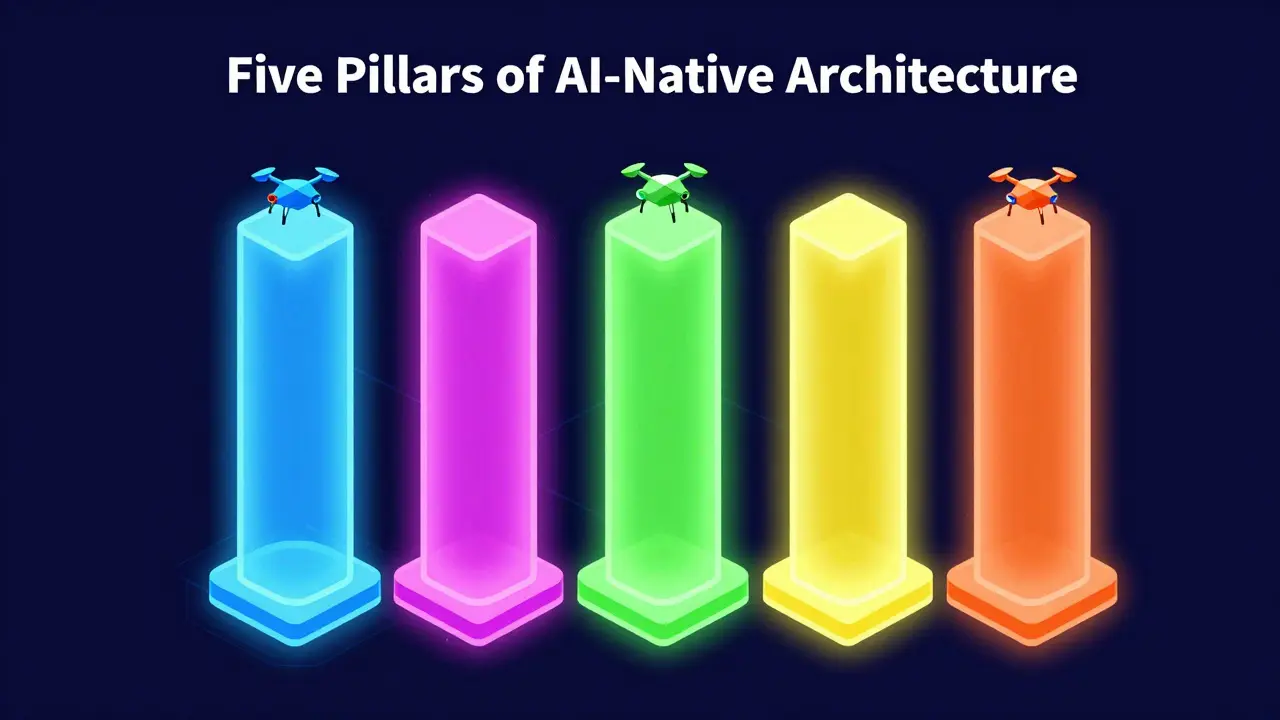
The Five Pillars of AI-Native Architecture
To stop the bleed, you need a "constitution" for your AI. You can't just tell the AI to "write clean code"; you have to mandate specific patterns. According to reference implementations from Synaptic Labs and vFunction, these five principles are non-negotiable for any production-grade vibe-coded system:
- Composition over Inheritance: Stop building deep class hierarchies. Use capability interfaces. In a May 2025 Synaptic Labs implementation, 87% of object behaviors were composed from 12 standardized interfaces, making the system incredibly flexible.
- Strict Dependency Injection (DI): Use interface-based contracts with constructor injection. vFunction found that this specific pattern reduced coupling by 63% in AI-generated codebases.
- The "Tell, Don't Ask" Principle: Command your objects to perform actions rather than asking them for their state. This simple shift results in 41% fewer conditional branches, which means fewer places for the AI to make logic errors.
- Law of Demeter Compliance: Keep your object chains flat. Instead of calling
user.profile.settings.theme.getColor(), create a service interface. Compliant systems saw method chain lengths drop from an average of 4.7 to just 1.2. - AI-Friendly Design: AI thrives on predictability. Use standardized REST interfaces (Create, Update, Delete, Get, List) and uniform error handling. This consistency improved AI extension success rates from 58% to 92%.
| Metric | Unstructured Approach | Structured (Architectural Guardrails) |
|---|---|---|
| Test Coverage | Variable / Low | Up to 94% |
| Technical Debt | High accumulation | 68% Lower |
| Security Vulnerabilities | 3.7x vs Manual Coding | ~18% gap vs Manual Coding |
| Maintenance Effort | Exponential increase | 3.2x Higher Maintainability |
Reference Architecture: The Four-Component Model
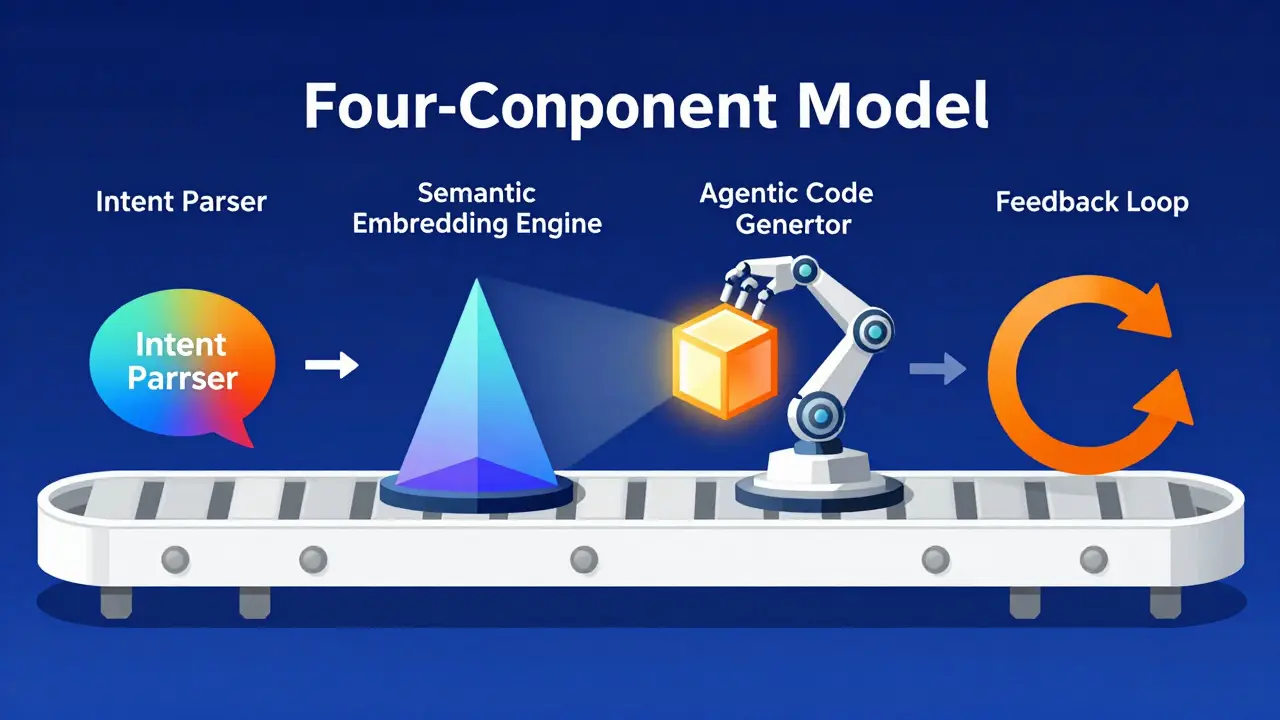
If you're building a system to manage vibe coding at scale, you need more than a prompt; you need a pipeline. The October 2025 arXiv paper (arXiv:2510.17842) defines a formal reference architecture that moves beyond the simple chat box. This model consists of four critical stages:
- Intent Parser: This converts free-form, "vibey" descriptions into a structured representation that the system can actually process.
- Semantic Embedding Engine: This interprets qualitative descriptors (like "minimalist," "enterprise-grade," or "aggressive") and maps them to specific technical constraints.
- Agentic Code Generator: This is where the Agentic Code Generator takes the structured intent and the architectural constraints to produce the actual executable code.
- Feedback Loop: An iterative process of testing, validation, and refinement based on the actual output.
When this architecture is paired with a "constitutional" approach-where security and architectural requirements are specified before a single line of code is generated-the results are staggering. Drew Maring's MacroMetric project prevented 112 potential vulnerabilities simply by setting these rules upfront.
Governance and Onboarding Strategy
You can't just drop an AI assistant into a team and hope they follow the rules. You need a formal onboarding process. Synaptic Labs suggests a three-phase approach to ensure the "vibe" doesn't override the architecture:
First, spend 4-8 hours establishing your Architectural Constitution. This is a living document that defines the "laws" of your codebase. Second, dedicate 12-24 hours to creating Reference Implementations. These are small, perfect examples of the patterns you want the AI to mimic. Finally, spend 8-16 hours building Validation Pipelines that automatically flag when the AI violates your constraints.
Beware of "prompt drift." This happens when developers, in the rush to finish a feature, start ignoring the architectural constraints in their prompts. Codecentric found that 68% of teams suffered from this. The fix? Continuous governance and regular reviews by architects who have the experience to spot a structural flaw before it's baked into 10,000 lines of code.
The Future of AI Governance
We are seeing a massive shift toward formalization. The IEEE P2874 standard is currently in draft, aiming to mandate separation of concerns metrics (minimum 85% adherence) and coupling thresholds (maximum 0.35 fan-out) for AI-generated systems. Regulated industries like healthcare and finance are already leading the charge, with 82% requiring formal architecture reviews before any AI-generated code hits production.
The market is splitting. You have tools like GitHub Copilot handling the low-level "vibes," while platforms like vFunction focus on post-generation architectural observability. The winner won't be the one who can generate code the fastest, but the one who can generate code that doesn't need to be rewritten in 24 months.
What exactly is vibe coding?
Vibe coding is a paradigm where a developer describes the desired functionality and the "vibe" (the aesthetic, tone, or style) of the software using natural language. An AI agent then interprets these high-level intents to generate the actual code, shifting the developer's role from writing syntax to guiding intent.
Why is an "architectural constitution" necessary?
AI agents optimize for the immediate goal-making the code work-rather than long-term systemic health. A constitution provides a set of explicit, non-negotiable rules (like "all services must use constructor injection") that prevent the AI from creating tightly coupled, insecure, or unmaintainable code.
How does structured vibe coding differ from unstructured?
Unstructured vibe coding relies on simple prompting and often results in high technical debt and security flaws. Structured vibe coding uses a formal framework-including intent parsers, architectural constraints, and validation pipelines-which can lead to 94% test coverage and significantly lower total cost of ownership.
What are the main risks of using AI for architecture?
The primary risks include strong coupling, a lack of separation of concerns, and the introduction of critical security vulnerabilities. AI tends to overlook modularity and observability, which are essential for enterprise-scale systems.
What is the recommended onboarding process for teams?
The recommended process involves three phases: establishing an architectural constitution, creating a library of reference implementations for core patterns, and setting up automated validation pipelines to ensure the AI adheres to those standards.
- Apr, 24 2026
- Collin Pace
- 9
- Permalink
- Tags:
- vibe coding
- architectural standards
- AI-generated code
- software governance
- reference implementations
Written by Collin Pace
View all posts by: Collin Pace