Enterprise LLM Strategy Roadmap: A 2026 Guide to Scaling AI Safely
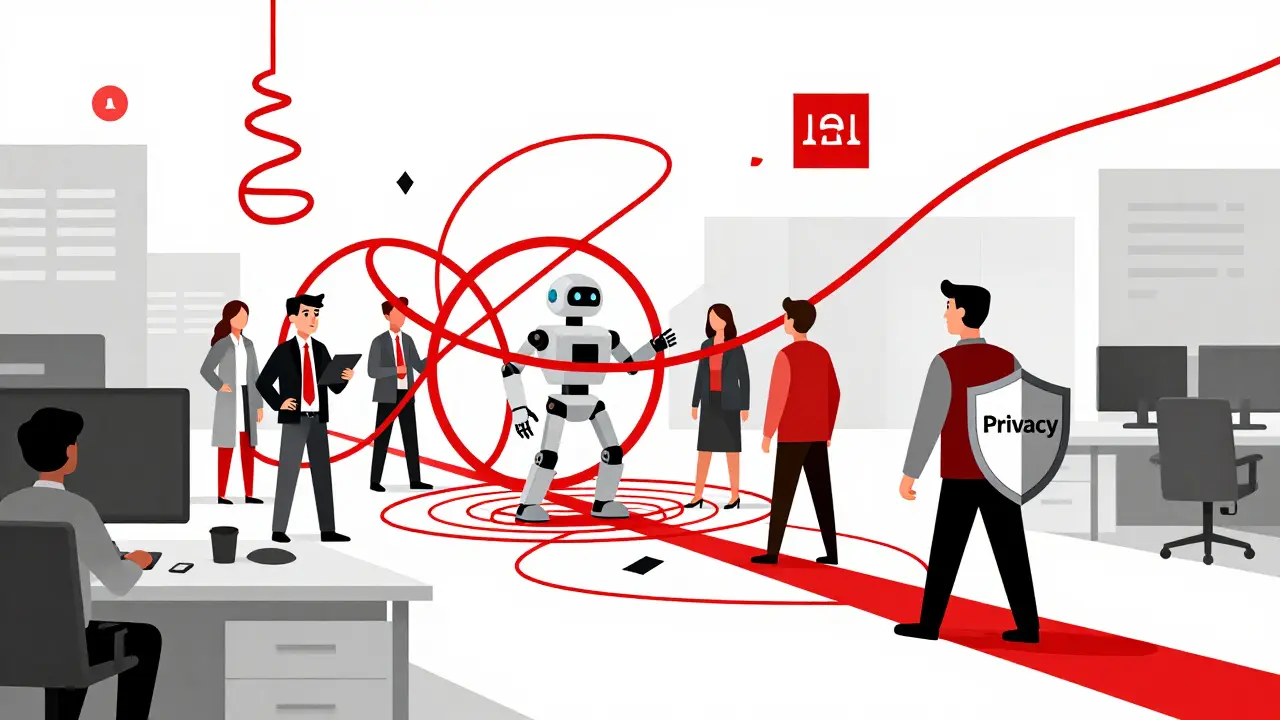
Most companies think they are ready for Large Language Models is a type of artificial intelligence that processes and generates human-like text based on vast amounts of training data.. They buy access to a model, let the marketing team write some emails, and call it innovation. Six months later, the project stalls. Costs spiral out of control because nobody tracked token usage. The legal team blocks deployment due to data privacy risks. And the engineering team is drowning in technical debt from a patchwork of scripts that don't talk to each other.
This is not an isolated incident. It is the standard outcome for organizations that treat generative AI as a tool rather than a strategic capability. In 2026, the gap between successful enterprises and those struggling with AI is no longer about who has the best model. It is about who has the best plan. An Enterprise LLM Strategy Roadmap is a structured planning document that outlines how an organization will integrate, govern, and scale large language models across its business units over time. serves as the bridge between experimental pilots and profitable production systems.
Without this roadmap, you are essentially gambling with your digital infrastructure. With one, you transform AI from a cost center into a measurable driver of operational efficiency and revenue growth. This guide breaks down exactly how to build that roadmap, avoiding the common pitfalls that cause half of all enterprise AI initiatives to fail.
Why Your Current AI Approach Is Failing
Let's look at the hard numbers. According to Gartner's 2025 enterprise AI survey, nearly 50% of enterprise AI initiatives fail to deliver value. Why? Because they lack foundational architecture. When teams rush to deploy Generative AI is artificial intelligence capable of creating new content such as text, images, or code, distinct from traditional analytical AI. without a coordinated strategy, they create silos. Marketing uses one vendor, customer service uses another, and IT doesn't know what's happening until a security breach occurs.
The cost of this disorganization is staggering. Forrester's 2025 case studies show that unstructured implementations lead to redundant tooling and duplicated efforts. In contrast, companies using a formal AI Implementation Framework is a set of guidelines and phases used to systematically introduce artificial intelligence technologies into an organization's operations. see a 31% reduction in total cost of ownership. They also achieve value 5.3 months faster. The difference isn't magic; it's discipline.
Consider the scenario of a mid-sized retailer. They deployed a chatbot for customer support in Q1 2025. It worked well initially. But by Q4, the model began hallucinating product details because it wasn't connected to the updated inventory database. Fixing this required rebuilding the entire integration layer. A proper roadmap would have identified the need for real-time data pipeline integration in Phase 3, preventing this costly rework entirely.
The Five Phases of a Winning LLM Roadmap
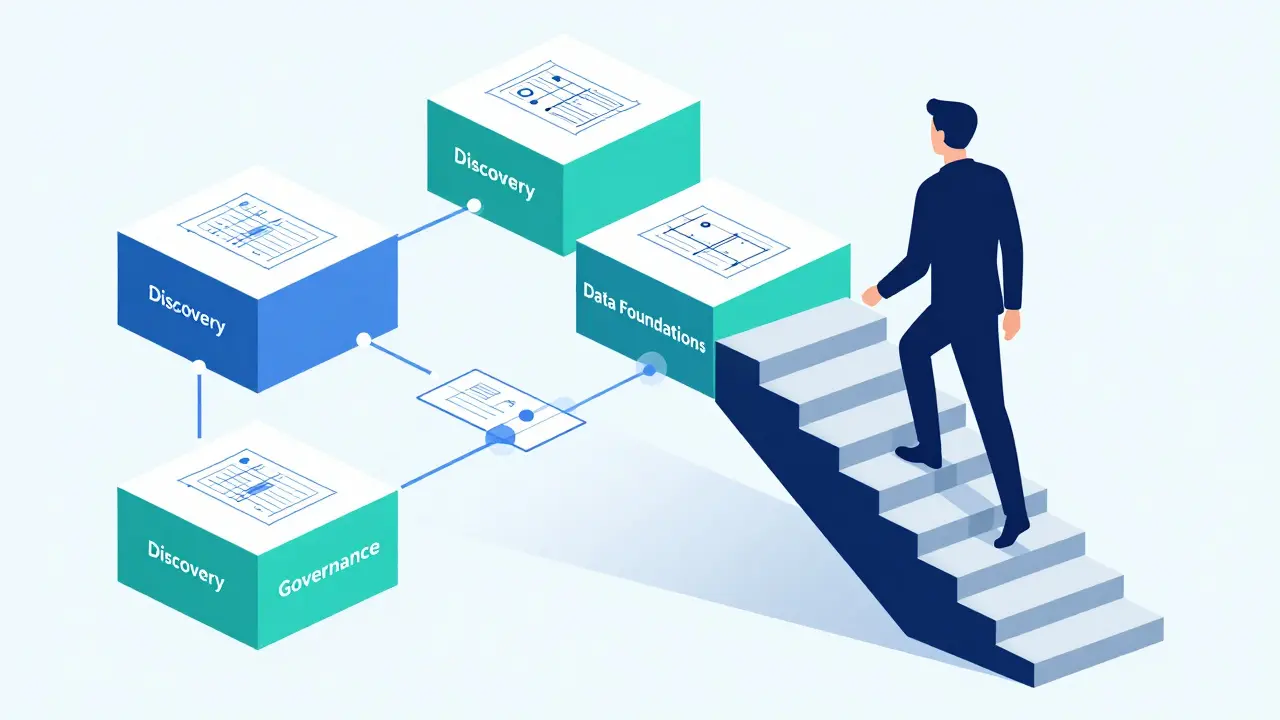
A robust LLM Deployment Strategy is a comprehensive plan detailing the steps, resources, and timelines required to move large language models from development to production environments. follows a phased approach. RTS Labs' 2026 Enterprise AI Roadmap Guide outlines five critical stages that have become the industry standard. Here is how you execute them.
- Discovery and Alignment (Weeks 1-8): Stop talking about technology. Start talking about pain points. Conduct stakeholder interviews across business units. Identify where manual processes are slowest and most expensive. Document success metrics now, before you write a single line of code. If you can't define what success looks like, you won't recognize it when it happens.
- Use Case Selection (Weeks 6-12): Not all ideas are created equal. Score potential initiatives using a weighted matrix. Feasibility should account for 30%, data readiness for 25%, business value for 20%, risk for 15%, and timeline for 10%. Prioritize projects with a minimum 12-month payback period for Tier-1 initiatives. Avoid "nice-to-have" features that drain resources without clear ROI.
- Data and Infrastructure Foundations (Months 3-6): This is where most roadmaps break. You cannot run sophisticated Vector Databases is a specialized database system designed to store, index, and query high-dimensional vector embeddings generated by machine learning models. on legacy spreadsheets. Build modernized data pipelines that integrate at least five major enterprise systems. Ensure your infrastructure supports Kubernetes orchestration and MLOps pipelines with 95% uptime SLAs. Plan for vector database capacity of 10 million+ embeddings with latency under 100 milliseconds.
- Governance and Compliance Integration: Embed compliance early, not as an afterthought. Adhere to the NIST AI Risk Management Framework 1.1, released in December 2025. Implement guardrails for data privacy, bias detection, and output validation. For financial services firms, ensure your model registry tracks versioning and lineage, as required by FINRA's 2025 guidance.
- Deployment, Scale, and Optimization (Months 12-18): Launch in production with rigorous monitoring. Set up alerts for model drift, triggering retraining when distribution shifts exceed 5%. Establish continuous feedback loops where user interactions improve the model over time. This phase transforms your AI from a static tool into a dynamic asset.
Building the Technical Foundation
Your roadmap must address the hardware and software realities of 2026. Running Inference Engines is software components responsible for executing trained machine learning models to generate predictions or outputs from input data. requires significant compute power. You need minimum 16GB RAM per inference node and NVIDIA A100 GPUs for training workloads. Cloud environments are non-negotiable, with 87% of enterprises adopting Kubernetes for orchestration according to Flexera's 2026 Cloud Report.
Language choice matters too. Python remains dominant with 89% adoption, but TypeScript is surging at 76% for frontend integrations. For performance-critical components, Go and Rust are gaining traction among enterprise engineers. Your development team needs to be proficient in these stacks to maintain agility.
| Component | Specification | Purpose |
|---|---|---|
| Compute Hardware | NVIDIA A100 GPUs, 16GB+ RAM/node | Training and high-speed inference |
| Orchestration | Kubernetes | Scalable container management |
| Data Storage | Vector DB (10M+ embeddings) | Semantic search and context retrieval |
| Monitoring | Drift alerts at 5% shift | Maintain model accuracy over time |
| Security | Okta/Azure AD Integration | Identity and access management |
Governance, Risk, and Cost Control
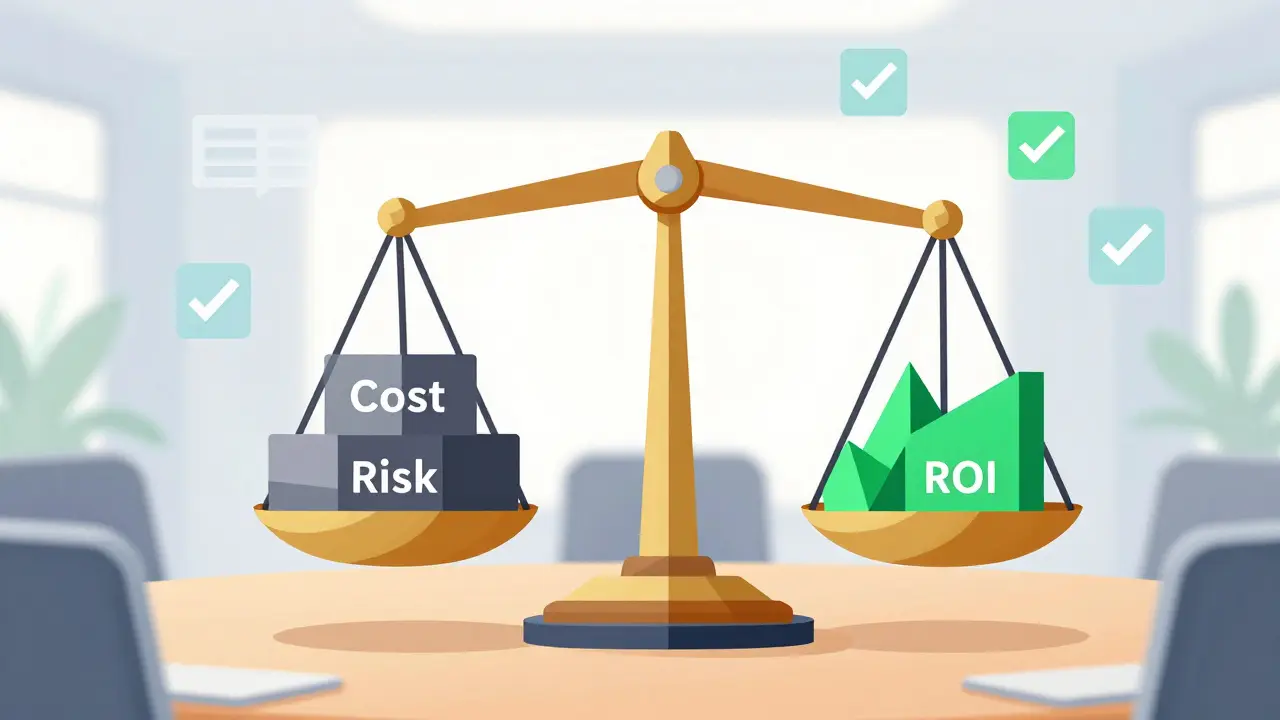
One of the biggest surprises for enterprises in 2025 was the hidden cost of tokens. Forrester Principal Analyst Mike Gualtieri reported that 63% of enterprises exceeded their initial LLM budgets by 2.1x due to unmonitored usage. You must implement cost observability frameworks that track expenses down to $0.0004-$0.002 per token, depending on model size.
Regulatory pressure is also intensifying. The EU AI Act enforcement began in January 2026, requiring documented risk assessment frameworks for high-impact AI systems. In the U.S., federal contractors must adopt the NIST AI RMF 1.1. Your roadmap must include specific milestones for achieving compliance. Ignoring this invites fines and reputational damage.
Furthermore, change management is often overlooked. MIT Sloan Management Review found that 52% of current roadmaps overemphasize technology while underinvesting in people. This leads to 28% lower user adoption rates. Dedicate 15-20% of your roadmap budget to reskilling employees. PwC's 2026 workforce transformation study indicates that effective reskilling takes 8-12 weeks per employee. Without this investment, your best technology will sit unused.
Measuring Success and Iterating
How do you know if your AI Center of Excellence is a dedicated organizational unit responsible for governing, developing, and scaling artificial intelligence capabilities across an enterprise. is working? Look at the metrics. Successful roadmaps deliver 3.2x higher ROI than ad-hoc implementations. Specific outcomes include:
- Operational Efficiency: 22% average savings in customer service operations through automated handling of routine inquiries.
- Forecasting Accuracy: 15-30% improvement in demand planning for retail sectors, reducing waste and stockouts.
- Customer Experience: 18-point increase in Net Promoter Score (NPS) among early adopters who provide personalized, instant responses.
But metrics alone aren't enough. You need a continuous learning framework. Seventy-two percent of 2026 roadmaps include mechanisms for incorporating user feedback into model refinement cycles. This means setting up systems where every interaction teaches the model something new, improving its relevance and accuracy over time.
Remember, a roadmap is not a static document. It is a living strategy. As agentic AI capabilities emerge-allowing models to perform multi-step tasks autonomously-you will need to update your phases. Gartner notes that 57% of new frameworks now include specific phases for multi-agent orchestration. Stay agile, review your progress quarterly, and adjust your trajectory based on real-world performance data.
What is the typical timeline for implementing an enterprise LLM roadmap?
A comprehensive enterprise LLM roadmap typically spans 12 to 18 months from discovery to full-scale deployment. The initial discovery and alignment phase takes 8 weeks, followed by use case selection (6-12 weeks), infrastructure building (3-6 months), and finally deployment and optimization (months 12-18). Leadership teams usually require 6-8 weeks to grasp the roadmap components, while technical teams need 12-16 weeks to implement foundational infrastructure.
How much does it cost to build an enterprise AI roadmap?
The cost varies significantly based on organization size and complexity. However, successful organizations dedicate 15-20% of their total AI budget to change management and roadmap execution. While initial investments are high, structured roadmaps reduce total cost of ownership by 31% compared to ad-hoc approaches by eliminating redundant tools and rework. Token usage costs range from $0.0004 to $0.002 per token, making ongoing monitoring essential to prevent budget overruns.
Which industries benefit most from LLM roadmapping?
Financial services leads with an 82% adoption rate, driven by strict regulatory requirements and the need for precise risk management. Healthcare follows closely at 76%, leveraging AI for patient data analysis and administrative efficiency. Retail has seen 68% adoption, focusing on customer experience and supply chain optimization. Manufacturing lags slightly at 54% due to challenges integrating AI with legacy industrial systems, but satisfaction rates are high once implemented.
What are the key technical skills needed for LLM implementation?
Enterprises need a mix of technical and strategic skills. Prompt engineering roles have grown rapidly, with 87% of enterprises now having dedicated specialists. Data stewardship is critical for ensuring quality inputs, required by 63% of organizations. MLOps engineering skills are seeing 41% year-over-year growth in job postings. Additionally, proficiency in Python (89% adoption) and TypeScript (76%) is essential for development, along with knowledge of Kubernetes for orchestration and vector databases for semantic search.
How do I avoid vendor lock-in when choosing an LLM platform?
To mitigate vendor lock-in, adopt a hybrid approach combining multiple sources, which represents 68% of current implementations. Use open-source frameworks like LangChain or LlamaIndex alongside proprietary platforms. Ensure your architecture allows for easy model swapping by abstracting the inference layer. Be aware that relying solely on vendor-specific frameworks can create 30-40% higher switching costs later. Prioritize interoperability standards and maintain clear documentation of your data pipelines and model registries.
- Jun, 28 2026
- Collin Pace
- 0
- Permalink
- Tags:
- enterprise LLM strategy
- AI roadmap 2026
- LLM governance
- generative AI implementation
- enterprise AI framework
Written by Collin Pace
View all posts by: Collin Pace