How Context Length Affects Output Quality in Large Language Model Generation
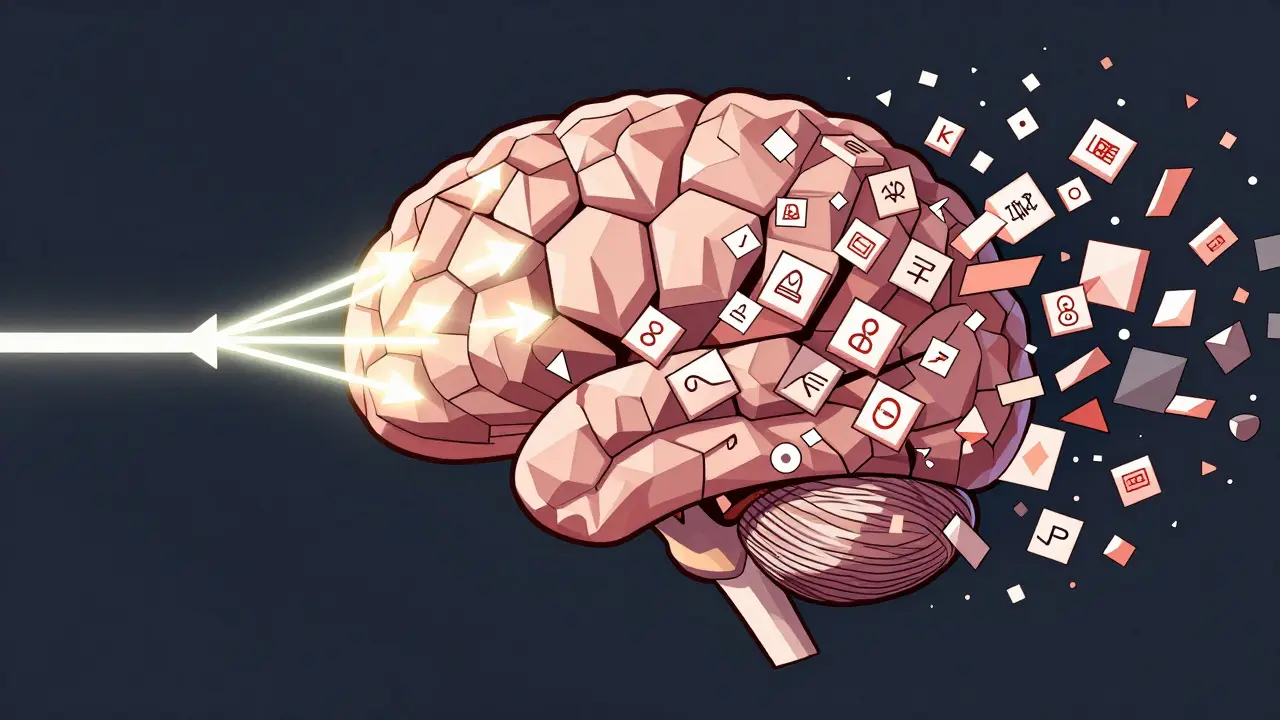
When you ask a large language model a question, it doesn’t just read your prompt and spit out an answer. It scans through everything you’ve given it-your question, past messages, attached documents, even code snippets-and tries to make sense of it all. That entire chunk of text is called the context. And how long that context is makes a huge difference in what the model can do… and what it gets wrong.
More Context Isn’t Always Better
It sounds logical: give the model more information, and it should give you a better answer. But that’s not what happens. Real-world testing shows that after a certain point, adding more context actually makes performance worse. This isn’t a bug-it’s a fundamental limit built into how these models work.Take GPT-4-Turbo and Claude-3-Sonnet. Both claim to handle up to 128,000 tokens. But in practice, their performance starts to drop after 16,000 tokens. Mixtral-Instruct peaks at 4,000. DBRX-Instruct hits its sweet spot at 8,000. Even when you feed them perfect, relevant information, they start to stumble. Why? Because the model doesn’t just process context-it tries to reason over it. And reasoning over 10,000 tokens is fundamentally harder than reasoning over 2,000.
The "Lost in the Middle" Problem
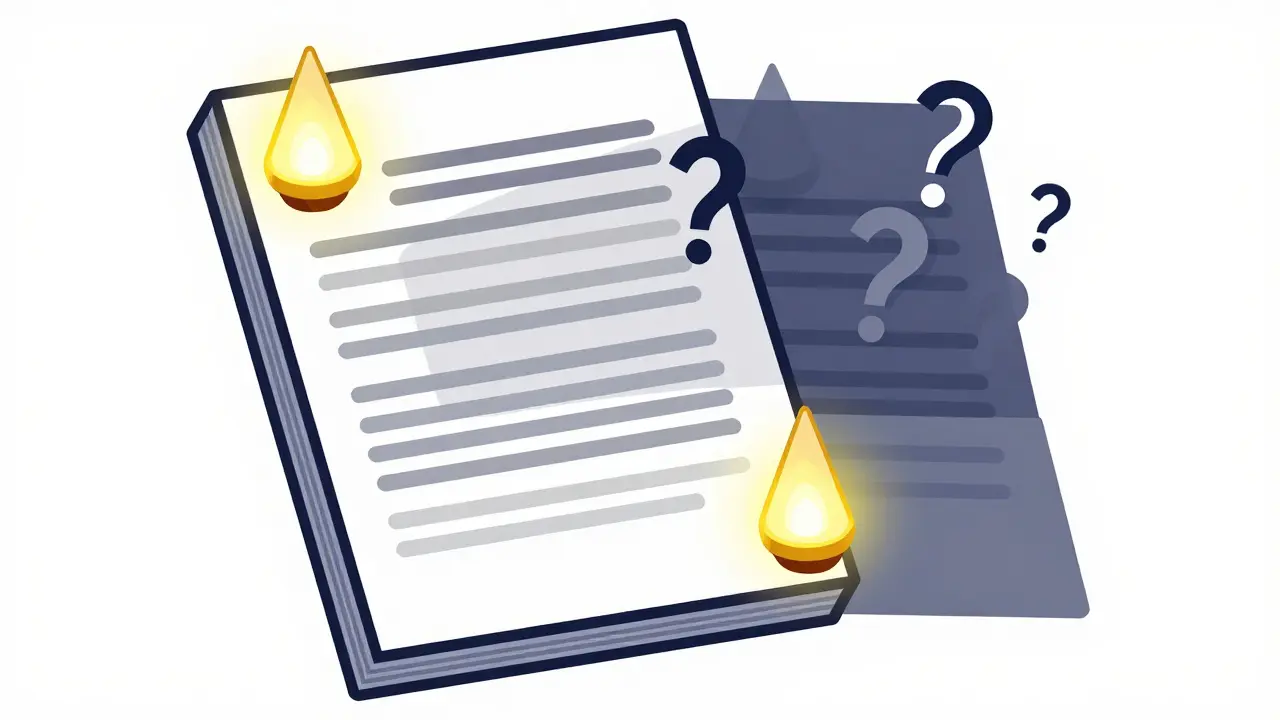
Imagine you’re reading a 50-page report. You remember the first few paragraphs clearly. The last few, too. But what about pages 20 to 30? You might recall something happened there… but not exactly what. That’s exactly what happens inside LLMs. Researchers found that information buried in the middle of long inputs gets ignored or misremembered. This is called the "Lost in the Middle" phenomenon.Experiments with models like GPT-3.5-Turbo and Claude-1.3 showed that when key facts were placed in the middle of a 16,000-token input, accuracy dropped by 30% compared to when the same facts were placed at the start or end. The model wasn’t confused by irrelevant data-it just couldn’t find what it needed. The longer the context, the harder it is to locate the right piece.
Attention Dilution: The Hidden Cost of Length
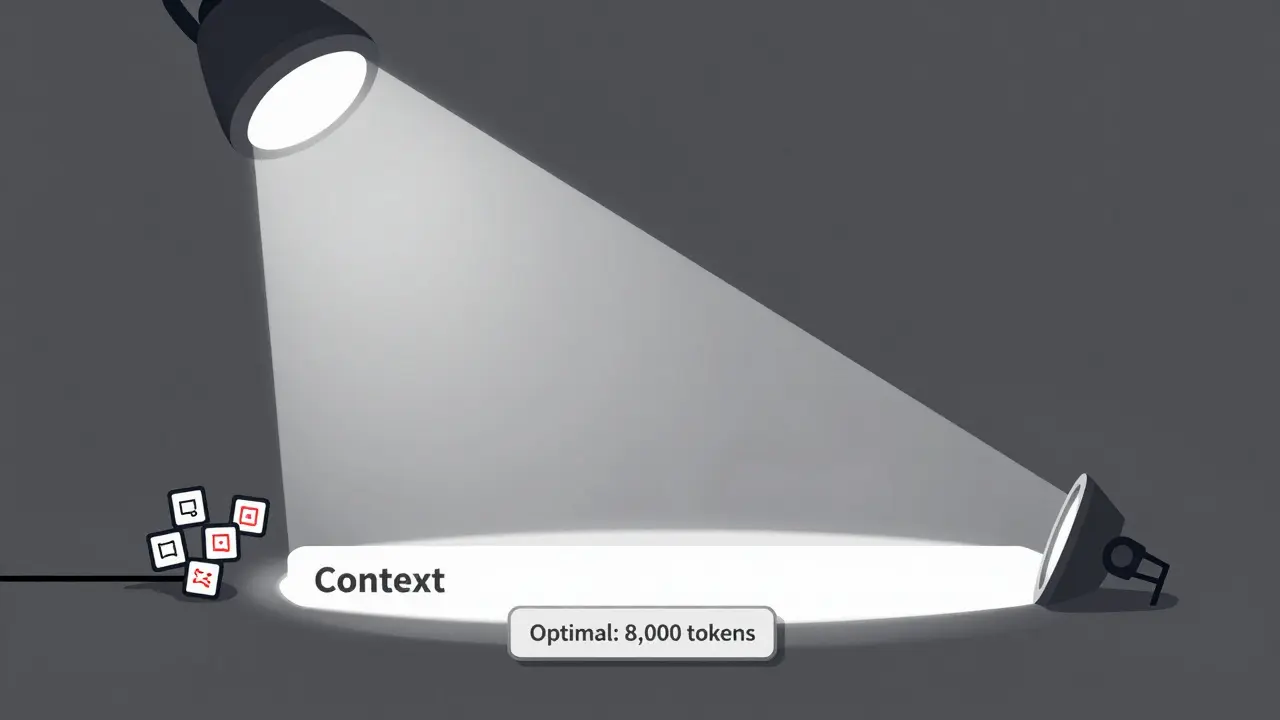
Modern LLMs rely on attention mechanisms to decide which parts of the input matter most. Think of attention like a spotlight. In short contexts, the spotlight stays focused. But when you flood the room with text, the light spreads thinner. That’s attention dilution.Studies show that as context length increases, the model’s ability to link distant parts of the input weakens. A fact at the beginning of a 100,000-token passage has almost no influence on the final answer. This isn’t about memory-it’s about how the model weighs relevance. The more you add, the less weight each piece gets. And when critical details lose weight, the output gets sloppy.
Effective Context Length vs. Claimed Context Length
Manufacturers often advertise maximum context lengths like "10 million tokens!" But what matters isn’t what the model can hold-it’s what it can actually use. That’s called effective context length.Research from the RULER paper tested models across retrieval, tracking, and question-answering tasks. They found that even models claiming 32,000-token capacity had an effective context length of just 8,000 to 12,000. Beyond that, performance flatlined or dropped. This means if you’re using a tool that says "supports 64k," but your task needs precision, you’re probably wasting tokens.
For example, if you’re summarizing a legal contract, feeding it 50 pages might seem helpful. But if the key clause is buried on page 32, and the model can’t reliably pull it out, you’re better off extracting just the relevant sections first.
Training Data Matters More Than You Think
Context length isn’t just about architecture-it’s tied to how the model was trained. Studies using GPT-2 on OpenWebText showed that models trained on small datasets actually perform worse with longer contexts. Why? Because they never learned how to filter noise. They don’t know what to ignore.Models trained on massive, diverse datasets handle long context better-but only up to a point. There’s a sweet spot where more data helps, but only if the context is clean and relevant. If you train a model on 100GB of text but give it 10,000 tokens of messy, unstructured data, it’ll still fail. The model needs to be trained on long-context patterns to use them well.
Task Type Changes Everything
Not all tasks benefit from more context. For simple retrieval-like finding a date or name-longer context helps. But for reasoning, coding, or multi-step logic? It often hurts.One experiment gave models a coding problem with 100 lines of related code. When the context was 2,000 tokens, accuracy was 82%. At 16,000 tokens, it dropped to 54%. Why? The model started hallucinating solutions based on irrelevant code snippets. The extra context didn’t help-it distracted.
Even time-series forecasting, where you’d expect longer history to help, showed degradation. Too much past data introduced noise that confused the model’s pattern recognition. Context length isn’t a one-size-fits-all setting. It depends on what you’re asking the model to do.
How to Actually Use Context Well
If longer context doesn’t mean better results, what should you do? Here’s what works:- Trim ruthlessly. Only include what’s necessary. Remove filler, repetition, and redundant background.
- Structure your input. Place critical information at the start and end. Avoid burying key facts in the middle.
- Use RAG wisely. Don’t dump 20 documents into context. Extract the top 2-3 most relevant snippets first.
- Test with real data. Don’t trust benchmarks. Run your own tests with your actual prompts and measure accuracy.
- Know your model’s sweet spot. If you’re using Claude-3-Sonnet, test performance between 4k and 16k. You might find 8k gives you the best balance of accuracy and speed.
One company using LLMs for customer support noticed their response quality dropped after adding more chat history. They switched from including the last 50 messages to just the last 5-and accuracy jumped 40%. The model wasn’t overwhelmed anymore.
What’s Next?
The industry is shifting from chasing longer context to building smarter context handling. New research is exploring ways to improve attention efficiency, reweight information dynamically, and even let models ask for clarification instead of guessing.For now, the rule is simple: context length is not a feature-it’s a constraint. The best models aren’t the ones that see the most. They’re the ones that understand the right parts.
Does increasing context length always improve LLM output quality?
No. While increasing context length can help up to a point, performance often degrades beyond a model’s effective context length. Studies show that models like GPT-4-Turbo and Claude-3-Sonnet peak around 16k tokens, while others like Mixtral-Instruct saturate at just 4k. Beyond that, accuracy drops due to attention dilution and the "Lost in the Middle" effect, even when all information is relevant.
What is the "Lost in the Middle" phenomenon?
"Lost in the Middle" refers to the tendency of large language models to ignore or misinterpret information placed in the center of long input contexts. Experiments with models like GPT-3.5-Turbo and Claude-1.3 show that when key facts are positioned in the middle of a 16,000-token input, accuracy can drop by 30% compared to when those same facts are placed at the beginning or end. The model struggles to prioritize information in longer sequences, regardless of relevance.
Why does longer context hurt reasoning tasks?
Longer context introduces noise and forces the model to process more irrelevant or redundant information. In reasoning tasks like coding or logic puzzles, this leads to attention dilution-where the model’s focus becomes spread too thin. Instead of finding the critical clue, it starts generating plausible but incorrect answers based on unrelated parts of the input. This is why adding more documents to a RAG system often reduces, not improves, accuracy.
How do I find the optimal context length for my use case?
Start by testing your actual prompts with varying context lengths. For example, if you’re summarizing reports, try 2k, 4k, 8k, and 16k tokens. Measure accuracy, hallucination rates, and response time. Most models show clear performance cliffs-like GPT-4-Turbo dropping after 16k. The optimal length is usually lower than the advertised maximum. Always validate with real data, not benchmarks.
Can training data affect how well a model handles long context?
Yes. Models trained on small datasets often perform worse with longer contexts because they never learned to filter noise. Research on GPT-2 showed that training on tiny datasets with long inputs led to performance worse than random guessing. Models trained on large, diverse datasets handle long context better-but only if the input is clean and well-structured. Training data quality directly shapes how effectively a model uses context.
- Mar, 21 2026
- Collin Pace
- 7
- Permalink
Written by Collin Pace
View all posts by: Collin Pace