How to Use Large Language Models for Marketing, Ads, and SEO
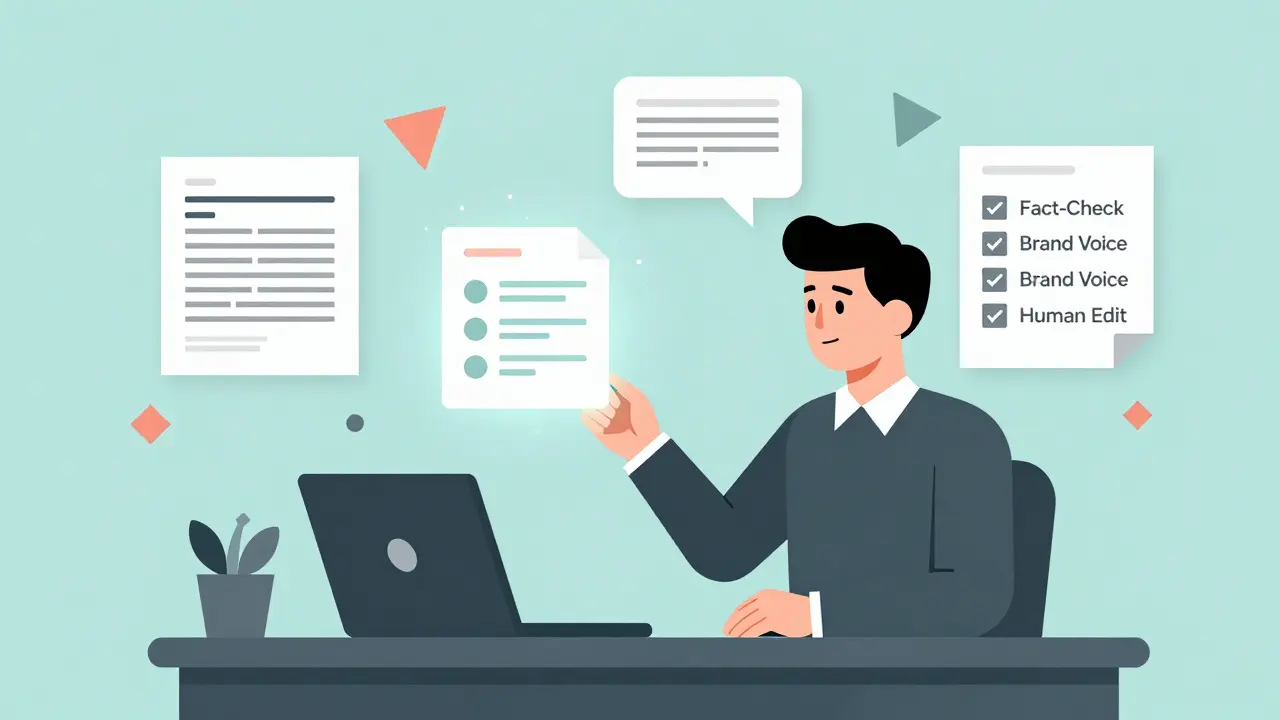
Most marketers today aren’t writing every blog post, ad, or product description from scratch. They’re using large language models to do the heavy lifting. And it’s not just a trend-it’s changing how campaigns are built, tested, and scaled. But using LLMs well isn’t about typing a prompt and hitting enter. It’s about understanding where they shine, where they fail, and how to make them work with your team-not replace it.
What Large Language Models Actually Do
Large language models (LLMs) like GPT-4, Claude, and Gemini aren’t magic. They don’t know what’s happening right now. They don’t browse the web. They’ve been trained on massive amounts of text-books, articles, forums, product pages-and learned how to predict the next word in a sentence. That’s it. But when you give them a clear task, they can generate hundreds of variations of ad copy, blog outlines, meta descriptions, or email subject lines in seconds.
They’re fast. Like, 5 to 10 times faster than a human writer. And they’re consistent. Once you train them on your brand voice-whether it’s playful, formal, or technical-they can replicate it across dozens of pieces. That’s why 76% of marketers are already using them for basic content creation, according to Salesforce’s 2024 State of Marketing Report.
But here’s the catch: they make things up. Not on purpose. They just don’t know the difference between fact and fiction if it wasn’t in their training data. If your product launched in March 2025 and their training data ended in 2024, they’ll invent features or specs that don’t exist. That’s called a hallucination. And it can hurt your credibility-or your conversion rates.
How LLMs Are Changing Marketing Content
Think about how much time you spend writing the same thing over and over. Product descriptions for 50 SKUs? Social media posts for 7 platforms? Email sequences for abandoned carts? LLMs turn hours of grunt work into minutes.
One e-commerce brand reduced their product description creation time from 3 hours per item to under 15 minutes. They used a template prompt that included the product’s key specs, tone guidelines, and SEO keywords. The LLM generated 10 versions. The team picked the best one and made two tweaks. Done.
For SEO, LLMs help with keyword clustering. Instead of targeting one keyword per page, they can generate content around topic clusters-like “best running shoes for flat feet” and “how to choose arch support for runners”-all in one piece. That boosts topical authority, which Google rewards.
And for ads? Generic headlines like “Buy Now!” or “Limited Time Offer!” are dead. LLMs can generate hundreds of variations based on customer segments: “For runners who hate blisters” or “For busy moms who need shoes that last.” A June 2025 study on the MarketingFM framework showed these personalized ad copies increased click-through rates by 22%.
The Real Limitations (And How to Fix Them)
LLMs aren’t creative geniuses. They’re pattern recyclers. They can write a compelling blog intro, but they can’t make you feel something deep-unless you guide them. A study by ZeroGravityMarketing found that AI-generated content for emotional campaigns (like charity appeals or personal stories) scored 35% lower in engagement than human-written versions.
Brand voice inconsistency is another big issue. One company used an LLM to write both their Instagram captions and their investor pitch deck. The tone was wildly different. Why? Because they didn’t give the model a clear voice guide. Now they use a 200-word “brand voice brief” every time they prompt the model: “Use short sentences. Avoid jargon. Sound like a friend who knows the product inside out.”
Fact-checking is non-negotiable. If you’re writing about a product’s warranty, ingredients, or certifications, verify every claim. Don’t trust the LLM. Even GPT-4, the most reliable model for marketing, gets details wrong about new products or regulations. The EU AI Act, which took effect in March 2025, now requires companies to disclose when content is AI-generated in commercial ads. That means mistakes aren’t just embarrassing-they’re legal risks.
How to Use LLMs for SEO Without Getting Penalized
Google doesn’t care if content is written by AI. It cares if it’s helpful. That’s the rule. So if your LLM-generated blog post answers questions better than the top 3 results, it’ll rank. But if it’s shallow, repetitive, or full of fluff, it’ll disappear.
Here’s how to make SEO content that works:
- Start with a real user question. Use tools like AnswerThePublic or Google’s “People also ask” to find what people are searching for.
- Feed that question into the LLM with clear instructions: “Write a 1,200-word guide for beginners. Use simple language. Include real examples. Cite sources where possible.”
- Don’t let the LLM write the whole thing. Write the intro and conclusion yourself. Those are where trust is built.
- Use the LLM to expand sections, rewrite awkward sentences, or suggest subheadings. Then edit for depth.
- Add original data: survey results, personal experience, or expert quotes. That’s what makes content stand out.
One SEO agency used this method to rank #1 for “how to fix slow WordPress site” after 6 months. Their content was 80% AI-generated-but the intro was written by their lead developer, and they included a real speed test from their own site. That human touch made all the difference.
Best Practices for AI Ads
Ads need to stand out in a noisy feed. LLMs help you test more variations faster. But the best ads still come from understanding people-not algorithms.
Try this workflow:
- Give the LLM your product’s key benefit: “Our protein bar has 20g of plant-based protein and no added sugar.”
- Ask for 10 ad variations targeting different audiences: busy moms, gym newbies, keto dieters.
- Use A/B testing tools to run them on Meta or Google Ads. Track clicks, conversions, and cost per acquisition.
- Take the top 3 performers and tweak them manually. Add urgency. Add emotion. Add a real testimonial snippet.
That’s what the MarketingFM framework does-it pulls live product data from your e-commerce platform and injects it into the ad copy. So if your product is out of stock, the LLM won’t write “Buy now!” It’ll say “Back in stock-only 12 left.” That’s relevance. That’s what converts.
Where Human Marketers Still Win
LLMs can write a great headline. But they can’t sense when your audience is tired of the same message. They can’t read the tone of a Reddit thread and adjust your brand voice accordingly. They can’t feel the frustration of a customer who’s been burned by false promises.
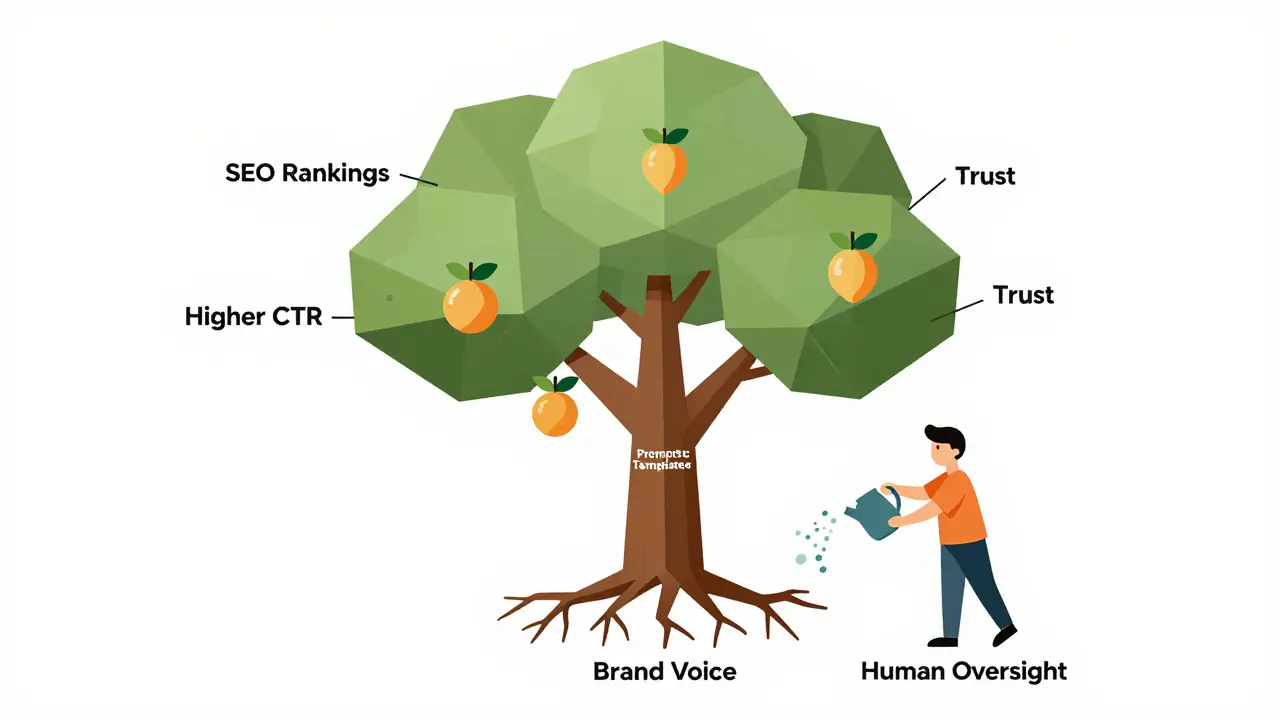
That’s why the best teams aren’t replacing writers-they’re redefining roles. Marketers are now prompt engineers, editors, and strategists. They’re the ones who decide: What story are we telling? Who are we talking to? What do we want them to feel?
One CMO at a SaaS company stopped assigning content to junior writers. Instead, she trained them to be AI supervisors. Their job: review every piece, fix tone issues, add real examples, and flag hallucinations. Their output quality jumped 60% in 3 months.
Getting Started Without Overwhelm
You don’t need a team of engineers or a $10,000/month AI budget. Start small.
- Pick one repetitive task: meta descriptions, email subject lines, or social captions.
- Write a simple prompt template. Example: “Rewrite this [product name] description for [audience]. Use casual tone. Include 2 keywords: [keyword1], [keyword2]. Keep it under 160 characters.”
- Run 10 versions. Pick the best one. Edit it. Publish it.
- Track performance. Did CTR go up? Did bounce rate drop?
- Repeat. After 5 rounds, you’ll have a system.
Most teams need 3 to 4 weeks to get comfortable with prompting. Don’t expect perfection on day one. Expect learning.
What’s Next
The next big shift isn’t just AI writing more content. It’s AI writing the right content for the right person at the right time. Platforms are already testing real-time personalization: your ad changes based on how long you hovered over a product, what you clicked last week, or even your weather app data.
That’s not science fiction. It’s happening in Shopify stores right now. And if you’re not thinking about how to control that, you’ll be left behind.
But here’s the truth: technology doesn’t replace strategy. It amplifies it. The best marketers aren’t the ones using the most AI. They’re the ones who know when to let it run-and when to step in.
Can LLMs replace human marketers?
No. LLMs handle execution-writing drafts, generating variants, optimizing keywords-but they can’t set strategy, understand emotion, or build brand trust. Human marketers decide what to say, why it matters, and who it’s for. The best teams use LLMs as assistants, not replacements.
Are AI-generated SEO articles penalized by Google?
No, Google doesn’t penalize content just because it’s AI-generated. What matters is quality. If the content is helpful, original, and answers the user’s question better than competitors, it will rank. But thin, repetitive, or inaccurate content-even if human-written-will get pushed down.
How do I stop LLMs from making up facts?
Use Retrieval-Augmented Generation (RAG). Connect your LLM to your company’s knowledge base-product specs, FAQs, policy docs-so it pulls accurate data before generating content. Always fact-check claims about pricing, features, or regulations. Never assume the LLM is correct.
What’s the best LLM for marketing content?
GPT-4 currently leads in consistency, tone control, and handling long-form content. Claude 3 is strong for nuanced editing and summarizing. Gemini works well if you’re already using Google Workspace. But the model matters less than your prompts. A well-crafted prompt with a basic model often outperforms a vague prompt with GPT-4.
Do I need to disclose AI-generated content?
In the EU, yes-under the AI Act, commercial content generated by AI must be clearly labeled. In the U.S., there’s no federal law yet, but transparency builds trust. If you’re running ads or product pages, it’s smart to disclose AI use. It shows you’re ethical, not trying to trick people.
How long does it take to learn LLM prompting for marketing?
Most teams see real improvement after 3 to 4 weeks of daily practice. Start with one content type-like email subject lines-and refine your prompts over 10-15 iterations. Keep a log of what works. Over time, you’ll build a library of high-performing templates.
- Sep, 5 2025
- Collin Pace
- 8
- Permalink
Written by Collin Pace
View all posts by: Collin Pace