In-Context Learning Explained: How LLMs Adapt to Prompts Without Retraining

You don’t need to rebuild a car engine to change its route. You just turn the steering wheel. For years, updating an artificial intelligence model meant something closer to rebuilding the engine-retraining it with new data, adjusting millions of parameters, and waiting days for the process to finish. Then came In-Context Learning (ICL), which changed everything.
In-Context Learning allows Large Language Models (LLMs) like GPT-4 or Llama 3 to perform new tasks instantly by simply showing them examples in the prompt. No code changes. No weight updates. No retraining. You give the model a few input-output pairs, and it figures out the pattern on the fly. It feels like magic, but under the hood, it’s a sophisticated statistical mechanism that has become the backbone of modern AI interaction.
What Is In-Context Learning?
At its core, In-Context Learning is the ability of a pre-trained language model to adapt to a specific task based solely on the information provided in the current input context, without modifying its internal parameters. Imagine you’re teaching a child how to solve a math problem. Instead of giving them a textbook chapter on algebra, you show them three solved examples and say, “Do this one.” If they get it right, they’ve learned from context.
This concept was formally introduced in May 2020 when OpenAI released GPT-3 alongside the paper Language Models are Few-Shot Learners. Before this, if you wanted an AI to classify emails as spam or not spam, you had to train it on thousands of labeled emails. With ICL, you can paste five examples of spam and non-spam emails into the prompt, ask the model to classify a sixth, and it will likely get it right. The model doesn’t “learn” in the traditional sense of updating its neural weights; instead, it conditions its next-token predictions on the patterns present in your prompt.
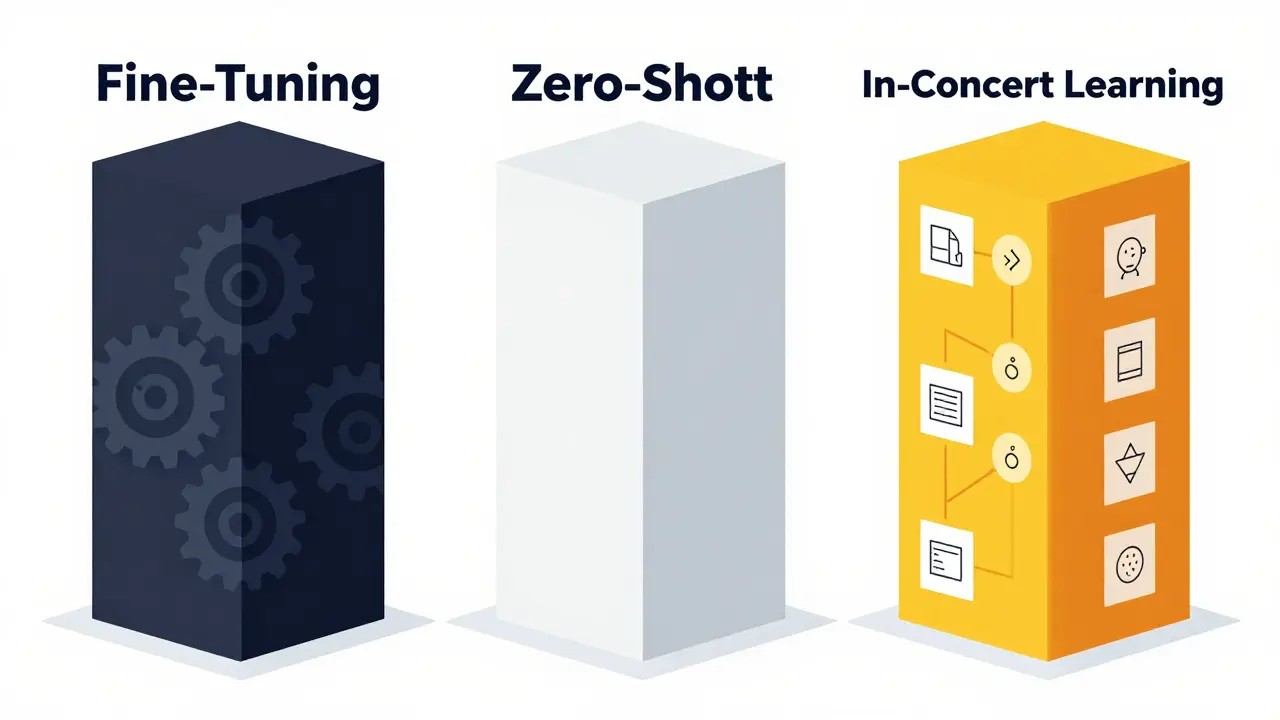
| Method | Parameter Updates? | Data Required | Speed |
|---|---|---|---|
| Traditional Fine-Tuning | Yes (Backpropagation) | Thousands of samples | Hours to Days |
| Zero-Shot Learning | No | None (Just instruction) | Instant |
| In-Context Learning (Few-Shot) | No | 1-10 Examples | Instant |
How Does It Work Under the Hood?
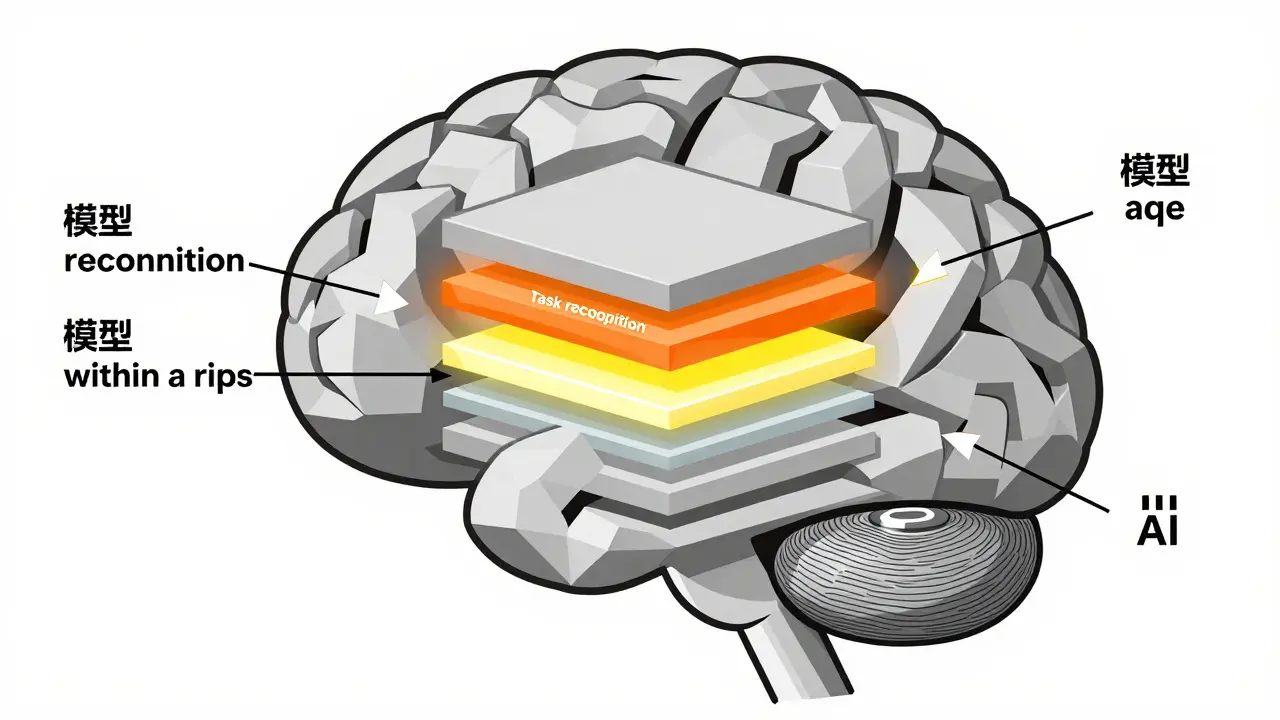
If the model isn’t changing its weights, how does it know what to do? This question has kept researchers at MIT, Stanford, and major tech companies busy for years. There are several competing theories, but the most compelling evidence points to a "model within a model" hypothesis.
Research suggests that during pre-training, LLMs learn not just facts, but also algorithms for learning itself-a concept known as meta-learning. When you provide examples in a prompt, the model uses its attention mechanisms to identify the relationship between inputs and outputs in those examples. It then applies that same logical mapping to your new query. Think of it like a calculator that remembers the last formula you used. You didn’t reprogram the calculator; you just set it to the right mode.
A breakthrough study published in 2024 analyzed layers in models like GPTNeo and Llama 3.1. They discovered a specific "task recognition" point, usually around layer 14 out of 32. Before this layer, the model is actively processing the examples in your prompt. After this layer, the task is encoded, and the model no longer needs to look back at the examples to generate the answer. This insight is huge for efficiency. By stopping attention calculations after the task is recognized, developers can save up to 45% in computational costs while maintaining accuracy.
Zero-Shot vs. One-Shot vs. Few-Shot
Not all prompting is created equal. The number of examples you provide drastically changes the outcome. Here is how performance typically scales:
- Zero-Shot: You give the model only an instruction (e.g., “Translate this to French”). Accuracy hovers around 30-40% for complex tasks because the model relies entirely on its pre-existing knowledge, which might not align with your specific format requirements.
- One-Shot: You provide one example. This boosts accuracy to 40-50% by establishing a clear input-output pattern.
- Few-Shot (2-8 examples): This is the sweet spot for In-Context Learning. Accuracy jumps to 60-80%. The model has enough data to generalize the rule but hasn’t hit the noise threshold yet.
However, more isn’t always better. Studies show that adding more than 16 examples often leads to diminishing returns or even degraded performance. Why? Because LLMs have limited context windows and attention spans. Too many examples can confuse the model, causing it to focus on irrelevant details or forget earlier instructions. For most natural language processing tasks, sticking to 3-5 high-quality examples is the golden rule.
Practical Tips for Effective In-Context Learning
Getting ICL to work reliably requires more than just pasting random examples. You need strategy. Here are proven techniques to maximize performance:
- Select Representative Examples: Don’t pick easy examples. Choose ones that cover edge cases and variations similar to your actual test data. Research shows relevant examples improve accuracy by up to 25% compared to random ones.
- Order Matters: Place difficult or ambiguous examples first. This forces the model to pay close attention to the nuances early on. In sentiment analysis tasks, leading with hard examples improved performance by 7.3%.
- Use Chain-of-Thought (CoT): For complex reasoning tasks like math or logic, don’t just show the answer. Show the steps. A famous study by Wei et al. showed that adding step-by-step reasoning to prompts increased GPT-3’s accuracy on math problems from 17.9% to 58.1%.
- Keep It Consistent: Ensure your examples follow the exact same format as your desired output. If you want JSON, show JSON. If you want bullet points, show bullets. The model mimics structure aggressively.
Limitations and Risks
In-Context Learning is powerful, but it’s not a silver bullet. It has distinct limitations that every developer should know.
Context Window Constraints: Even with modern models supporting 128K tokens or more, packing dozens of long examples consumes valuable space. If your prompt gets too long, the model may truncate important information or lose track of the initial instructions.
Prompt Sensitivity: Minor changes in wording can lead to wildly different results. Change “Classify this email” to “Categorize this message,” and you might see a drop in consistency. This lack of robustness makes ICL risky for mission-critical applications without rigorous testing.
Knowledge Boundaries: ICL cannot teach a model facts it doesn’t already possess. If you ask a model to analyze a highly specialized medical condition it wasn’t trained on, providing examples won’t help-it will likely hallucinate. ICL adapts behavior, not knowledge base.
The Future of In-Context Learning
As we move through 2026, ICL remains the dominant method for adapting AI. Gartner predicts that by 2026, 85% of enterprise AI applications will use ICL rather than fine-tuning. Why? Because it’s faster and cheaper. Companies report implementing ICL-based solutions in 2.3 days on average, compared to nearly a month for traditional fine-tuning.
Future developments are focusing on two areas: extending context windows to handle entire books or codebases as context, and improving example efficiency so that models need fewer demonstrations to grasp complex tasks. Researchers are also exploring "warmup training," where models are lightly tuned on prompt-style data before deployment, boosting ICL performance by over 12%.
In-Context Learning has democratized AI development. You no longer need a team of data scientists to train a custom classifier. You just need good examples and a clear prompt. But remember: the model is only as smart as the context you give it.
Does In-Context Learning actually update the model's weights?
No. In-Context Learning does not modify the model's underlying parameters or weights. It works by conditioning the model's prediction on the temporary context provided in the prompt. Once the inference is complete, the "learning" disappears.
How many examples should I include in my prompt?
For most tasks, 3 to 5 high-quality examples are optimal. While some complex tasks may benefit from up to 8 examples, adding more than 16 often leads to diminishing returns or confusion due to attention mechanism limits.
What is the difference between Zero-Shot and Few-Shot learning?
Zero-Shot learning provides no examples, relying solely on the model's pre-trained knowledge and instructions. Few-Shot learning provides a small number of examples (usually 1-10) within the prompt to guide the model's output format and logic.
Why does Chain-of-Thought prompting improve results?
Chain-of-Thought prompting encourages the model to break down complex problems into intermediate steps before generating the final answer. This reduces errors in logic and math tasks by allowing the model to "think" through the solution sequentially.
Is In-Context Learning suitable for production environments?
Yes, it is widely used in production, especially for tasks requiring flexibility and rapid iteration. However, it requires careful monitoring for consistency and cost management, as long prompts increase latency and API expenses.
- Jun, 10 2026
- Collin Pace
- 5
- Permalink
Written by Collin Pace
View all posts by: Collin Pace