Knowledge vs Fluency in Large Language Models: Understanding Strengths and Gaps
Have you ever chatted with an Large Language Model (LLM) like GPT-4 or Claude and been amazed by how human-like the conversation felt? The text flows naturally. It understands context. It can even write code or draft legal briefs. But here is the uncomfortable truth: that smoothness is often a mask. What looks like deep understanding is frequently just statistical mimicry. This distinction between fluency and actual knowledge is the single most important concept to grasp if you want to use AI effectively today.
We tend to anthropomorphize these tools. We assume that because an LLM passes the Bar Exam, it "knows" the law. Because it scores high on the SAT, it "understands" reading comprehension. But recent research into the architecture of models like GPT-4, ChatGPT, and PaLM2 reveals a stark divide. These systems possess immense surface-level fluency but lack the deep structural knowledge that characterizes human cognition. Understanding this gap isn't just academic; it determines whether your AI assistant will save you hours or lead you into costly errors.
The Human Advantage: Innate Bias vs. Statistical Learning
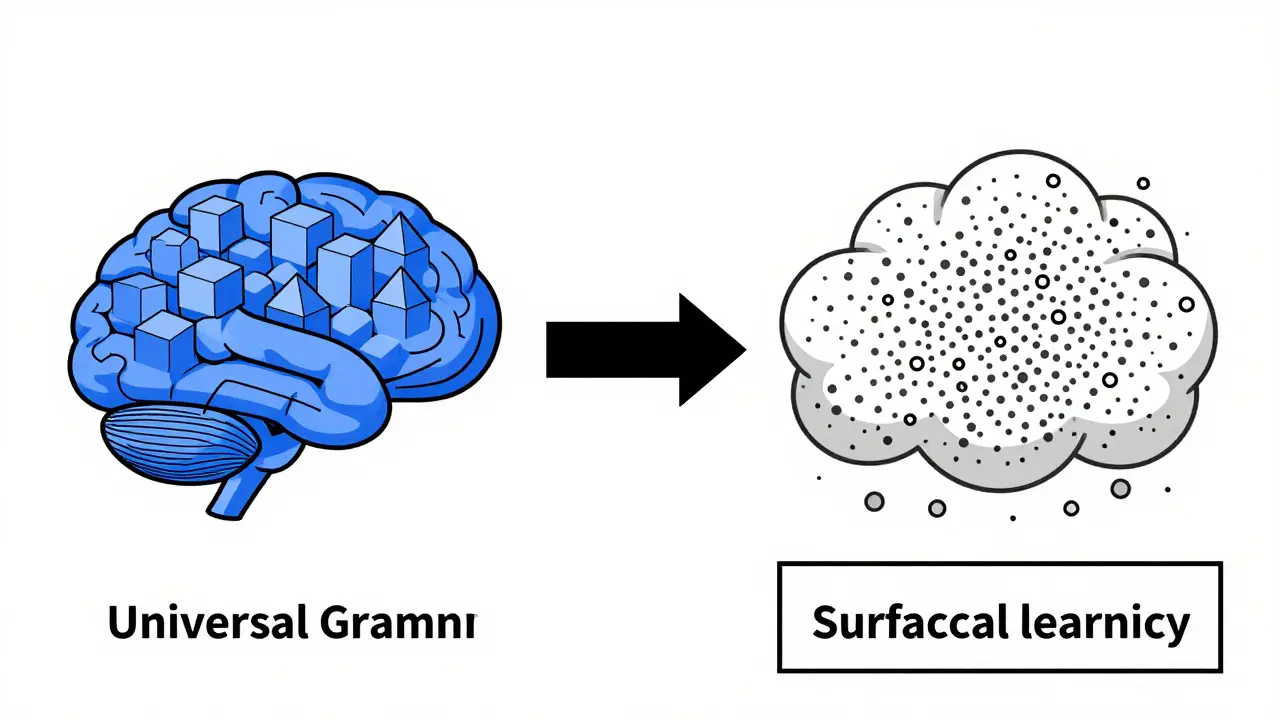
To understand why LLMs stumble where humans soar, we have to look at how we learn language compared to how they do. Humans are born with something called Universal Grammar. Think of this as an innate learning bias-a set of hardwired constraints in our brains that allow children to converge on grammatical rules incredibly fast. A child needs exposure to roughly 5 million tokens (words/pieces of words) to achieve native fluency. They don't need to see every possible sentence structure to understand how language works; their brains fill in the gaps using this internal framework.
Large Language Models learn through Statistical Learning Theory, processing petabytes of data without any innate linguistic bias. There is no "grammar instinct" in the code. Instead, there are layers, gates, and hyperparameters-artificial constraints introduced by engineers. The model predicts the next most likely token in a sequence based on probability distributions derived from its training data. This sequential approach works beautifully for common phrases and simple sentences. However, when faced with intricate, infrequent, or novel grammatical structures, the flat, statistical nature of the model breaks down. It lacks the hierarchical knowledge that allows a human to instantly recognize a complex nested clause as valid or invalid.
Decoding the Test Scores: Fluency Without Mastery
If LLMs lack deep knowledge, why do they score so well on standardized tests? Let's look at the numbers. When OpenAI released GPT-4 in March 2023, it achieved a performance level surpassing 93% of human test-takers on the SAT Reading and Writing section. That is impressive fluency. On the Uniform Bar Exam, GPT-4 jumped from a 10th percentile rank (seen in earlier versions like GPT-3.5) to a 90th percentile rank. In medical assessments, ChatGPT-4 scored an average of 68 on funduscopic examination questions, outperforming general ophthalmologists who averaged 61.
But here is the catch: these scores demonstrate the ability to produce correct answers, not necessarily the mastery of the underlying concepts. Consider the difference between memorizing the answer key to a math test and actually understanding calculus. LLMs excel at pattern matching. If the question appears in their training data-or closely resembles it-they can retrieve the statistically probable answer. However, this does not equate to the robust, flexible understanding that expert specialists possess. For instance, while GPT-4 beat general doctors in those eye exams, it still fell short of funduscopic disease specialists who averaged 73. The gap widens as the domain requires deeper, non-statistical reasoning.
The Confidence Trap: Stability vs. Accuracy
One of the most dangerous aspects of LLM fluency is the illusion of confidence. You might ask the same question three times and get three different answers. Research into the reliability profiles of various models shows significant variance in how stable their "knowledge" is across multiple trials.
| Model | Correct Confidence Rate | Incorrect/Error Rate | Stability (Correlation) |
|---|---|---|---|
| ChatGPT-4 | 59% | 28% | High (>0.8 SD) |
| PaLM2 | 44% | 38% | High (>0.8 SD) |
| SenseNova | 29% | 26% | Moderate |
| ChatGPT-3.5 | 23% | 26% | Low |
| Claude 2 | 21% | 32% | Low |
Look closely at ChatGPT-4. While it has a high stability correlation (meaning it gives consistent answers), it still provides incorrect responses in 28% of cases where it seems confident. PaLM2 shows a similar trend: it either knows the answer with high confidence or it is confused. This variation suggests that what we perceive as fluency is often just surface-level pattern matching. The model doesn't "know" it's wrong; it just calculates the next word based on incomplete signals. This inconsistency is why human oversight remains non-negotiable in high-stakes environments.
Where LLMs Shine: The Power of Working Memory
Despite these gaps, dismissing LLMs would be a mistake. Their strengths are real and valuable, particularly in domains where deep structural knowledge is less critical than vast working memory and contextual awareness. Humans have limited cognitive bandwidth. We cannot perfectly recall thousands of words read minutes ago. An LLM like GPT-3.5, with a context window of 2,000 tokens (and larger windows in newer iterations), can hold entire documents in mind simultaneously.
This makes them exceptional at tasks like:
- Content Summarization: Extracting key points from lengthy reports without losing nuance.
- Terminology Extraction: Identifying specific jargon or entities within unstructured text.
- Style Transfer: Altering the voice of a document, such as converting informal notes into professional emails or neutralizing gendered language.
- Sentiment Analysis: Gauging the emotional tone of customer feedback at scale.
Furthermore, techniques like Instruction Tuning and Reinforcement Learning from Human Feedback (RLHF) have aligned these models closer to human preferences. Tools like CodeX, built upon GPT-3, demonstrate that state-of-the-art LLMs can understand formal languages like programming code as well as humans. In these structured, rule-based environments, the "fluency" translates directly into utility because the patterns are consistent and well-documented.
The Critical Gaps: When Syntax Fails
The cracks appear when you move away from common patterns into linguistically complex territory. LLMs make grammaticality judgments based on probability, not syntax knowledge. If you present them with a novel, intricate sentence structure-one that hasn't appeared frequently in their training data-their "flat grammar" approach fails. They might generate text that sounds plausible but is structurally unsound.
For example, try asking an LLM to rewrite a complex legal argument using a rare rhetorical device while maintaining strict logical consistency. It might produce eloquent prose, but the logical underpinning could be flawed. It lacks the hierarchical understanding to evaluate whether the new construction follows proper rules. This is why linguistic experts remain crucial for prompt design and validation. The AI provides the draft; the human provides the truth.
Future Outlook: Scaling vs. Structural Priors
Can we fix this? Current research suggests two paths. First, scaling. As models grow beyond certain parameter thresholds, they exhibit emergent capabilities, including better context learning. GPT-4’s leap over GPT-3.5 suggests that size matters. However, scaling alone may not bridge the gap entirely.
The second path involves architectural innovation. To achieve human-level linguistic competence on datasets as small as those humans learn from, future models may need to be enriched with non-trivial structural priors-essentially, coding in a version of Universal Grammar. Until then, we must accept the current reality: LLMs are fluent mimics, not knowledgeable thinkers. They are powerful tools for augmentation, but they require human guidance to navigate the nuances of true understanding.
What is the main difference between LLM fluency and human knowledge?
LLM fluency is based on statistical prediction of the next token in a sequence, learned from vast amounts of data without innate biases. Human knowledge relies on Universal Grammar, an innate structural bias that allows for deep, hierarchical understanding of language with far less data exposure.
Why do LLMs score high on tests like the Bar Exam if they lack deep knowledge?
They excel at pattern matching and retrieving statistically probable answers from their training data. High scores indicate the ability to produce correct outputs (fluency) rather than a robust, flexible understanding of the underlying legal principles (mastery).
Are LLMs reliable for complex grammatical tasks?
No. LLMs struggle with intricate and infrequent grammatical structures because they use a "flat" statistical approach rather than hierarchical syntactic knowledge. They may generate plausible-sounding text that is structurally incorrect.
What are the strongest use cases for current LLMs?
LLMs excel at tasks requiring large context windows and working memory, such as summarization, terminology extraction, style transfer, sentiment analysis, and understanding formal languages like code.
How does the confidence of different LLM models compare?
Models like ChatGPT-4 and PaLM2 show higher stability and confidence correlations, but still have significant error rates (e.g., 28% for GPT-4). Older or smaller models like Claude 2 and ChatGPT-3.5 show lower confidence and higher inconsistency in their answers.
- Jun, 19 2026
- Collin Pace
- 0
- Permalink
Written by Collin Pace
View all posts by: Collin Pace