Long-Context Transformers for Large Language Models: How to Extend Windows Without Losing Accuracy
Most large language models still struggle with long documents. You paste in a 50-page contract, a 100-page research paper, or a multi-hour meeting transcript - and the model starts missing key details, contradicting itself, or just giving vague answers. This isn’t a bug. It’s called drift. And it’s the biggest bottleneck holding back real-world use of LLMs.
Why Context Windows Matter More Than You Think
Early models like GPT-2 could only handle 1,024 tokens. That’s about 750 words - less than a single page of double-spaced text. By 2023, models like Llama-2 pushed that to 4,096 tokens. Still not enough for legal briefs, medical records, or full codebases. The problem isn’t just memory. It’s attention. Transformers work by comparing every token to every other token. That’s the attention mechanism. For a 1,000-token context, that’s 1 million comparisons. For 32,000 tokens? Over a billion. And that’s why most models collapse under their own weight. The math doesn’t scale. It grows quadratically. Double the context, and you need four times the compute. Triple it? Nine times. That’s why even powerful GPUs choke.What Is Drift - And Why It’s Worse Than Slowdown
Drift isn’t just about speed. It’s about accuracy. When you feed a model a 128,000-token document, it doesn’t suddenly become smarter. It gets distracted. Studies from Stanford’s Center for Research on Foundation Models show factual accuracy drops by up to 47% when context exceeds 32,000 tokens using standard attention. Why? Because the model can’t tell what matters anymore. Important details get buried under noise. The attention weights spread too thin. Think of it like trying to remember every word from a 10-hour podcast while answering a question about the third minute. Your brain starts mixing up phrases, filling gaps with guesses, losing track of the thread. That’s what happens inside the model. The more tokens you add, the more it hallucinates.How Gemini 1.5 and Yi-34B-200K Break the Mold
Google’s Gemini 1.5, released in early 2024, changed the game. It handles up to 1 million tokens - that’s 750,000 words - without collapsing. How? Not by throwing more GPUs at it. By redesigning attention. Gemini uses a Mixture of Experts approach. Instead of processing every token the same way, it routes parts of the context to specialized sub-models. Think of it like assigning different lawyers to different sections of a contract. One handles definitions, another handles penalties, another cross-references clauses. This cuts computational load dramatically. Open-source models like Yi-34B-200K take a different route. They use something called attention sinks. The first 5% of tokens - usually the introduction or key definitions - are kept fully attended. Everything after that uses a sliding window, only looking back 4,000-8,000 tokens. It’s not perfect, but it’s fast, cheap, and works surprisingly well. Users on Reddit report successfully analyzing 200-page legal documents with it on a single 48GB GPU.FlashAttention-2 and the 83% Efficiency Gain
You don’t need a Google-scale TPU to get long-context benefits. FlashAttention-2, developed by Stanford and UC Berkeley, is an open-source algorithm that reorders attention computations to minimize memory swaps. It doesn’t change the model - it just makes the math faster. Standard attention on a 100,000-token context needs 10 billion floating-point operations. FlashAttention-2 cuts that to 1.2 billion. That’s an 83% reduction. The result? You can run a 32,000-token context on a consumer-grade 24GB GPU. Without it, you’d need a 48GB A100 or worse. Developers using FlashAttention-2 in Llama-3 report 3x faster inference and 15-20% higher coherence on long-form summarization tasks. It’s not magic - but it’s the closest thing we have to a practical upgrade path for existing models.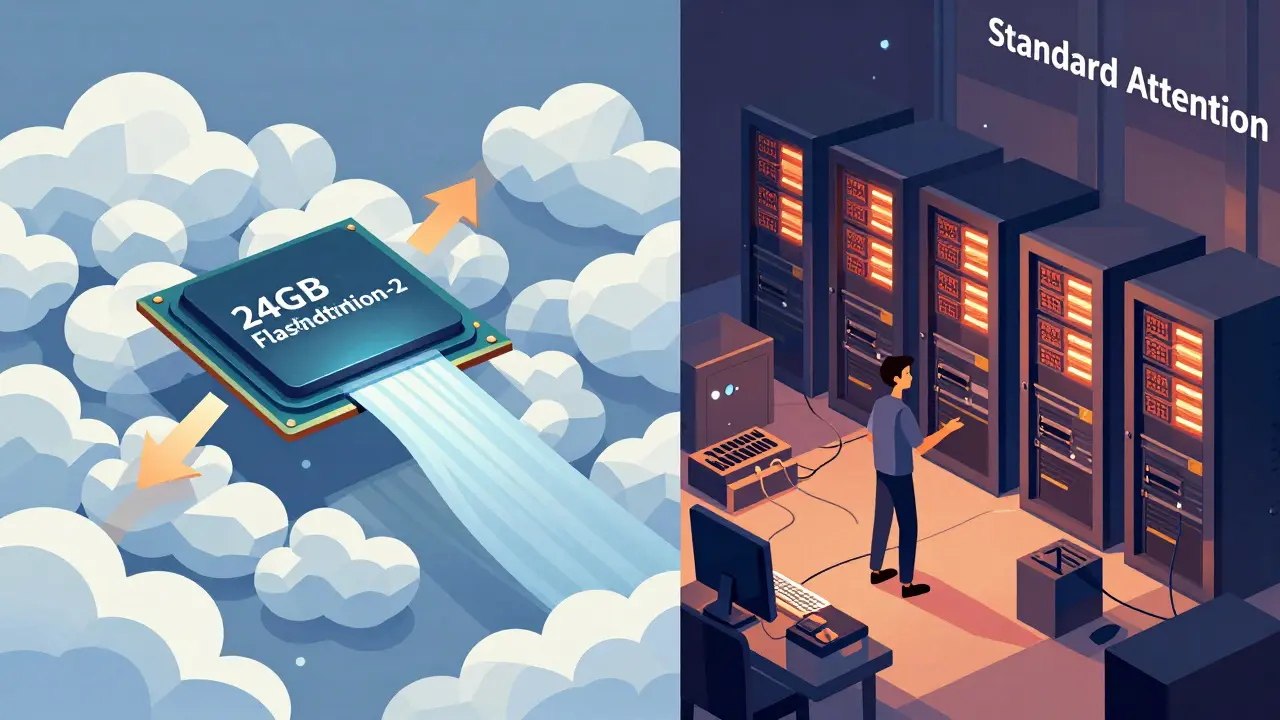
Retrieval-Augmented Generation (RAG) Isn’t the Alternative - It’s the Partner
A lot of people think RAG replaces long-context models. It doesn’t. It complements them. RAG works by pulling in only the most relevant snippets from a large document database before feeding them to the model. It’s like giving the model a highlighter instead of the whole book. This reduces context load and cuts hallucinations. But RAG has its own flaws. If the retrieval system misses the right passage - and it often does - the model has nothing to work with. Studies show RAG systems fail on 22% of complex queries because of bad retrieval. The best systems combine both. Use RAG to narrow down the key 5-10 pages from a 100-page report. Then feed those 5,000 tokens into a long-context model like Yi-34B-200K for deep reasoning. That’s what top enterprise teams are doing now. It’s not either/or. It’s both.Real-World Use Cases That Actually Work
Not every use case needs a million tokens. Most don’t. But some do - and they’re changing industries. In legal tech, firms are using 64k-128k context models to analyze entire case files in one pass. No more stitching together snippets. One firm in Chicago cut contract review time from 14 hours to 45 minutes. Healthcare is another winner. A hospital in Minnesota now uses LLMs with extended context to summarize patient histories from decades of notes, lab reports, and doctor’s handwriting scans. Before, they had to manually tag each record. Now, the model finds patterns across 50+ years of data. Even software teams are benefiting. Engineers at a fintech startup use 32k context windows to scan entire codebases for security vulnerabilities. Instead of checking files one by one, they feed the whole repo. The model spots inconsistencies between modules that no linter could catch.Where Long-Context Models Still Fail
Don’t be fooled by the hype. Longer isn’t always better. Stanford’s Foundation Model Transparency Index found hallucination rates jumped 18% between 8,000 and 128,000 tokens when processing technical documentation. Why? Because irrelevant context introduces noise. The model starts overfitting to tangential details. And latency? It’s brutal. A 32,000-token context takes 3.8 times longer to process than an 8,000-token one - even with optimizations. That’s fine for batch processing. Not for chatbots or real-time tools. Then there’s cost. Gemini 1.5’s API charges $0.75 per 100k tokens. That’s five times more than standard context. For a company processing 10 million tokens a month, that’s $75,000 extra. Most can’t justify it.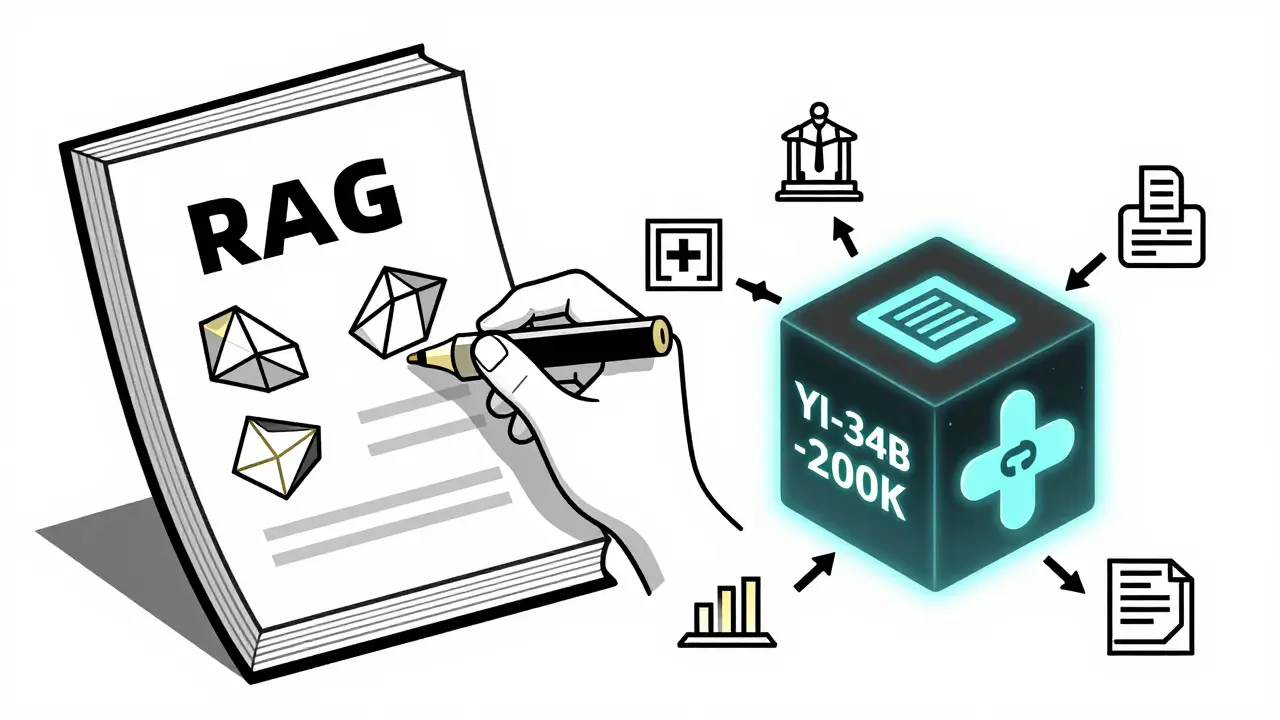
What You Should Actually Do - Right Now
You don’t need to train your own transformer. You don’t need a million-token window. Here’s what works:- If you’re working with documents under 8,000 tokens: Use Llama-3 or Mistral with FlashAttention-2. It’s fast, cheap, and accurate.
- If you’re handling 8,000-64,000 tokens: Try Yi-34B-200K or Claude 3. They’re open or affordable, and they handle legal, medical, and code contexts well.
- If you’re processing 100k+ tokens: Use RAG to cut the context down first, then feed the top 10% to a long-context model. Don’t go full brute force.
- If you’re on a budget: Quantize your model to 4-bit. It cuts VRAM use by 58% and still performs well for most tasks.
The Future Isn’t Bigger Windows - It’s Smarter Attention
The next breakthrough won’t be a 5-million-token model. It’ll be attention that scales linearly, not quadratically. Researchers are already testing sparse attention patterns that only look at key tokens - like how humans skim a document for headings, names, and dates. Meta’s upcoming Llama-3.1 will support native 128k context with optimized attention. Google’s Gemini 1.5 Pro now maintains 95% accuracy up to 1 million tokens. But the real winner? The hybrid approach: smart retrieval + moderate context + efficient attention. By 2026, Gartner predicts 80% of enterprise LLM systems will use context-aware chunking - not maximum context. That’s the practical truth. You don’t need to see everything. You just need to see the right parts.Frequently Asked Questions
What is the difference between long-context transformers and standard transformers?
Standard transformers process every token in relation to every other token, which causes computational load to grow quadratically (O(n²)). Long-context transformers use optimizations like sparse attention, attention sinks, or Mixture of Experts to reduce this load, allowing them to handle tens or hundreds of thousands of tokens without collapsing. They don’t just add more memory - they change how attention works.
Can I run a long-context model on my home PC?
Yes - but only if you’re smart about it. Models like Yi-34B-200K can run on a 24GB GPU for 32k-64k contexts using FlashAttention-2 and 4-bit quantization. For 128k+ contexts, you’ll need at least 48GB VRAM. Consumer GPUs like the RTX 4090 can handle it, but expect slower response times and high power use.
Does more context always mean better answers?
No. Beyond 32,000-64,000 tokens, most models show diminishing returns. In fact, accuracy can drop because irrelevant information causes distraction. The goal isn’t to feed the model everything - it’s to feed it the right things. That’s why RAG and context-aware chunking are becoming standard.
What’s the best long-context model for legal documents?
For open-source: Yi-34B-200K works well on 200k contexts and handles dense legal language effectively. For cloud APIs: Gemini 1.5 Pro and Claude 3 Opus both score highly on legal benchmark tests. But the real advantage comes from combining RAG to extract key clauses first, then using the long-context model to analyze relationships between them.
Why do some models drift even with optimized attention?
Drift happens when attention weights become too diluted across too many tokens. Even with efficient attention, if the model isn’t trained specifically on long-form reasoning - like comparing clauses across 100 pages - it still struggles to maintain focus. Fine-tuning on long documents and using techniques like attention sinks help, but they’re not foolproof.
Is FlashAttention-2 easy to use?
It’s not plug-and-play, but it’s accessible. If you’re using Hugging Face’s Transformers library, you can enable it with one line of code: `use_flash_attention=True`. You’ll need PyTorch 2.3+ and a CUDA-compatible GPU. No custom CUDA code required. Most developers can implement it in a day.
- Jan, 9 2026
- Collin Pace
- 5
- Permalink
Written by Collin Pace
View all posts by: Collin Pace