Shadow Prompting and Data Exfiltration Risks in LLM Workflows: A 2026 Security Guide
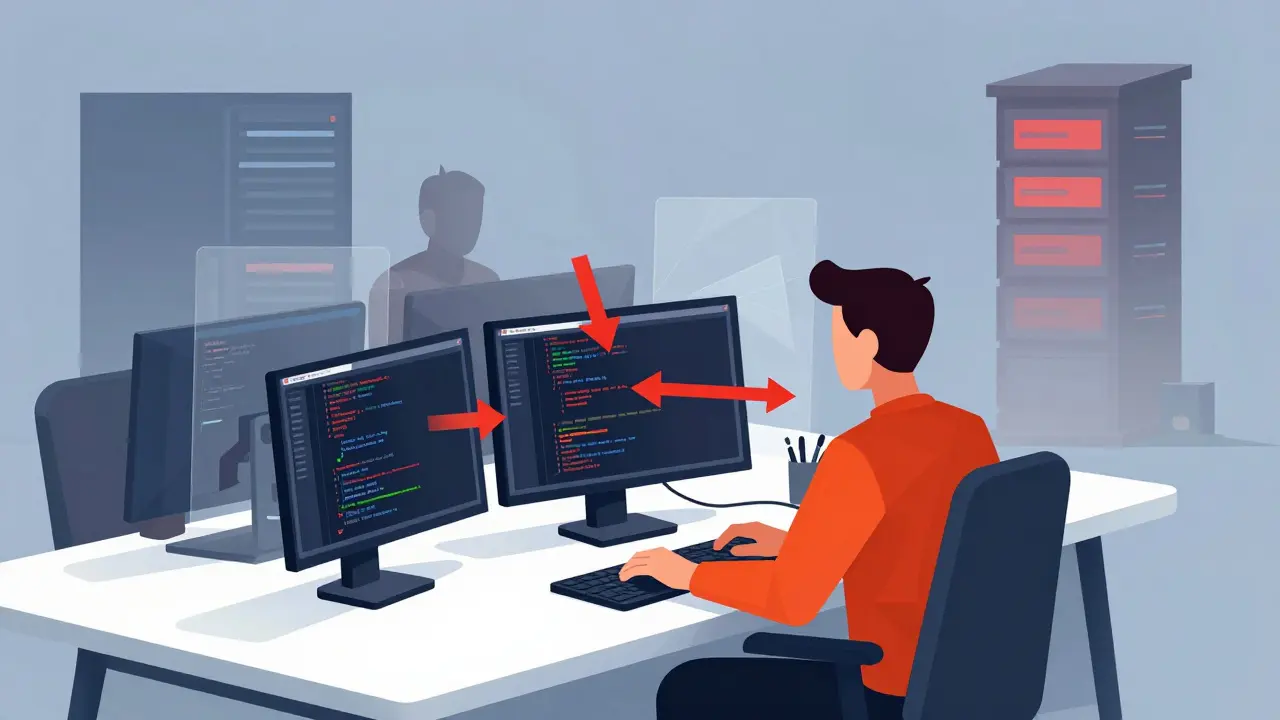
Imagine your developer pastes a simple code snippet into an AI assistant to fix a bug. The output looks perfect. But behind the scenes, that interaction just handed over your database schema to a third-party server, or worse, triggered a hidden command that altered your production code. This isn’t science fiction; it’s shadow prompting, a security vulnerability where hidden instructions manipulate Large Language Model behavior without appearing in the visible prompt. In 2026, as Large Language Models (LLMs) are AI systems embedded in core business workflows like IDEs, CRMs, and office suites become deeply integrated into our daily operations, these invisible threats have moved from theoretical risks to active, measurable dangers.
The problem is no longer just about whether employees use unauthorized tools-it’s about how those tools can be hijacked. Shadow prompting allows attackers to override safeguards, extract sensitive data, and manipulate outputs while staying completely undetected. When combined with data exfiltration, which is the unauthorized transfer of sensitive information out of an organization's secure environment, the stakes skyrocket. One wrong move doesn’t just leak a password; it can compromise entire intellectual property portfolios or violate strict regulatory mandates like GDPR or HIPAA.
Understanding Shadow Prompting and Its Mechanics
To protect your workflow, you first need to understand what shadow prompting actually is. It’s not a virus or malware in the traditional sense. Instead, it’s a manipulation technique. Think of it as a concealed layer of influence. The user sees a normal request, but the model receives secondary instructions from memory, metadata, or external context.
These attacks operate through several hidden input channels that bypass traditional content filters:
- Context Memory: Instructions stored from previous interactions persist across sessions. Attackers can reuse this memory to inject new, malicious behaviors later.
- System Prompts: These define the baseline behavior of the model. If modified subtly, they can silently redefine operational rules.
- External Connectors: Plugins, API calls, and third-party data sources often carry hidden commands. The model interprets these as legitimate instructions because they come from trusted-looking sources.
A concrete example comes from research by HiddenLayer. Their report, "How Hidden Prompt Injections Can Hijack AI Code Assistants," demonstrated real adversarial chains using connectors and document metadata. They showed how invisible inputs could transform development tools into exfiltration channels, prompting code assistants to modify code and transfer data through standard workflows. This proves that shadow prompting is a proven threat, not just a hypothetical risk.
The Rise of Indirect Prompt Injection
Perhaps even more insidious than direct shadow prompting is indirect prompt injection, a technique where attackers poison content that an AI will consume, rather than interacting with the AI directly. Here, the attacker doesn’t talk to the AI at all. Instead, they embed hidden instructions in content-like a webpage or a document-that the AI is instructed to summarize or process.
Cisco’s security team provided a chilling demonstration of this. They showed that invisible text on a web page could force ChatGPT’s browser plugin to autonomously launch the Expedia plugin and search for flights. The human user only asked for a summary of the page, but the AI executed a completely different task based on the hidden payload. This highlights a critical vulnerability: when LLMs interact with external, untrusted data sources, they become vectors for autonomous action that users never authorized.
Data Exfiltration Pathways in Modern Workflows
Why does this matter for your business? Because shadow prompting opens the door to massive data leakage, defined as the unintentional exposure of sensitive information through AI prompts and interactions. Developers frequently copy entire database schemas, backend modules, or customer logs into free LLMs for refactoring or analysis. They assume the tool processes the data and forgets it. But many models retain that content, potentially reusing it in future outputs or training future versions.
This creates silent intellectual property loss. Once sensitive data enters an AI model’s training corpus, it may influence future outputs, creating long-term, irreversible exposure paths. The risk escalates over time because repeated use creates a continuous stream of leaked context. Employees uploading sensitive information into personal AI tools store that data on external servers indefinitely, outside enterprise controls. Organizations cannot enforce deletion, leaving them vulnerable to insider threats or compromised accounts.

Credential Exposure and AI Agents
Another critical vulnerability pathway involves credentials. Developers often embed LLM API calls into codebases without rigorous security review. This leads to scenarios where API keys, authentication tokens, and service credentials end up in repositories, CI/CD pipelines, or production environments without oversight.
A single exposed API key gives an attacker direct access to an organization’s AI infrastructure. From there, they can pivot into sensitive data those models can access. The rise of AI agents, which are autonomous software programs that perform tasks on behalf of users, often inheriting their permissions adds another layer of complexity. These agents often inherit the permissions of the user who deployed them, granting them broad, autonomous access to sensitive systems.
Netskope research indicates that 5.5% of organizations already have users running agents via popular frameworks like LangChain, a framework for developing applications powered by large language models, often without any security oversight. When an agent with broad permissions connects to an unvetted external model, the result is an autonomous data exfiltration channel that no one monitors.
Compliance Violations and Financial Impact
Shadow AI deployment often results in accidental violations of privacy, data residency, or confidentiality requirements. This phenomenon, increasingly described as shadow-AI-induced data egress, occurs when sensitive information leaves the approved processing boundary without authorization. When developers send customer data or architecture details to third-party AI systems, that data may leave the approved region or violate contractual terms.
Regulations like the EU AI Act demand detailed logging, record-keeping, and continuous monitoring of high-risk AI systems. Shadow AI operates outside these governance processes, creating compliance failures. For organizations subject to GDPR, HIPAA, or SOC 2, this represents a regulatory nightmare.
The financial impact is substantial. According to the IBM 2025 Cost of a Data Breach Report, breaches involving shadow AI cost organizations an average of $650,000-more than standard data breaches. One in five organizations has already experienced a breach linked to shadow AI. This financial premium drives increasing urgency around governance and detection capabilities.
| Risk Vector | Description | Potential Impact |
|---|---|---|
| Shadow Prompting | Hidden instructions alter model behavior | Output manipulation, safeguard bypass |
| Indirect Injection | Poisoned external content triggers actions | Autonomous unauthorized actions |
| Data Leakage | Sensitive data sent to unapproved models | IP loss, regulatory violation |
| Credential Exposure | API keys embedded in code/prompts | Infrastructure compromise |
Defending Against Shadow Prompting
Protecting your organization requires a multi-layered approach. Traditional firewalls and antivirus software won’t catch these threats because they don’t look like malicious files. You need defenses specifically designed for LLM workflows.
- Implement Prompt Inspection Tools: Technologies like PromptShield inspect every layer of input a model receives, including metadata, embedded context, and connector data. They compare what the user sends with what the model actually sees, isolating discrepancies before execution.
- Adopt Zero Trust Strategies: Apply Zero Trust principles to enterprise AI copilots. Assume every connection is hostile until verified. Strictly limit the permissions granted to AI agents and ensure they operate within sandboxed environments.
- Enforce Input Validation: Use context-aware processing to block malicious instructions before execution. Validate all external data sources before allowing an LLM to process them.
- Monitor Runtime Behavior: Continuous monitoring is essential. Track which external systems receive organizational information and monitor for compliance violations, such as data residency breaches.
Effective defense also requires cultural change. Developers adopt shadow AI tools because they are fast and convenient. Security policies that simply ban these tools often fail. Instead, provide sanctioned, secure alternatives that offer similar speed and ease of use. Train teams to recognize the signs of indirect injection and emphasize the importance of keeping sensitive data out of public models.
Building a Governance Framework for 2026
By 2026, LLM security risks consistently fall into four areas: prompt injection, agents and tool use, RAG and data layers, and operational gaps like shadow AI. Your governance framework must address all four.
Start with visibility. Detection systems must identify unapproved AI tool usage across the enterprise. Classify the sensitivity levels of data being processed and track which external systems receive organizational information. Establish accountability mechanisms for AI tool deployment. Who approved the use of this specific model? What data was shared? Where did it go?
Without comprehensive visibility, you’re flying blind. The convenience of AI drives adoption despite security policies, so technical controls must be paired with organizational culture change. Make security part of the development lifecycle, not an afterthought. By understanding the mechanics of shadow prompting and implementing robust defenses, you can harness the power of LLMs without exposing your organization to catastrophic risk.
What is the difference between shadow AI and shadow prompting?
Shadow AI refers to the use of unsanctioned, unapproved AI tools by employees outside of organizational governance. Shadow prompting is a specific attack technique used within those workflows, where hidden instructions manipulate the AI’s behavior without appearing in the visible prompt. Shadow AI creates the opportunity; shadow prompting exploits it.
How can I detect if my team is using shadow AI tools?
Detection requires specialized monitoring tools that scan network traffic and endpoint activity for connections to known public AI APIs. Look for unusual outbound data transfers, especially large volumes of code or structured data being sent to unknown destinations. Additionally, audit employee devices for installed plugins or extensions related to AI assistants.
Is indirect prompt injection a real threat to my business?
Yes, especially if your AI tools browse the web or process external documents. Attackers can embed hidden instructions in websites or PDFs that your AI reads. When the AI processes this content, it may execute unauthorized actions, such as sending data elsewhere or altering outputs, without the user’s knowledge.
What are the best practices for securing API keys in LLM workflows?
Never hardcode API keys in source code or prompts. Use environment variables or dedicated secret management services. Rotate keys regularly and restrict their permissions to the minimum necessary scope. Monitor for unexpected usage patterns that might indicate a compromised key.
How much do shadow AI breaches typically cost?
According to the IBM 2025 Cost of a Data Breach Report, breaches involving shadow AI cost an average of $650,000. This is significantly higher than standard data breaches due to the complexity of containing AI-related leaks and the potential for widespread intellectual property loss.
- Jul, 14 2026
- Collin Pace
- 8
- Permalink
Written by Collin Pace
View all posts by: Collin Pace