Top Enterprise Use Cases for Large Language Models in 2025

Enterprise LLMs Are No Longer Experimental - They’re Running Core Business Functions
In 2023, companies were testing large language models (LLMs) in side projects. By 2025, enterprise LLMs are embedded in customer service, compliance, supply chain planning, and even medical diagnostics. The shift wasn’t gradual - it was explosive. Organizations that waited too long to act are now scrambling to catch up. Those that moved early are seeing 23-37% lower operational costs, 65-80% faster decision cycles, and customer satisfaction scores rising by up to 29 points. This isn’t hype. It’s measurable impact.
What changed? Three things: better models, smarter deployment, and hardened security. LLMs today aren’t just chatbots with big vocabularies. They’re precision tools trained on proprietary data, locked behind firewalls, and tuned to handle your industry’s jargon - not generic internet text. The most successful enterprises don’t ask, “Can we use AI?” They ask, “Which process are we automating first?”
Customer Service That Actually Understands Your Business
Most customer service chatbots still sound like robots reciting manuals. Enterprise LLMs in 2025 don’t. They use retrieval-augmented generation (RAG) to pull answers directly from your internal documents - service policies, product specs, warranty terms - then explain them in plain language. A global retail chain reduced ticket resolution time by 62% after deploying RAG-powered support. Their system doesn’t guess. It pulls from the official handbook, cites the exact section, and even flags contradictions in policy.
One healthcare provider used this approach to handle insurance claim questions. Before, agents spent 12-15 minutes per call verifying coverage. Now, the LLM cross-references patient records, payer rules, and billing codes in under 15 seconds. Accuracy jumped from 74% to 91%. The human agents now handle only the edge cases - complex appeals, emotional distress, or system errors. The result? Fewer burnouts, faster service, and higher NPS scores.
Document Processing at Scale - No More Manual Review
Legal teams, HR departments, and finance units still drown in PDFs, scanned contracts, and unstructured emails. In 2025, enterprise LLMs read, summarize, extract clauses, and flag risks automatically. A Fortune 500 bank automated contract review for commercial loans. Previously, lawyers spent 200 hours per month reading 800+ documents. Now, an LLM scans them in 90 minutes, highlights non-standard terms, and suggests redlines based on internal compliance rules.
It’s not perfect. Early versions flagged too many false positives. But after six months of fine-tuning with real contracts and feedback from senior attorneys, accuracy hit 93%. The team now reviews only the flagged items. That’s 150 hours saved every month - time redirected to high-value negotiations, not document drudgery.
Same story in HR. One tech company automated onboarding for 1,200 new hires annually. The LLM pulls data from offer letters, benefits guides, and IT policies, then generates personalized welcome packets - including video walkthroughs of internal tools. New employees report feeling 47% more prepared on day one.
Fraud Detection That Learns From Real Patterns
Rule-based fraud systems are rigid. They catch obvious scams but miss subtle, evolving patterns. Enterprise LLMs, however, detect anomalies by understanding context. JPMorgan Chase deployed a fine-tuned LLM to analyze transaction narratives - not just amounts or locations. The model learned to spot phrases like “urgent wire to offshore account” or “paying a supplier for non-existent goods” that human analysts often overlooked.
Results? 94.7% detection accuracy and 38% fewer false positives. That means fewer angry customers blocked by mistake and less time wasted investigating clean transactions. The model was trained on 18 months of labeled fraud cases and continuously learns from new alerts. It doesn’t replace analysts - it gives them smarter leads.
Similar systems are now live in insurance underwriting. One insurer used LLMs to scan medical records and claims history to predict fraudulent rehabilitation claims. Accuracy improved from 68% to 89% after 11 months of training. The key? They didn’t just feed data - they built a knowledge base of real fraud patterns, reviewed by compliance officers.
Supply Chain Intelligence That Anticipates Disruptions
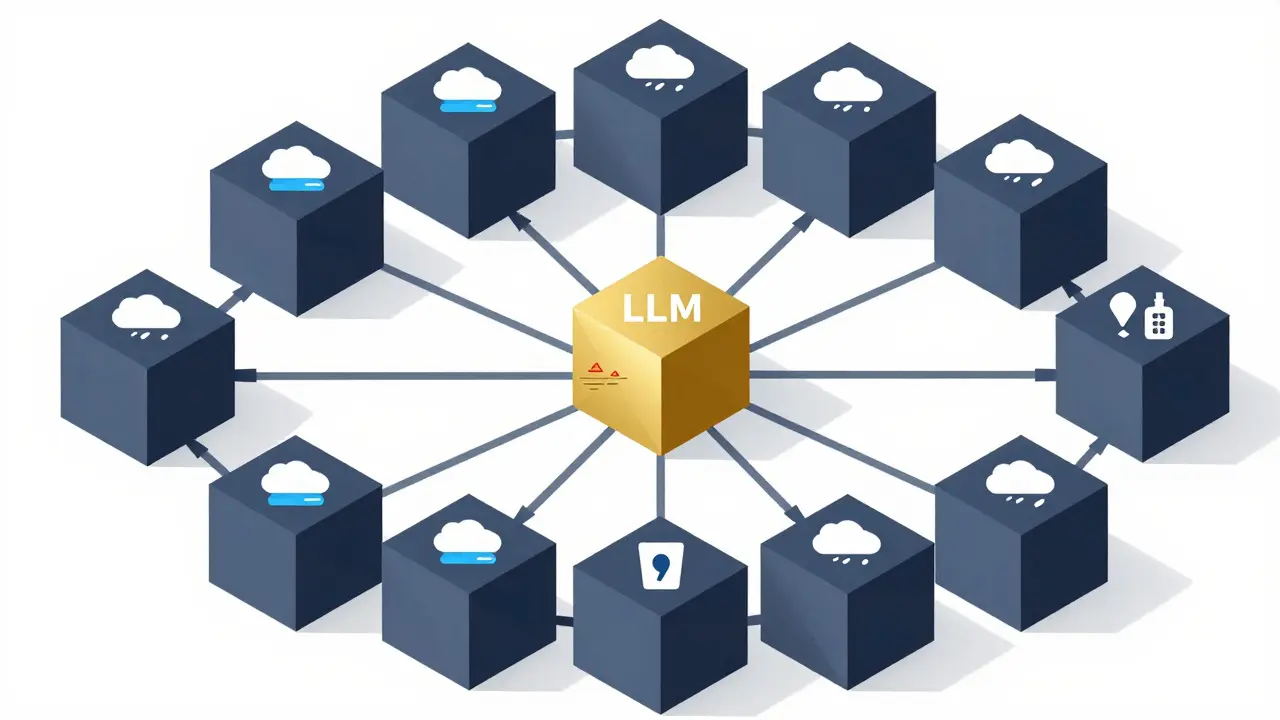
Supply chains are messy. Emails, vendor updates, port delays, weather reports - all scattered across platforms. Enterprise LLMs now stitch this together. A global manufacturer uses an LLM to monitor news, supplier emails, and logistics trackers. When a typhoon hits Southeast Asia, the model doesn’t just alert you - it identifies which factories are affected, which components are at risk, and suggests alternative suppliers based on past performance and contract terms.
One company reduced lead time uncertainty by 58%. They used to rely on manual check-ins with 40+ suppliers. Now, the LLM scans every communication, extracts key dates, and updates the production schedule automatically. When a key supplier missed a delivery, the system didn’t just notify the team - it rerouted orders to two backup vendors and recalculated delivery windows in real time.
This isn’t fantasy. It’s happening at companies like Siemens, Unilever, and FedEx. The common thread? They didn’t try to automate everything. They automated information gathering - and let humans make the decisions.
Compliance and Regulatory Reporting Made Simple
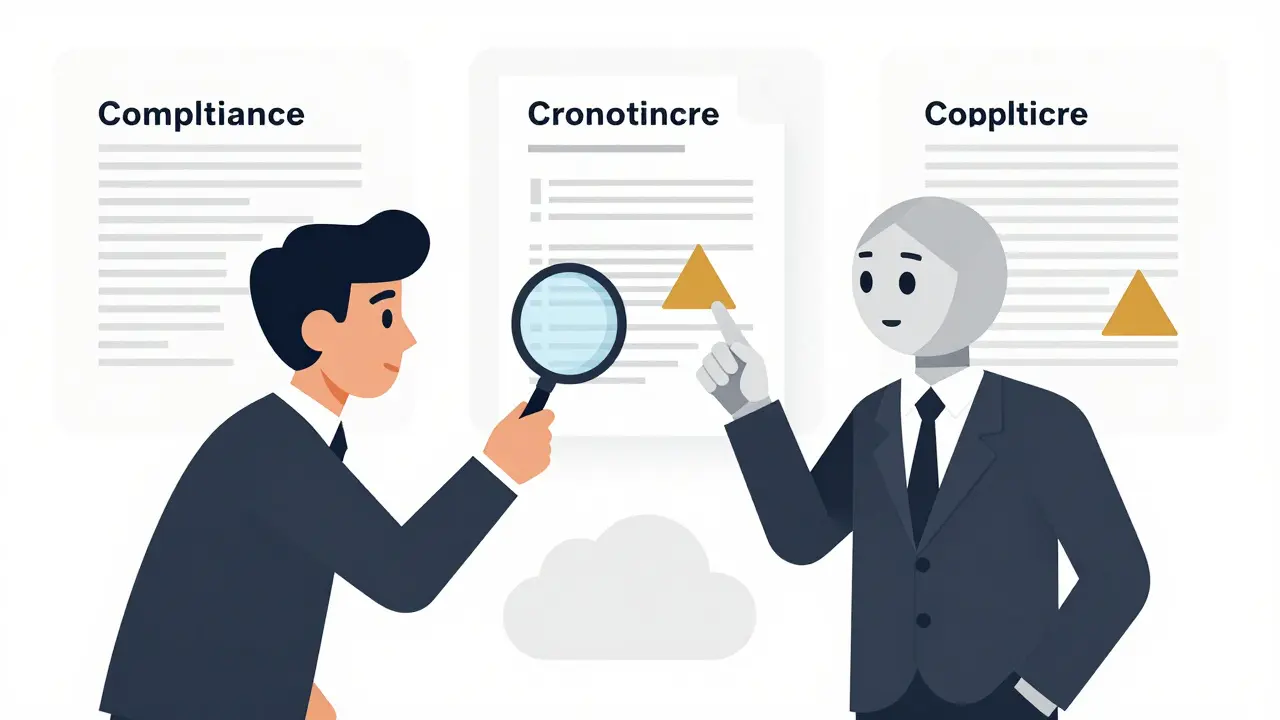
Regulations like GDPR, HIPAA, and SOX are complex. Keeping up manually is nearly impossible. Enterprise LLMs now auto-generate compliance reports by pulling data from internal systems and mapping it to regulatory requirements. A financial services firm automated its annual AML (anti-money laundering) filings. The LLM scanned transaction logs, customer profiles, and internal investigations, then built a compliant report with supporting evidence - reducing preparation time from 6 weeks to 3 days.
Healthcare providers use similar systems to ensure patient data handling meets HIPAA standards. The model checks every access log, data transfer, and third-party vendor contract. If someone downloaded a patient file without authorization, the system flags it immediately - and generates a remediation plan.
Crucially, these systems are auditable. Every output includes source references. Regulators don’t just get a summary - they get the trail. That’s why 94% of financial and healthcare firms now require on-premise or private cloud LLMs. Public APIs are off the table.
Code Generation Is the Quiet Breakout Use Case
While everyone talks about chatbots, the biggest productivity win for enterprises in 2025 is code generation. Developers use LLMs to write boilerplate, debug errors, and even generate unit tests. A fintech startup cut its development cycle by 40% by integrating an LLM into its CI/CD pipeline. The model suggests code snippets based on internal libraries, follows security standards, and avoids deprecated APIs.
It’s not replacing developers - it’s removing the tedium. One team reported that 28% of their total engineering time went into writing repetitive code before. Now, that’s automated. Engineers focus on architecture, security reviews, and complex logic. The result? Faster releases, fewer bugs, and higher morale.
Companies like Adobe and Salesforce now embed LLMs directly into their internal IDEs. The model knows your codebase, your naming conventions, and your compliance rules. It doesn’t guess - it adapts.
What’s Driving Adoption? Security, Integration, and Precision
Why are companies choosing Anthropic over OpenAI? Why are they moving away from open-source models? Three reasons:
- Security: 87% of enterprises say secure deployment is non-negotiable. On-premise, private cloud, and encrypted inference are now standard.
- Integration: 89% demand seamless connections to Microsoft 365, Salesforce, and ServiceNow. No one wants another siloed tool.
- Precision: Generic models get 70-78% accuracy on domain tasks. Fine-tuned enterprise models hit 85-92%. That 15-point gap matters when you’re approving loans or diagnosing patients.
Small Language Models (SLMs) like Mistral 7B and IBM’s Granite are gaining ground because they deliver 90% of the accuracy of larger models - at 60-75% lower cost. You don’t need a $50,000 GPU cluster to run them. Many run on standard enterprise servers.
Where Enterprises Are Still Falling Short
Not everyone is succeeding. Forrester found 78% of companies underestimate how much data prep is needed. You can’t just throw your PDFs into an LLM and expect magic. Successful deployments take 3-6 months to clean, structure, and label data.
Another big mistake? Treating LLMs like black boxes. Gartner reports that 65% of enterprises see accuracy drop within six months because they didn’t build feedback loops. The model needs constant tuning - human reviewers flagging errors, updating knowledge bases, and retraining on new data.
And then there’s cost. Token-based pricing catches people off guard. One retail chain burned through $12,000 in a month because their chatbot was answering the same question 500 times a day. They fixed it by adding caching and limiting prompts to unique queries.
What’s Next? Multimodal, Real-Time, and Industry-Specific Models
By late 2025, LLMs will start seeing images, videos, and sensor data - not just text. Google and Anthropic are already testing multimodal models that can analyze a warehouse camera feed and generate a maintenance report. Cohere is rolling out real-time collaboration features where multiple users edit prompts together, and the model adapts on the fly.
The biggest trend? Industry-specific models. Instead of one general-purpose LLM, companies are building custom ones for finance, healthcare, manufacturing, and logistics. These models are smaller, faster, and far more accurate because they’re trained only on your data and your rules. Gartner predicts these vertical models will grow at 47% annually - more than double the pace of general-purpose ones.
Final Thought: Augment, Don’t Replace
The most successful enterprises don’t use LLMs to replace workers. They use them to create “superagency” teams - humans working alongside AI, each doing what they do best. The AI handles data, patterns, and repetition. The human handles judgment, ethics, and emotion.
That’s the real edge in 2025. Not the model size. Not the cost. Not the speed. It’s how well you pair human insight with machine scale.
Are enterprise LLMs worth the investment in 2025?
Yes - if you’re targeting the right use cases. Companies that automated document review, customer service, fraud detection, or compliance reporting saw ROI within 6-9 months. Those that tried to build a general AI assistant or replace entire teams are still struggling. Focus on high-volume, repetitive tasks with structured data. That’s where the value is.
Can small businesses use enterprise LLMs too?
Absolutely. You don’t need a Fortune 500 budget. Small Language Models (SLMs) like Mistral 7B or IBM Granite run on standard servers and cost under $200/month in cloud fees. Many vendors offer tiered pricing for small teams. The key is starting small: automate one process - like email sorting or invoice extraction - before scaling.
What’s the biggest risk with enterprise LLMs?
Over-reliance on a single vendor. Many companies lock into one provider’s API without a backup. If pricing changes, the service goes down, or compliance rules shift, you’re stuck. The smartest organizations use multi-vendor strategies - running parallel systems across Anthropic, Cohere, and open-source models - and testing outputs against each other.
Do I need AI engineers to deploy LLMs?
Not for basic use cases. Prompt engineering and RAG setups can be handled by business analysts after 2-3 weeks of training. But for fine-tuning models, building knowledge bases, or integrating with legacy systems, you’ll need data engineers and domain experts. Start with low-code tools from Cohere or Anthropic - they’re designed for non-technical users.
How do I measure LLM success?
Track metrics tied to your goal. For customer service: resolution time, first-contact resolution rate, CSAT. For document processing: time saved per document, error rate reduction. For compliance: audit preparation time, number of flagged issues caught before review. Don’t just track “accuracy” - track business impact.
Why are open-source models losing ground in enterprises?
Because they lack enterprise-grade support, reliability, and compliance. Open-source models often have 85% uptime vs. 92%+ for paid options. They don’t offer 24/7 SLAs, SOC 2 certifications, or dedicated security teams. While they’re customizable, most enterprises prioritize stability over flexibility. The cost of a single outage or compliance breach outweighs the savings.
- Sep, 19 2025
- Collin Pace
- 6
- Permalink
- Tags:
- enterprise LLM use cases
- LLM in business
- large language models 2025
- AI automation
- RAG for enterprises
Written by Collin Pace
View all posts by: Collin Pace