Why Transformers Power Modern Large Language Models: Core Concepts Explained

You’re staring at a chatbot that writes code, summarizes legal contracts, or translates poetry in real-time. It feels like magic, but it’s actually math. Specifically, it’s the Transformer architecture, a design pattern that completely rewrote the rules of how computers understand language. If you’ve ever wondered why older AI models struggled with long sentences while modern ones seem to have an infinite memory, the answer lies in one specific innovation from 2017. This isn’t just academic trivia; understanding these core concepts helps you grasp why your current tools work the way they do and where the industry is heading next.
The Problem With Old School AI
Before Transformers took over, the gold standard for processing text was the Recurrent Neural Network (RNN), specifically variants like LSTMs. Think of an RNN like reading a book by looking through a keyhole. You see one word at a time, left to right. To understand the end of a sentence, you have to remember every single word that came before it. The problem? Human memory fades, and so does digital memory in these models. By the time an RNN reached the end of a long paragraph, the context from the beginning had often vanished into noise. This is known as the "vanishing gradient problem," and it made training large models incredibly slow and inefficient because each step depended on the previous one. You couldn’t parallelize the work; you had to wait for step A to finish before starting step B.
Enter the Transformer: Attention Is All You Need
In 2017, eight researchers at Google Brain published a paper titled "Attention is All You Need." They proposed a radical shift: stop processing words sequentially. Instead, look at the entire sequence all at once. This is the core value proposition of the Transformer architecture. It doesn’t care about the order of processing steps; it cares about the relationships between words. By allowing the model to process an entire sentence simultaneously, engineers could train models on massive datasets much faster. For context, the original Transformer trained in 3.5 days on 8 P100 GPUs, whereas comparable LSTM-based models took weeks. That speed difference didn’t just save money; it enabled the scale we see today.
Decoding Self-Attention: How Machines "Focus"
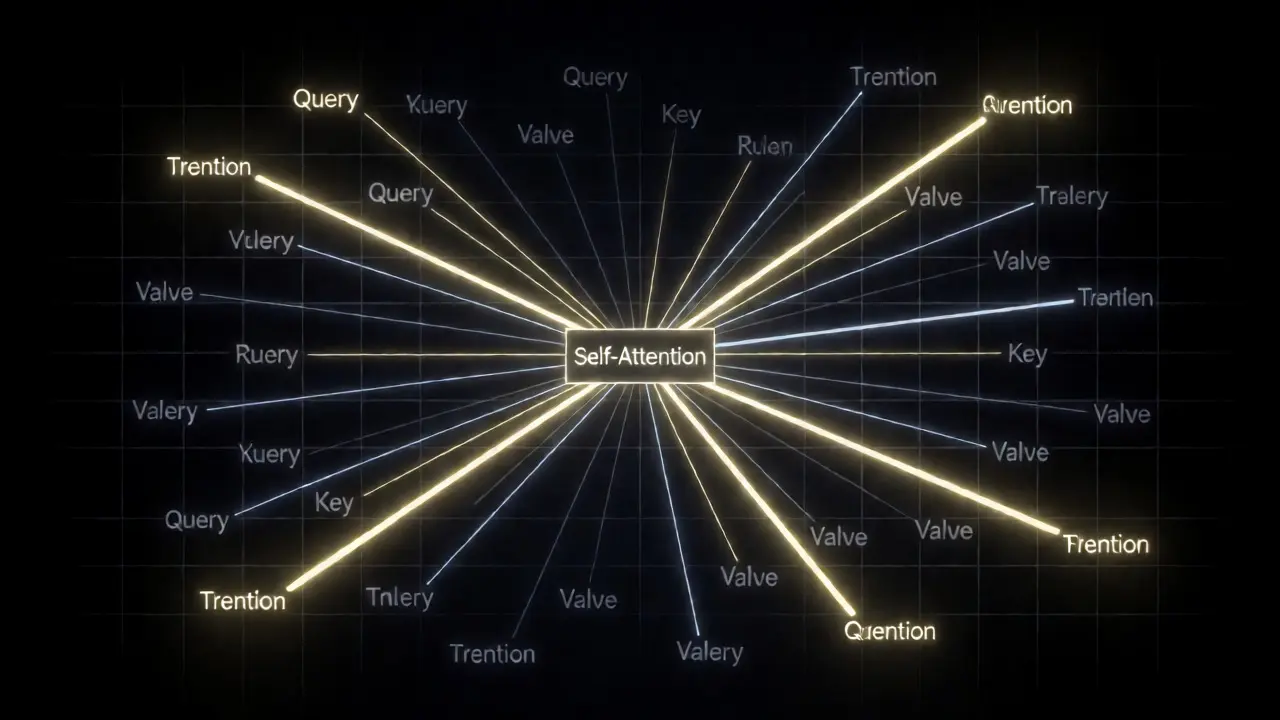
If there’s one concept you need to wrap your head around, it’s self-attention. This mechanism allows the model to weigh the importance of different parts of the input data when producing an output. Imagine you’re reading the sentence: "The animal didn't cross the street because it was too tired." When you read "it," you instantly know it refers to the "animal," not the "street." You did this by paying attention to the relationship between those two words. Self-attention does exactly that mathematically.
The mechanism uses three vectors: Query (Q), Key (K), and Value (V). Don’t let the names confuse you. Think of Q as what the current word is looking for, K as what other words are offering, and V as the actual information being retrieved. The formula looks intimidating-Attention(Q,K,V) = softmax(QK^T/√dk)V-but the logic is simple. The model calculates a score for how relevant every other word is to the current word. High scores mean high relevance. This allows the model to maintain a comprehensive understanding of the entire context, regardless of how far apart two related words are in the sentence.
| Feature | Traditional RNN/LSTM | Transformer Architecture |
|---|---|---|
| Processing Method | Sequential (one token at a time) | Parallel (entire sequence at once) |
| Context Retention | Weak for long sequences (vanishing gradients) | Strong global context via self-attention |
| Training Speed | Slow (weeks for large datasets) | Fast (days for large datasets) |
| Computational Cost | Linear O(n) | Quadratic O(n²) relative to sequence length |
| Key Innovation | Gating mechanisms (forget/input gates) | Multi-head self-attention |
Positional Encoding: Teaching Order Without Recurrence
Here’s a catch: if the Transformer processes all words at once, how does it know which word comes first? In English, "Dog bites man" means something very different than "Man bites dog." Since Transformers lack the sequential nature of RNNs, they don’t inherently understand order. Engineers solved this with positional encodings. These are mathematical patterns added directly to the word embeddings (the numerical representations of words).
The original implementation used sine and cosine functions of different frequencies. Each position in the sequence gets a unique fingerprint. So, the word "cat" at position 1 has a slightly different numerical signature than "cat" at position 100. This injects the sense of time and order back into the model without forcing it to process words one by one. It’s a clever hack that preserves the benefits of parallel processing while respecting the structure of language.
Encoder-Decoder Structure: The Two Halves of the Brain
The full Transformer architecture consists of two main parts: the encoder and the decoder. The encoder’s job is to build a rich representation of the input text. It takes the raw tokens, adds positional info, and passes them through multiple layers of self-attention and feed-forward networks. Each layer refines the understanding of the text, capturing nuances like tone, syntax, and semantic meaning.
The decoder generates the output. In tasks like translation, the decoder looks at the encoded input (via encoder-decoder attention) and its own previously generated words to predict the next word. However, not all modern LLMs use both. Models like GPT-4 are primarily decoders optimized for generation, while BERT is primarily an encoder optimized for understanding. Understanding this split helps you choose the right tool for the job. Need to classify sentiment? An encoder model might be more efficient. Need to write an email? A decoder model shines.

The Quadratic Bottleneck: Why Long Contexts Are Hard
For all their power, Transformers have a significant weakness: computational complexity. Because self-attention compares every word to every other word, the cost grows quadratically with the length of the text. If you double the length of the input, the computation effort quadruples. Processing a 1,024-token sequence requires roughly 1 million attention calculations. Now imagine processing a 100,000-token document. The numbers get astronomical fast.
This limitation sparked a wave of innovations. Researchers developed techniques like Sliding Window Attention (used in Meta’s Llama 3) and Sparse Attention to limit comparisons to local neighborhoods rather than the whole document. These methods allow modern models to handle contexts up to 1 million tokens, though at a higher computational price tag. As of late 2025, training a 13-billion parameter model can still cost upwards of $18,500 on cloud infrastructure, highlighting that while the architecture is powerful, it’s also expensive to run.
Real-World Impact and Adoption
The dominance of Transformers isn’t just theoretical. According to Gartner’s 2025 AI Market Guide, nearly 99% of new enterprise LLM deployments rely on this architecture. Industries have moved beyond experimentation. Financial services firms use Transformer-based models for fraud detection, analyzing transaction sequences with a precision that rule-based systems missed. Healthcare organizations deploy them to parse unstructured medical notes, extracting patient history that doctors might overlook.
For developers, the barrier to entry has lowered significantly thanks to libraries like Hugging Face’s Transformers. You don’t need to implement the math from scratch anymore. With pre-trained models available on the Model Hub, you can fine-tune a 7-billion parameter model on custom data in a matter of hours. However, experts warn against treating these models as black boxes. Dr. Emily Bender’s critique of "stochastic parrots" reminds us that these systems mimic language patterns without necessarily understanding meaning. Knowing the underlying mechanics helps you spot when a model is hallucinating versus when it’s genuinely reasoning.
Looking Ahead: Beyond Pure Transformers
Is the Transformer era ending? Not anytime soon. While alternatives like State Space Models (SSMs) such as Mamba show promise for specific linear-scaling tasks, the core attention mechanism remains foundational. Recent developments, like Google’s Gemini 2.0 introducing "Mixture-of-Depths" attention, show that the architecture is evolving rather than being replaced. Hybrid models that combine the parallelism of Transformers with the efficiency of recurrent architectures are gaining traction. For now, if you want to understand modern AI, you must understand Transformers. They are the engine under the hood of the most intelligent software we have today.
What is the main advantage of Transformers over RNNs?
The primary advantage is parallel processing. Unlike RNNs, which process data sequentially, Transformers analyze entire sequences simultaneously using self-attention. This drastically reduces training time and allows models to better capture long-range dependencies in text without losing context.
Why do Transformers require so much computing power?
Transformers have a quadratic computational complexity relative to sequence length. Because the self-attention mechanism compares every token to every other token, doubling the input length quadruples the computational cost. This makes processing very long documents resource-intensive compared to linear-complexity architectures.
Do I need to know advanced math to use Transformers?
Not for basic usage. Libraries like Hugging Face abstract away the complex matrix operations. However, understanding concepts like embeddings, attention heads, and positional encoding helps significantly when debugging issues, fine-tuning models, or optimizing performance for specific hardware constraints.
What is positional encoding in simple terms?
Positional encoding adds unique numerical markers to each word based on its position in the sentence. Since Transformers process all words at once, they don't naturally know the order. These encodings act as timestamps, telling the model whether a word appeared early or late in the sequence, preserving grammatical structure.
Are Transformers going to be replaced by newer architectures?
While alternatives like State Space Models (e.g., Mamba) offer efficiency gains for specific tasks, Transformers remain the dominant architecture for general-purpose language modeling. Most current research focuses on hybrid approaches that retain the attention mechanism's strengths while addressing its computational limitations.
- Sep, 9 2026
- Collin Pace
- 7
- Permalink
Written by Collin Pace
View all posts by: Collin Pace