Zero-Shot vs Few-Shot Learning in LLMs: When to Use Examples
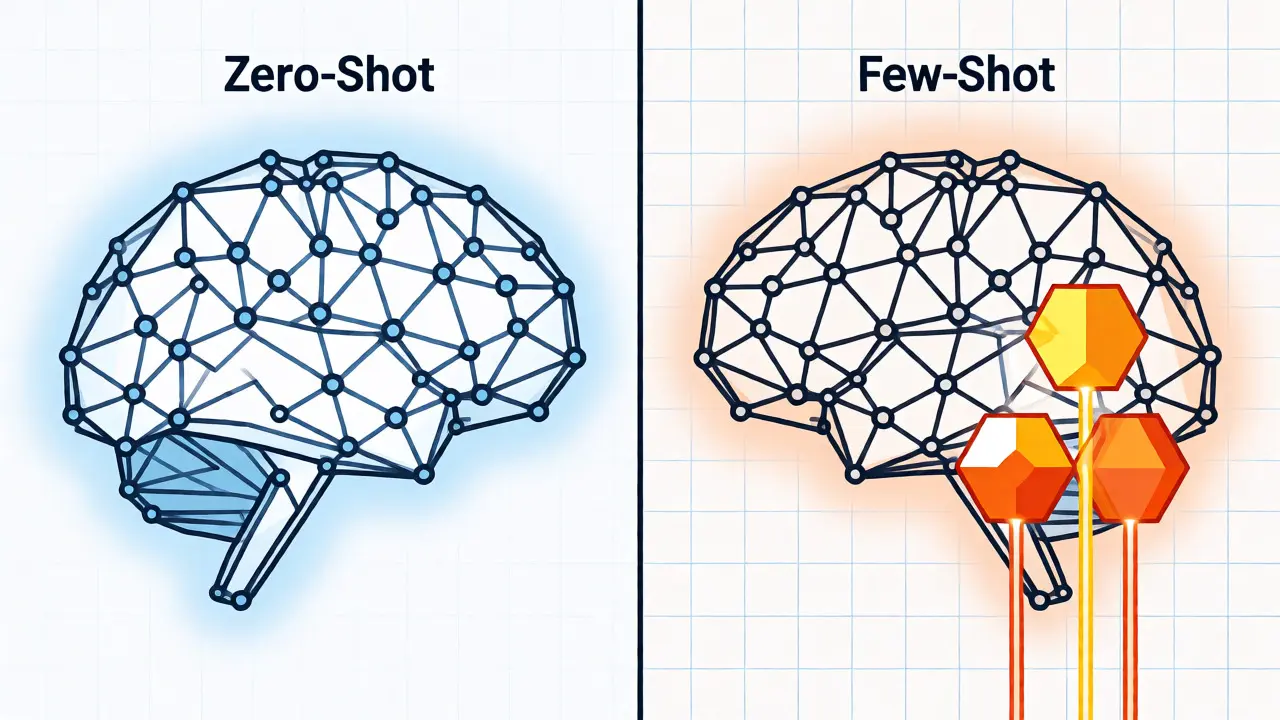
You’ve got a task. Maybe it’s sorting customer support tickets or extracting dates from messy invoices. You don’t have thousands of labeled examples ready to go. Do you throw your data at the model and hope for the best? Or do you spend hours crafting perfect examples first? This is the core dilemma of Large Language Models usage today: choosing between zero-shot and few-shot approaches.
The difference isn’t just academic-it’s about time, money, and accuracy. Zero-shot means asking the model to do something without showing it any prior examples. It relies entirely on what it learned during its massive pre-training phase. Few-shot means giving the model a handful of examples-usually between two and ten-to guide its output. The right choice depends on your specific constraints. Let’s break down when each method shines, where they fail, and how to pick the winner for your project.
Understanding the Core Mechanisms
To make the right call, you need to know what’s happening under the hood. Zero-shot learning is essentially a test of generalization. The model has seen billions of words across countless topics. When you ask it to classify sentiment in a niche medical journal, it doesn’t have a specific "medical sentiment" classifier. Instead, it uses linguistic patterns it learned from general text to infer meaning. It’s like asking someone who has read every book in the library to summarize a new scientific paper they’ve never seen before. They haven’t studied that specific paper, but their broad knowledge helps them understand the jargon and structure.
Few-shot learning, by contrast, is about pattern matching within a limited context. You provide input-output pairs directly in the prompt. If you show the model three examples of "Invoice Date: 10/12/2023" mapping to "Date: 2023-10-12", it recognizes the transformation rule immediately. This technique leverages the model’s in-context learning ability. It doesn’t update its weights; it just adjusts its behavior based on the immediate conversation history. Think of it as handing someone a cheat sheet before an exam. They still rely on their general intelligence, but the cheat sheet ensures they follow the specific format you want.
Performance Metrics: What the Data Says
It’s easy to assume more examples always equal better results. The data suggests it’s more nuanced than that. In evaluations involving over 700,000 sentences, certain models achieved a 78.5% accuracy rate on complex tasks like identifying factors affecting drug exposure using zero-shot methods alone. That’s impressive for a system with no task-specific training.
However, when we look at precision and recall, the gap can widen depending on the model. For instance, in recent benchmarks, Flan-T5 showed high specificity (0.95) in zero-shot settings, meaning it rarely made false positives. Meanwhile, Tk-Instruct balanced sensitivity and F1-scores differently. These numbers aren’t abstract; they determine whether your automated email filter catches spam or accidentally deletes your boss’s message.
| Metric | Zero-Shot Approach | Few-Shot Approach | Why It Matters |
|---|---|---|---|
| Setup Time | Minutes | Hours | Zero-shot gets you to MVP faster. |
| Data Requirement | None | 2-10 High-Quality Examples | Few-shot requires curation effort. |
| Consistency | Variable | High | Few-shot locks in formatting rules. |
| Domain Adaptation | Struggles with niche terms | Adapts quickly | Few-shot teaches the model new slang or codes. |
| Cost per Query | Lower | Higher | More tokens in prompt = higher API costs. |
When Zero-Shot Is Your Best Friend
Use zero-shot when speed is critical and you’re dealing with broad, common-sense tasks. Imagine you’re building a prototype for a chatbot that answers FAQs. You don’t have time to label hundreds of Q&A pairs. You just type: "Answer the following question based on the provided context." The model likely handles this well because answering questions is a fundamental skill it mastered during pre-training.
This approach also works wonders when human oversight is part of the loop. If you’re generating draft blog posts or summarizing meeting notes, a 90% accurate summary is often good enough for a human editor to polish. The cost of fixing a bad summary is low compared to the time saved not creating training data. A 2023 study noted that zero-shot models reached up to 90% accuracy in image classification tasks without labeled examples, highlighting their raw power on standard visual-language tasks.
Another sweet spot is exploratory analysis. If you’re unsure if a dataset even contains the information you need, run a zero-shot query first. It’s cheap and fast. If the results are garbage, you know the problem lies in the data or the prompt, not necessarily the lack of fine-tuning.
When Few-Shot Saves the Day
Few-shot becomes non-negotiable when consistency and strict formatting matter. Suppose you need to extract JSON objects from unstructured emails. If you use zero-shot, the model might sometimes return valid JSON, other times plain text, and occasionally markdown code blocks. By providing three clear examples of the exact JSON structure you want, you force the model to mimic that pattern. This reduces parsing errors significantly.
Regulatory and brand compliance also demand few-shot. If your legal team insists that disclaimers appear in a specific order, or if your marketing voice must avoid certain adjectives, examples teach these nuances better than instructions alone. In healthcare, one organization cut diagnostic tool development time by 40% using few-shot prompting. They didn’t have thousands of labeled rare disease cases, but they had five perfect examples of how a diagnosis should be structured. That was enough to boost early detection rates by 30%.
Also, consider few-shot when dealing with domain-specific jargon. General models might confuse "apple" the fruit with "Apple" the company in financial texts. Showing two examples where "AAPL" maps to "Apple Inc." clarifies the context instantly, whereas a zero-shot prompt might miss the nuance in ambiguous sentences.
Pitfalls and How to Avoid Them
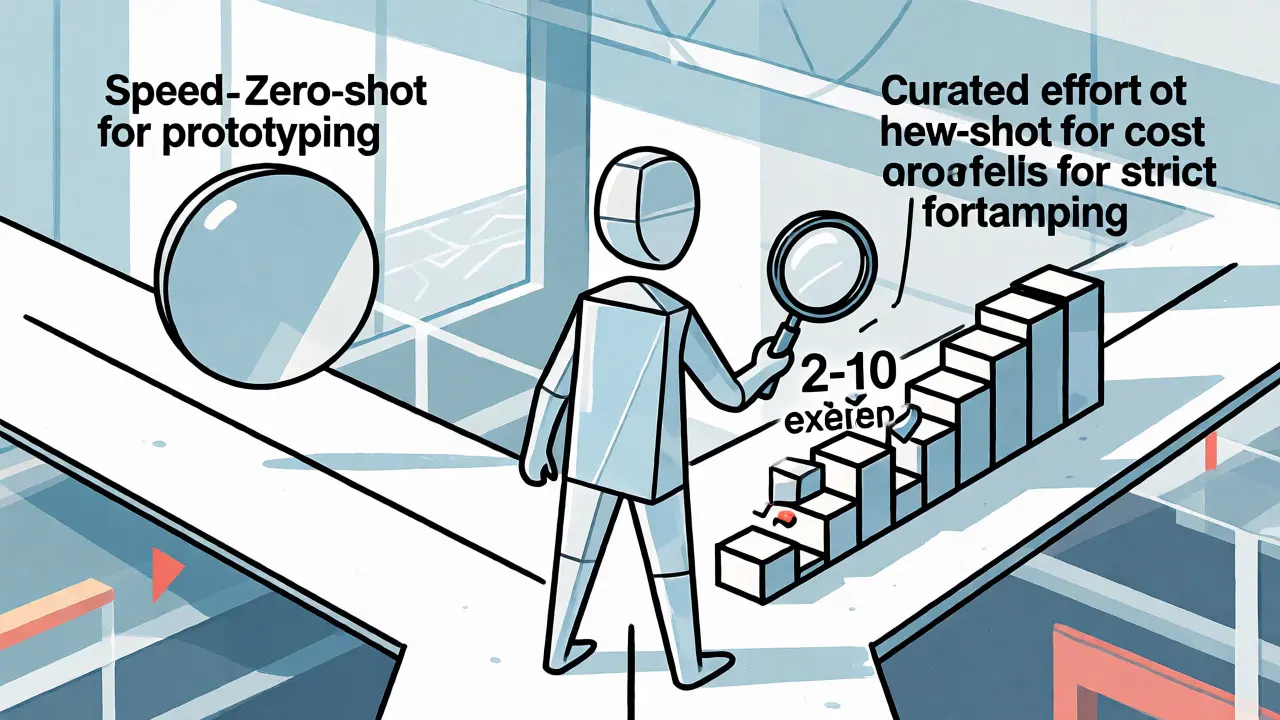
Don’t fall into the trap of thinking more examples are always better. There’s a point of diminishing returns. Adding 50 examples instead of 5 rarely improves performance linearly but drastically increases token costs and latency. Stick to 2-10 diverse examples that cover edge cases.
Beware of example bias. If all your few-shot examples start with "Q:" and end with "A:", the model will rigidly adhere to that format, even if it’s inefficient for longer outputs. Mix up the phrasing slightly while keeping the structural intent clear.
Finally, remember that zero-shot fails hard on highly specialized tasks. Asking a general LLM to perform clinical relation extraction without examples often yields lower results than specialized models like PubMedBERT. If your task involves deep domain logic, don’t rely on the model’s general intuition. Feed it examples.
Practical Decision Framework
Here’s a quick mental checklist to decide which path to take:
- Do you have labeled data? If no, start with zero-shot. If yes, move to few-shot.
- Is the format flexible? If you can edit the output manually, zero-shot is fine. If the output feeds another software system, use few-shot to enforce structure.
- Is the domain niche? Common sense tasks work zero-shot. Niche industry tasks usually need few-shot guidance.
- What’s your budget? Zero-shot prompts are shorter and cheaper. Few-shot prompts consume more tokens per request.
In many enterprise scenarios, a hybrid approach works best. Start with zero-shot to gauge baseline performance. If accuracy dips below acceptable thresholds, add two or three targeted examples to fix specific failure modes. This iterative process saves weeks of manual annotation while ensuring high-quality outputs.
What is the main difference between zero-shot and few-shot learning?
The primary difference is the number of examples provided to the model. Zero-shot learning asks the Large Language Model to perform a task without any prior examples, relying on its pre-trained knowledge. Few-shot learning provides a small set of examples (typically 2-10) within the prompt to guide the model's response format and content.
Does few-shot learning require fine-tuning the model?
No, few-shot learning does not involve changing the model's internal weights or parameters. It is an inference-time technique where examples are included in the input prompt. The model learns the pattern temporarily through in-context learning, making it much faster and cheaper than traditional fine-tuning.
When should I use zero-shot prompting?
Use zero-shot prompting when you need quick results, lack labeled training data, and the task aligns with general knowledge or common-sense reasoning. It is ideal for prototyping, simple summarization, translation, or tasks where minor formatting inconsistencies can be handled by human review.
How many examples are needed for effective few-shot learning?
Typically, 2 to 10 examples are sufficient. Research suggests that adding more than 10 examples yields diminishing returns in performance while increasing computational costs and latency. The key is selecting diverse examples that represent potential edge cases rather than just quantity.
Can zero-shot models handle specialized domains like medicine?
They can attempt it, but performance often lags behind specialized models. While some instruction-tuned models approach state-of-the-art performance in zero-shot biomedical tasks, they generally struggle with complex classification or relation extraction compared to domain-specific models trained on medical literature. Few-shot prompting is usually required for higher accuracy in these fields.
- Nov, 29 2026
- Collin Pace
- 0
- Permalink
- Tags:
- zero-shot learning
- few-shot learning
- large language models
- prompt engineering
- LLM capabilities
Written by Collin Pace
View all posts by: Collin Pace