Autonomous Agents in Generative AI: Moving from Plans to Actions in Business
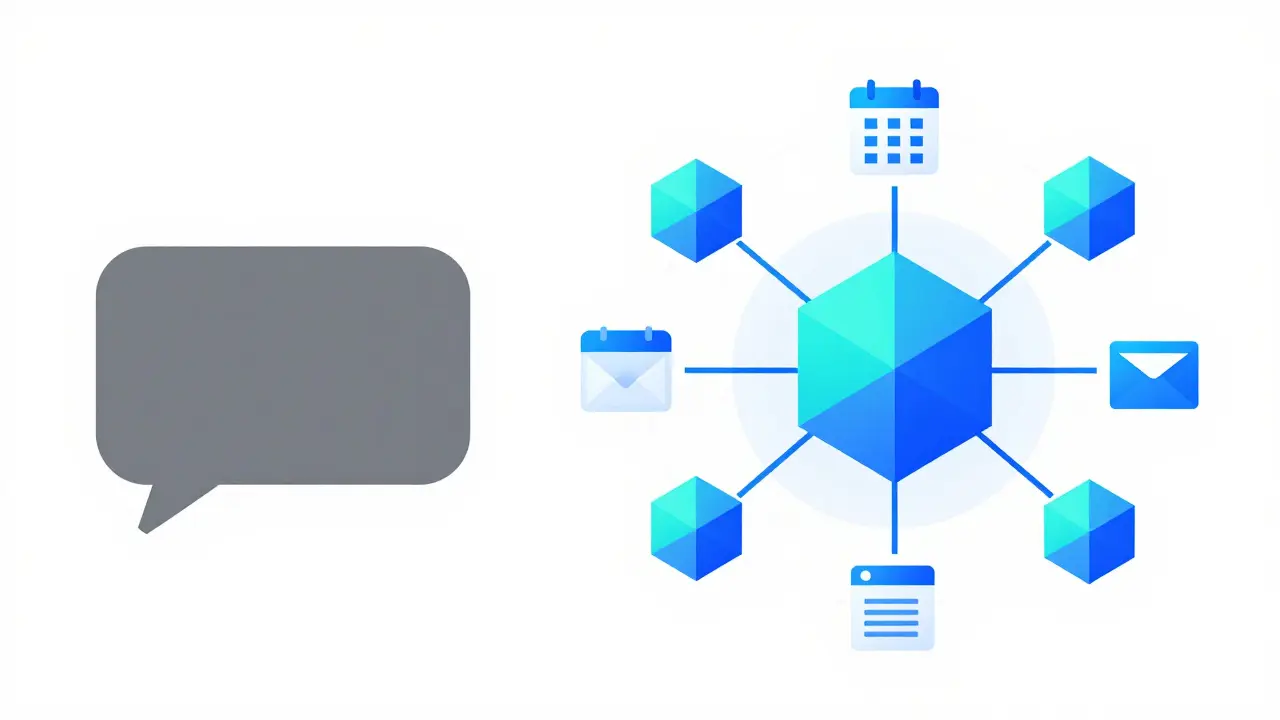
Remember when we first started using chatbots? They were helpful for simple questions but stopped dead if you asked something complex. Now, we are entering a new phase. Autonomous Agents are proactive software entities that can plan, execute, and adapt complex business workflows with minimal human intervention. These aren't just chatbots waiting for your next prompt. They are digital workers that take a goal, break it down into steps, use tools to get the job done, and adjust their plan if things go wrong. This shift from reactive responses to proactive action is changing how businesses operate.
In 2024, Deloitte defined these systems as "agentic AI"-software that completes complex tasks with little or no supervision. The difference is stark. A co-pilot suggests an email draft; an agent writes the email, checks the calendar, finds the right attachment, and sends it if the context allows. As of mid-2026, this technology has moved from theoretical hype to practical implementation in industries like biotech, finance, and tech. Companies are no longer asking if they should use agents; they are asking how to build them safely.
How Autonomous Agents Work: The Observe-Plan-Act Cycle
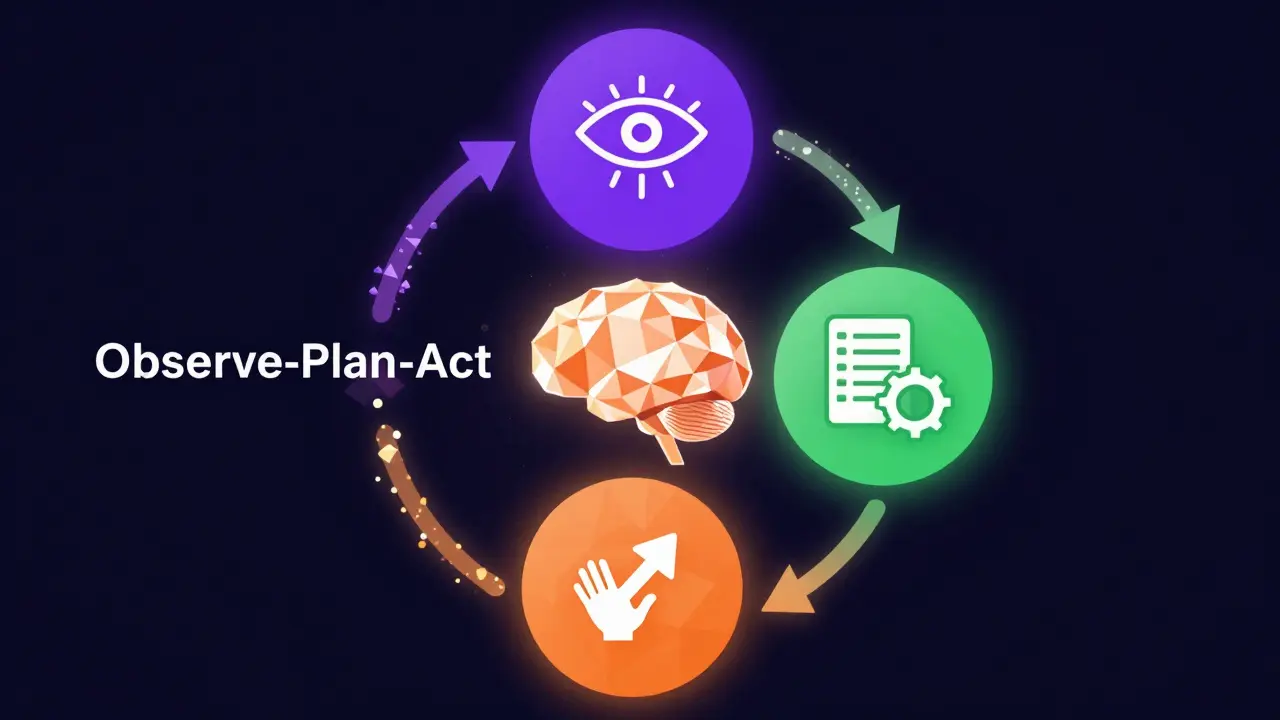
To understand why autonomous agents are different, you have to look at their internal logic. Traditional automation follows a rigid script: if X happens, do Y. If Z happens, stop. It breaks easily. Autonomous agents follow a cycle described by BCG (2024) as observe-plan-act. This cycle is self-reinforcing. The agent observes the current state of the world, plans a sequence of actions to reach a goal, acts on those plans, and then observes the result to learn and adjust.
Think of it like hiring a junior researcher. You don't tell them exactly which button to click. You say, "Find me the latest data on biomarker validation." They observe what databases are available, plan a search strategy, act by querying those databases, and if one source is outdated, they adjust their plan and try another source. In the digital world, this involves Large Language Models (LLMs) acting as the brain, connected to a toolkit of APIs, databases, and software applications.
| Level | Name | Description | Example Use Case |
|---|---|---|---|
| 1 | Chain | Rule-based RPA. Pre-defined actions and sequences. | Extracting invoice data from PDFs. |
| 2 | Workflow | Pre-defined actions, dynamic sequencing via LLM routers. | Drafting customer emails with branching logic. |
| 3 | Partially Autonomous | Plans, executes, and adjusts sequences given a goal. Minimal oversight. | Resolving support tickets across multiple systems. |
| 4 | Fully Autonomous | Operates across domains, sets goals, adapts to outcomes. | Strategic research agents synthesizing market trends. |
Most enterprises today are operating between Level 2 and Level 3. True Level 4 autonomy remains rare due to risk concerns. However, even Level 3 agents represent a massive leap. McKinsey (2024) notes that these systems excel at workflows requiring qualitative and quantitative analysis that previously resisted traditional automation because of wide variations in inputs.
From Chatbots to Agents: Why the Shift Matters
You might wonder, "Why not just stick with advanced chatbots?" The answer lies in agency. A chatbot is passive. It waits for input. An agent is active. It pursues an outcome. This distinction changes the value proposition entirely.
Consider a supply chain disruption. A chatbot can tell you, "There is a delay in shipping." An autonomous agent can detect the delay, check alternative suppliers, negotiate rates within pre-approved limits, update the logistics system, and notify the sales team-all without human hand-holding. According to AWS Insights (2024), this capability reduces bottlenecks and operational costs significantly. Genentech, a biotech company, deployed an AWS-based solution for automating biomarker validation. Their agents reduced time-to-target identification in drug discovery by 30-40%. That is not just convenience; that is competitive advantage.
However, this power comes with complexity. Basic Retrieval-Augmented Generation (RAG) implementations can be built in weeks. Enterprise-grade autonomous agents often require 3-6 months of development. Why? Because they need a robust data fabric. Appian (2024) emphasizes that effective agentic AI requires easy retrieval of contextual data. If the agent cannot access clean, secure, and relevant data, its plans will fail. This is why early pilots often stall-not because the AI is dumb, but because the infrastructure around it is messy.
Building the Architecture: Data Fabrics and Subagents
So, how do you actually build one of these systems? You don't start with the AI model. You start with the data. Modern agentic AI integrates structured and unstructured data, security protocols, and RAG engines into a cohesive stack. Tamar Yehoshua of Glean explained that this involves building a search index, likely using a vector database, and layering LLMs on top to create assistants.
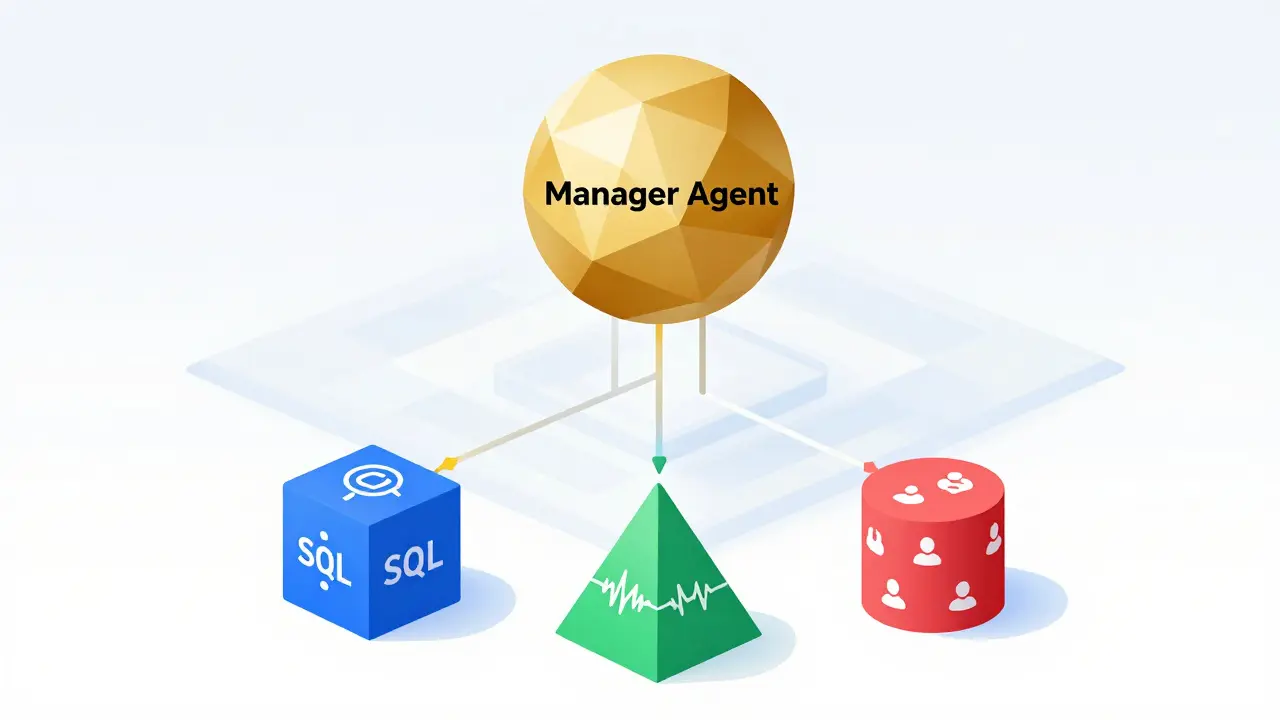
The architecture typically uses a multi-agent structure. Imagine a manager subagent that receives a high-level goal, such as "Analyze Q3 marketing performance." This manager breaks the task into subtasks: pull sales data, scrape social media sentiment, and review ad spend. It then assigns these to specialized subagents. One subagent might be an expert in SQL queries, another in natural language processing for social text. They coordinate, share findings, and synthesize a final report.
This hierarchical approach solves the problem of context limits. No single LLM can hold all the knowledge of a large enterprise. By distributing tasks among specialized agents, the system handles complexity better. Research cited by Deloitte shows that multiagent models outperform single-model systems by 22-35% in complex environments. But this coordination requires careful engineering. You need permission-aware access layers so the marketing agent doesn't accidentally access HR records. You need standardized API connections so the agents can talk to your legacy ERP systems.
Challenges: Control, Consistency, and Risk
It is not all smooth sailing. The biggest complaint from early adopters is consistency. Appian (2024) describes the initial phase as a "wild west scenario." Two employees could prompt the same agent on the same task and get vastly different results. This variability is unacceptable in regulated industries like finance or healthcare.
To fix this, companies are moving away from open-ended prompting toward standardized frameworks. They create background models that enforce rules and guardrails. For example, a financial agent might be restricted to only suggesting trades within specific risk parameters. If the agent tries to deviate, the system flags it for human review. This hybrid approach-human-in-the-loop for critical decisions, full autonomy for routine ones-is becoming the standard.
Security is another major hurdle. In 2024, Reddit discussions in r/MachineLearning revealed that engineers spent months just building the data fabric layer to give agents proper context. Without secure, permissioned access, agents are useless or dangerous. Furthermore, regulatory bodies are catching up. The European AI Act draft guidelines (September 2024) classify Level 3-4 autonomous agents as "high-risk" systems. This means rigorous validation, documentation, and human oversight protocols are required before deployment. Companies must prove their agents are safe, explainable, and controllable.
Real-World Impact: Productivity and ROI
Despite the challenges, the return on investment is compelling. Microsoft's feature analysis (2024) reports that successful implementations deliver 25-35% productivity gains in knowledge work. How? By removing the friction of switching between apps. An agent can live inside your workflow, pulling data from Salesforce, updating Jira tickets, and summarizing Slack threads without you leaving your screen.
Enterprise architects report that while upfront investment is 15-20% higher than basic LLM integrations, the ROI hits 3-5x within 12-18 months. This comes from two sources: direct labor savings and accelerated decision-making. In drug discovery, saving 40% of research time means bringing life-saving medicines to market faster. In finance, faster portfolio adjustments mean capturing market opportunities others miss.
Adoption patterns show that companies focus first on internal knowledge worker productivity (67% of pilots). Customer service automation follows (22%), and supply chain optimization trails behind (11%). This makes sense. Internal processes are easier to control and test. Once trust is built, companies expand outward to customers and partners.
The Future: Multi-Agent Systems and Beyond
Where is this going? The trend is toward more sophisticated multi-agent ecosystems. Google released no-code agent builder tools in Vertex AI in October 2024, allowing non-technical users to create agents for specific tasks like generating marketing collateral. AWS continues to refine Bedrock Agent capabilities. Startups like LangChain and AutoGen are providing the plumbing for developers to orchestrate complex agent networks.
Deloitte predicts that by 2027, 50% of companies using generative AI will have launched agentic AI pilots. More importantly, they predict these agents will handle 35-50% of routine knowledge work in pilot industries. This is not sci-fi. It is happening now. The question is no longer whether autonomous agents will change business processes, but how quickly you can adapt to them.
The era of passive AI is ending. We are moving into an age where software does not just respond-it acts. For businesses, this means rethinking roles, redesigning workflows, and rebuilding trust in automated systems. The agents are ready. Are you?
What is the difference between a chatbot and an autonomous agent?
A chatbot is reactive; it waits for user input and responds based on predefined rules or language models. An autonomous agent is proactive; it accepts a goal, plans a sequence of actions, uses tools to execute those actions, and adapts to outcomes with minimal human intervention. Agents can complete multi-step workflows independently, whereas chatbots typically handle single-turn interactions.
How long does it take to implement an enterprise autonomous agent?
While basic RAG implementations can take weeks, enterprise-grade autonomous agents typically require 3-6 months of development. This timeline includes building the necessary data fabric, integrating secure API connections, establishing permission-aware access layers, and testing for consistency and safety. Complex multi-agent systems may take longer depending on the integration requirements with legacy systems.
Are autonomous agents safe to use in regulated industries?
Safety depends on implementation. The European AI Act classifies Level 3-4 autonomous agents as "high-risk," requiring rigorous validation and human oversight. To ensure safety, companies use hybrid approaches where agents operate within strict guardrails, require human approval for critical decisions, and undergo continuous monitoring. Proper data governance and permission controls are essential to prevent unauthorized actions.
What is the ROI of deploying agentic AI?
Enterprise architects report that agentic AI delivers 3-5x ROI within 12-18 months through productivity gains. Specific metrics include 25-35% improvements in knowledge worker productivity, 30-40% reductions in manual research effort (as seen in Genentech's case), and significant decreases in operational bottlenecks. The initial investment is 15-20% higher than basic LLM integrations, but the long-term efficiency gains justify the cost.
What skills are needed to build autonomous agents?
Building autonomous agents requires a mix of AI/ML engineering, enterprise integration expertise, and domain-specific knowledge. Deloitte reports that 80% of implementation teams consist of AI/ML engineers. Additionally, you need experts who can codify domain expertise into actionable workflows, design secure data fabrics, and manage multi-agent coordination. Non-technical business users also play a role in defining goals and validating outputs.
Will autonomous agents replace human workers?
Autonomous agents are designed to augment human work, not necessarily replace it entirely. They excel at handling repetitive, complex, or data-heavy tasks that consume human time. While some routine technical roles may be displaced, new roles focused on agent supervision, prompt engineering, and system maintenance are emerging. The primary goal is to free humans for high-impact, creative, and strategic work that requires nuanced judgment.
- Jun, 3 2026
- Collin Pace
- 0
- Permalink
Written by Collin Pace
View all posts by: Collin Pace