From BERT to GPT: How LLM Architectures Evolved
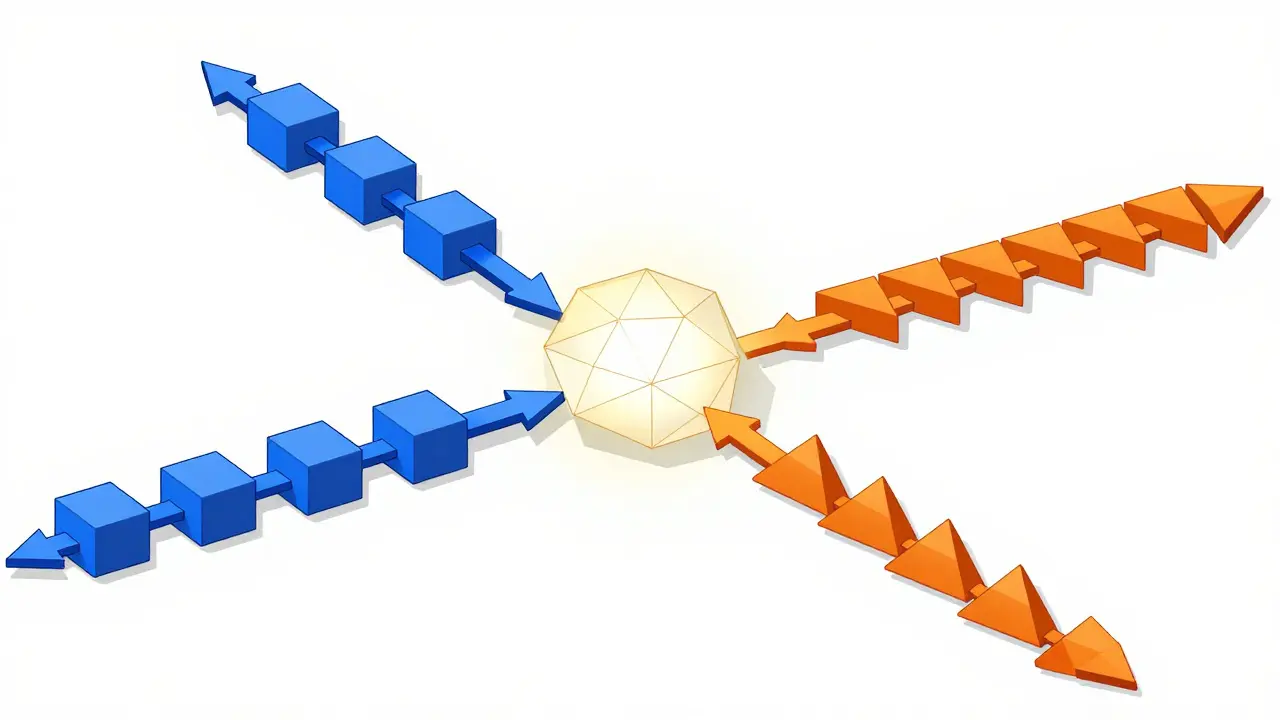
Back in 2017, the world of natural language processing (NLP) changed forever with the introduction of the Transformer is a neural network architecture that uses self-attention mechanisms to process sequential data more efficiently than previous recurrent models. Before this, models struggled with long-range dependencies and slow training times. Then came a split in the road. On one side, we got BERT (Bidirectional Encoder Representations from Transformers), designed to understand text deeply. On the other, GPT (Generative Pre-trained Transformer), built to generate coherent, human-like text. These two paths-encoder-only versus decoder-only-defined the next decade of AI development. Today, as we look at the landscape in 2026, understanding this divergence isn't just academic history; it’s the key to choosing the right tool for your specific problem.
The Core Split: Understanding vs. Generating
The fundamental difference between BERT and GPT lies in their primary job. Think of BERT as a brilliant analyst who reads a document once, understands every nuance, context, and relationship between words, and then gives you a summary or classification. It doesn’t write new stories; it interprets existing ones. GPT, on the other hand, is like a creative writer. It looks at what has been written so far and predicts what should come next, word by word, sentence by sentence.
This distinction drives their architectural choices. BERT uses an Encoder-only architecture which processes input sequences to create dense vector representations (embeddings) that capture semantic meaning. This allows it to look at both left and right contexts simultaneously. When BERT sees the word "bank," it checks if the surrounding words suggest a river or a financial institution. It sees the whole picture at once. GPT uses a Decoder-only architecture which generates output sequences token by token, using only previously generated tokens as context. It cannot see the future. It can only predict the next word based on everything that came before. This causal approach is essential for generation because, in real-time writing, you don’t know the end of the sentence when you start it.
BERT: The Power of Bidirectionality
Released by Google in 2018, BERT revolutionized NLP by introducing bidirectional training. Previous models were largely unidirectional-they read text from left to right or right to left, but not both at the same time during pre-training. BERT changed this by masking random words in a sentence and asking the model to predict them based on the full context.
Here is how BERT works under the hood:
- Masked Language Modeling (MLM): During pre-training, about 15% of the words in a sequence are replaced with a special [MASK] token. The model must guess the original word using the surrounding context from both directions. For example, in the sentence "The cat sat on the [MASK]," BERT uses "cat," "sat," and "on" to predict "mat."
- Multi-Head Attention: BERT uses standard multi-head attention mechanisms. This allows different parts of the model to focus on different aspects of the sentence simultaneously-one head might track pronouns, while another tracks verb tenses.
- Model Sizes: The original BERT Base has 12 layers and 110 million parameters. BERT Large scales up to 24 layers and 340 million parameters. Both can handle inputs up to 512 tokens.
Because BERT processes the entire input at once, it is incredibly efficient for tasks that require deep understanding rather than creation. If you need to classify customer reviews as positive or negative, extract names from legal documents, or answer specific questions from a provided text, BERT is often the superior choice. Its embeddings capture rich semantic relationships, making it excellent for downstream tasks like Named Entity Recognition (NER) and Natural Language Inference (NLI).
GPT: The Art of Autoregressive Generation
While BERT was mastering understanding, OpenAI was pushing the boundaries of generation with GPT. The first GPT model emerged in 2018, but it was the subsequent iterations-GPT-2, GPT-3, and eventually GPT-4-that captured the public imagination. Unlike BERT, GPT is trained on a Causal Language Modeling objective. It predicts the next word in a sequence based strictly on the preceding words.
This architectural constraint forces GPT to learn the flow and structure of language naturally. To predict the next word accurately, it must understand grammar, syntax, and common sense reasoning. Here are the key features of GPT’s design:
- Causal Masking: In the attention mechanism, future tokens are masked out. The model literally cannot "cheat" by looking ahead. This ensures that during inference, the model generates text sequentially, maintaining coherence over long passages.
- Scale and Depth: GPT models tend to have more layers and significantly more parameters than early BERT variants. GPT-3, for instance, had 175 billion parameters. This scale allows it to store vast amounts of factual knowledge and stylistic patterns directly in its weights.
- Training Data Volume: GPT-4 was trained on approximately 45TB of data, compared to BERT’s 3TB. This massive dataset gives GPT a broader worldview, enabling it to perform complex tasks like translation, summarization, and creative writing without explicit fine-tuning for each task.
The result is a model that excels at open-ended generation. You can ask GPT to write a poem, debug code, or draft an email, and it will produce fluent, contextually appropriate responses. However, because it predicts the next most likely word, it can sometimes hallucinate facts or drift off-topic if not carefully guided.
Comparing Performance: Which Model Wins?
Choosing between BERT and GPT isn’t about picking a winner; it’s about matching the tool to the task. Each architecture has distinct strengths and weaknesses depending on the application.
| Feature | BERT (Encoder-Only) | GPT (Decoder-Only) |
|---|---|---|
| Primary Objective | Understanding & Classification | Text Generation & Completion |
| Attention Mechanism | Bidirectional (sees all tokens) | Causal/Masked (sees past tokens only) |
| Pre-training Task | Masked Language Modeling (MLM) | Causal Language Modeling (CLM) |
| Best Use Cases | Sentiment Analysis, NER, QA | Chatbots, Story Writing, Translation |
| Inference Speed | Faster for short texts | Slower due to sequential generation |
| Context Window | Typically 512 tokens (original) | Variable, often much larger (e.g., 8k+) |
If your goal is accuracy in extracting information, BERT is generally faster and more precise. It doesn’t waste compute generating unnecessary text. For example, in a medical diagnosis support system where you need to identify symptoms from patient notes, BERT’s ability to weigh the importance of each word in the entire note simultaneously makes it ideal. Conversely, if you are building a customer service chatbot that needs to maintain a conversation over multiple turns, GPT’s autoregressive nature allows it to build context progressively, mimicking human dialogue more effectively.
The Convergence: Hybrid Models and Beyond
As we moved into the mid-2020s, the line between BERT and GPT began to blur. Researchers realized that the best systems often combine the strengths of both architectures. This led to the rise of encoder-decoder models like T5 (Text-To-Text Transfer Transformer) and BART (Bidirectional Auto-Regressive Transformers). These models use an encoder to understand the input deeply and a decoder to generate high-quality outputs.
Furthermore, modern large language models (LLMs) have evolved beyond simple binary choices. Techniques like Retrieval-Augmented Generation (RAG) now allow generative models like GPT to access external knowledge bases, mitigating hallucination issues. Meanwhile, instruction-tuned versions of BERT-family models have improved their ability to follow complex directives. The evolution hasn’t stopped at BERT or GPT; it has integrated them into more sophisticated, hybrid ecosystems.
Understanding these foundational architectures helps you navigate this complex landscape. Whether you are fine-tuning a small model for edge devices or deploying a massive LLM for enterprise search, knowing whether you need bidirectional understanding or autoregressive generation is the first step toward building effective AI solutions.
What is the main difference between BERT and GPT?
The main difference lies in their architecture and purpose. BERT is an encoder-only model designed for understanding text by analyzing context in both directions (bidirectional). It excels at classification and information extraction. GPT is a decoder-only model designed for generating text by predicting the next word based on previous words (autoregressive). It excels at creative writing and conversational tasks.
Why does BERT use masked language modeling?
BERT uses Masked Language Modeling (MLM) to force the model to learn bidirectional context. By hiding random words and asking the model to predict them using the surrounding text, BERT learns to understand the relationships between all words in a sentence simultaneously, rather than just reading left-to-right.
Is GPT better than BERT for question answering?
It depends on the type of question answering. For extractive QA, where the answer is a specific span of text from a provided document, BERT is typically more accurate and efficient. For generative QA, where the model needs to synthesize an answer in its own words or draw from internal knowledge, GPT is generally better suited.
Can BERT generate text?
Not natively in the way GPT does. BERT produces embeddings (vector representations) of text. While you can technically use BERT to fill in masked words, it is not designed for open-ended, coherent text generation. For generation tasks, decoder-based models like GPT or hybrid encoder-decoder models are preferred.
What is the significance of the Transformer architecture?
The Transformer architecture, introduced in 2017, replaced recurrent neural networks (RNNs) as the dominant model for NLP. It uses self-attention mechanisms to process all words in a sequence simultaneously, allowing for parallel processing and better handling of long-range dependencies. Both BERT and GPT are built on this foundation.
- Jun, 21 2026
- Collin Pace
- 10
- Permalink
- Tags:
- BERT vs GPT
- transformer architecture
- large language models
- encoder-only vs decoder-only
- NLP evolution
Written by Collin Pace
View all posts by: Collin Pace