How Context Windows Work in Large Language Models and Why They Limit Long Documents

When you ask a large language model (LLM) to summarize a 50-page report or debug a 10,000-line codebase, it doesn’t just read everything at once. It has a limit - a context window - that determines how much information it can hold in its working memory during a single response. Think of it like your short-term memory: you can only focus on so many things before you start forgetting the rest. That’s exactly what’s happening inside these models, and it’s why long documents often get chopped up, misunderstood, or ignored entirely.
What Is a Context Window?
A context window is the maximum number of tokens a model can process at once. Tokens aren’t words - they’re smaller pieces. For example, the word "unhappiness" might be split into three tokens: "un-", "happi-", and "-ness". On average, one token equals about 0.75 English words. So a 128,000-token context window can handle roughly 96,000 words - that’s a 300-page book. But if your document is longer than that, the model can’t see it all at once.
This limit comes from the transformer architecture, the foundation of nearly all modern LLMs. Introduced in Google’s 2017 paper "Attention is All You Need," transformers use a mechanism called self-attention to weigh how each token relates to every other token in the input. That sounds powerful - and it is - but it has a big catch: the computational cost grows quadratically with the number of tokens. Double the context window? You quadruple the memory and processing power needed. That’s why a model with a 1M-token window uses far more GPU memory than one with 32K tokens.
How Context Windows Are Measured - And Why It Matters
Context window sizes are always measured in tokens, not characters or words. That’s important because tokenization varies between models. GPT models use Byte Pair Encoding (BPE), which splits rare words into subword units. Claude and Gemini use different methods. This means a 10,000-token window doesn’t always mean the same amount of text across models.
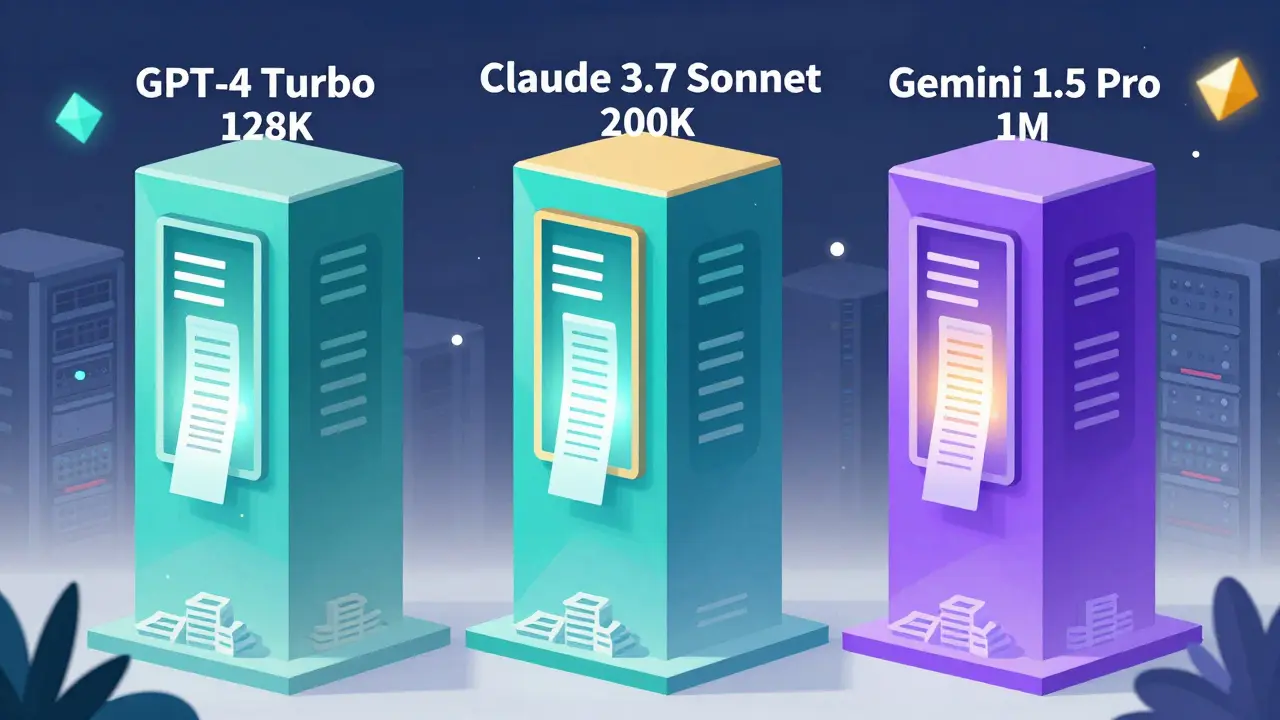
Here’s how current top models stack up as of early 2026:
| Model | Context Window | Text Capacity | Cost per Million Tokens | Latency (Avg. for 100K tokens) |
|---|---|---|---|---|
| GPT-4 Turbo | 128,000 | ~96,000 words | $10 | 3.8 seconds |
| Claude 3.7 Sonnet | 200,000 | ~150,000 words | $3 | 2.9 seconds |
| Gemini 1.5 Pro | 1,000,000 | ~750,000 words | $7.50 | 12.1 seconds |
| Mistral 7B | 32,000 | ~24,000 words | $0.20 | 0.8 seconds |
Notice the trade-offs? Gemini 1.5 Pro can handle a full novel in one go - but it’s slower and more expensive. Claude 3.7 Sonnet gives you a sweet spot: high capacity, lower cost, and faster responses. Mistral 7B, used in many local models, is cheap and fast but can’t touch documents longer than a few dozen pages.
Why Context Limits Break Long-Form Tasks
When input exceeds the context window, the model doesn’t just stop - it starts sliding. It drops the oldest tokens to make room for new ones. This is fine for short conversations, but it’s disastrous for long documents.
Imagine you’re analyzing a legal contract. The first 50 pages define key terms. The last 10 pages contain the actual obligations. If the model forgets the definitions because they were pushed out of context, it might misinterpret the obligations. That’s not a bug - it’s how the architecture works.
Real-world pain points are everywhere:
- Developers using GitHub Copilot or Cursor IDE report that 45-78% of them hit context limits when working with medium-to-large codebases. They have to manually split files, copy-paste snippets, or restart the conversation.
- Legal teams trying to review contracts say 29% of their time is spent re-feeding context after the model "forgets" earlier clauses.
- Enterprise users of GPT-3.5 (16K context) rated long-document analysis at 2.4/5 satisfaction. Those using Claude 3 with 200K tokens rated it 3.7/5.
Even with huge windows, problems persist. OpenAI’s internal tests found that when GPT-4 Turbo processes more than 64K tokens, its accuracy on reasoning tasks drops by 15%. Anthropic’s data shows a 12% accuracy drop when context usage exceeds 75% of capacity - even if the model "sees" everything, it gets distracted.
How Experts Are Working Around the Limits
Since we can’t magically remove the O(n²) problem, engineers have built workarounds. Three main strategies are in use today:
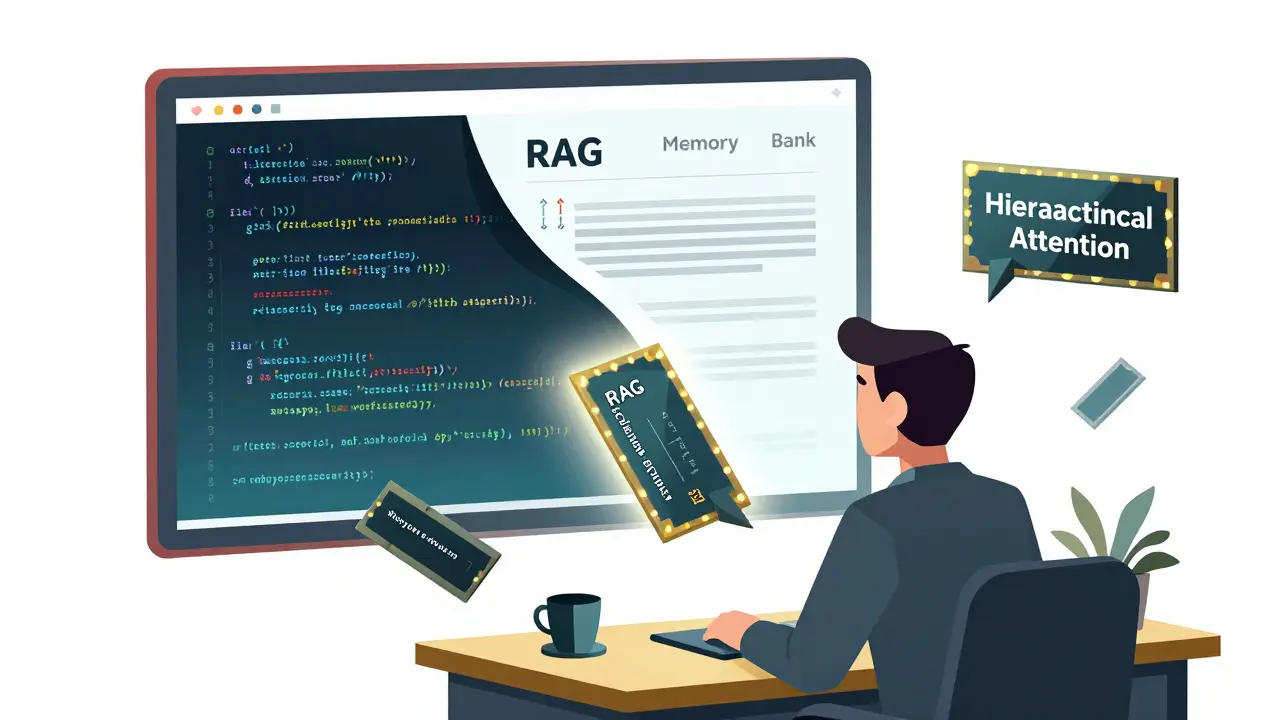
- Retrieval-Augmented Generation (RAG): Instead of feeding the whole document, you extract only the most relevant chunks - say, 5-7 sections of 512 tokens each - and feed them in. Swimm.io’s testing found that keeping context under 25% of the model’s max capacity improves accuracy by 18%.
- Memory-Augmented Architectures: Tools like MemGPT simulate an external memory. The model writes summaries of past context into a "memory bank," then retrieves them when needed. This mimics long-term memory without bloating the window.
- Hierarchical Attention: Models like Transformer-XL and Google’s "Focal Transformer" learn to focus on key tokens across longer sequences, ignoring less important ones. This reduces the need to keep everything in memory.
These methods help - but they add complexity. RAG requires good chunking and embedding systems. Memory systems need careful design to avoid hallucinations. And none of them replace the need for a large context window when you truly need to see everything at once.
The Future: Will Context Windows Keep Growing?
Yes - but not forever. The market for long-context tech hit $1.2 billion in late 2024, and 68% of enterprises now prioritize context size in AI procurement. Google’s Gemini 1.5 Pro (1M tokens) and Anthropic’s context caching (which remembers 20% of prior context) are pushing boundaries. Meta’s rumored Llama 4 may hit 2M tokens by late 2026.
But there’s a catch. Gemini 1.5’s 1M-token window is 3.2x more expensive than Claude 3’s 200K window. Latency jumps from under 3 seconds to over 12 seconds. And accuracy doesn’t always improve - it plateaus or even declines.
The real shift isn’t just about size. It’s about smartness. The next breakthrough won’t be a bigger window - it’ll be better filtering. Models that learn to ignore noise, prioritize relevance, and compress context intelligently will outperform those that just shove more data in.
Forrester predicts that until 2027, context windows will remain a bottleneck. True unlimited context may come from entirely new architectures like State Space Models (SSMs), which don’t rely on self-attention. But until then, we’re stuck managing what we have.
What You Should Do Today
If you’re using LLMs for long documents, here’s what works:
- Don’t max out the window. Use only 25-50% of capacity. More context doesn’t mean better results - it means more noise.
- Pre-filter. Summarize, tag, or chunk your documents before feeding them in. Let the model focus on what matters.
- Choose the right model. For coding? Claude 3.7 Sonnet. For cost-sensitive tasks? GPT-4 Turbo. For massive documents? Gemini 1.5 Pro - but expect slower responses.
- Test your workflow. Try feeding a 50K-token document. Does the model miss key points? Then you need better context management - not a bigger model.
Context windows aren’t going away. But understanding them - and how to work with them - is the difference between getting useful answers and getting confused, incomplete ones.
What happens if my document is longer than the context window?
The model can’t process the entire document at once. It uses a "sliding window" technique - it keeps the most recent tokens and drops older ones to make room. This means if important information appears early in the document, it may be forgotten by the time the model reaches the end. That’s why long documents often lead to inconsistent or incorrect responses.
Is a larger context window always better?
Not necessarily. Larger windows increase cost, latency, and memory use. They also introduce "attention dilution" - the model gets overwhelmed trying to weigh every token equally. Studies show accuracy drops when context exceeds 64K-75% of the model’s capacity. A 200K-token window isn’t better than a 128K one if you’re only analyzing 50K tokens of relevant data.
Why do token counts vary between models?
Different models use different tokenization methods. GPT models use Byte Pair Encoding (BPE), which splits words into subword units. Claude and Gemini use their own systems. A single word like "university" might be one token in one model and two in another. That’s why a 100K-token window doesn’t always mean the same amount of text across models.
Can I use RAG to bypass context limits?
Yes - and it’s often the best approach. RAG (Retrieval-Augmented Generation) lets you extract only the most relevant parts of a long document and feed them into the model. This avoids overwhelming the context window and improves accuracy. Most enterprise systems use RAG for document analysis because it’s more reliable than trying to shove everything into the model.
Will we ever have unlimited context windows?
Not with current transformer architecture. The quadratic scaling of self-attention makes unlimited context computationally impossible without massive trade-offs. But new architectures like State Space Models (SSMs) are being developed to handle long sequences efficiently. Experts predict SSMs could become mainstream by 2027, potentially removing context limits entirely.
Context windows are the invisible wall between what LLMs can do - and what they can’t. Until we have better architectures, the key isn’t just using bigger models. It’s using smarter ones.
- Feb, 23 2026
- Collin Pace
- 0
- Permalink
Written by Collin Pace
View all posts by: Collin Pace