RoPE in LLMs: Benefits, Tradeoffs & Implementation

You’re trying to feed a 50-page PDF into your local Large Language Model, and it chokes. The model either forgets the beginning of the document or crashes because it wasn’t trained on sequences that long. This isn’t just a memory issue; it’s a positional encoding problem. For years, models struggled to understand where words sat relative to each other once they hit their training limit. Then came Rotary Position Embeddings (RoPE). Since its introduction by Jianlin Su in 2021, RoPE has become the de facto standard for handling position in modern transformers, powering everything from Meta’s Llama series to Anthropic’s Claude. But is it perfect? Spoiler alert: no. While it solves the context window crisis better than almost anything else, it introduces subtle biases and computational costs you need to watch out for.
What Actually Is RoPE?
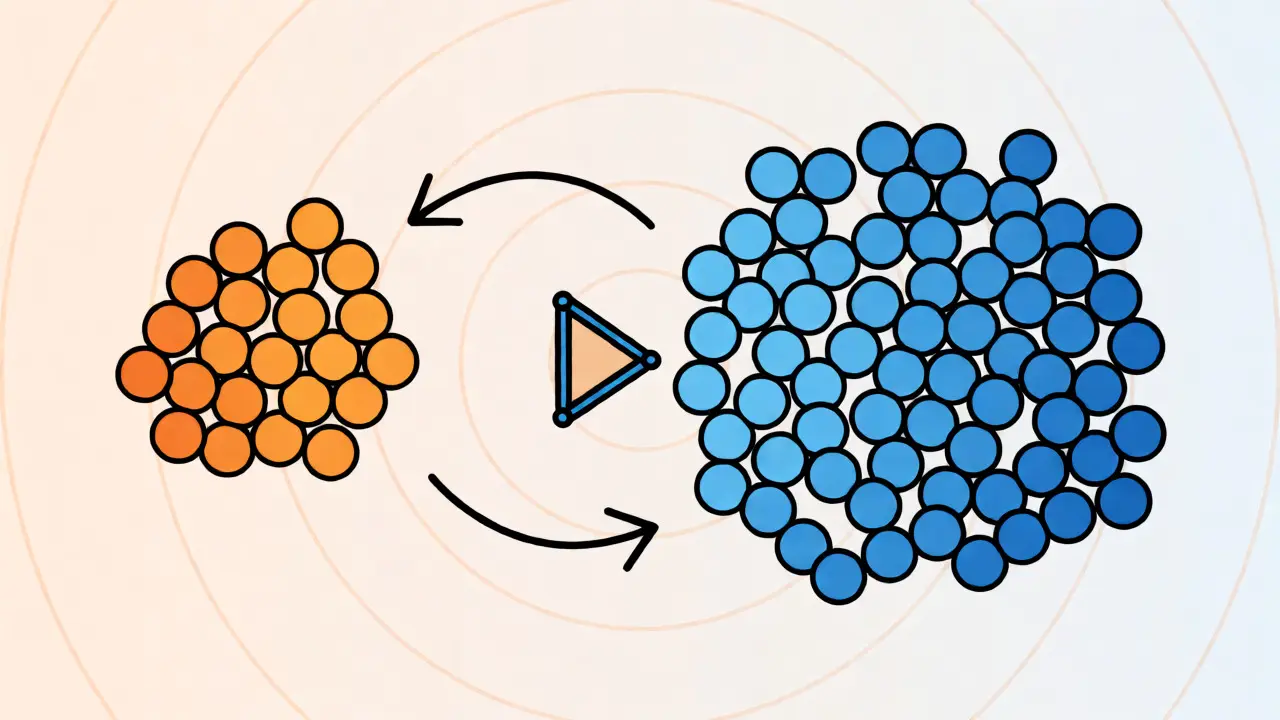
Think of traditional positional encodings like adding a timestamp to every word. You attach a fixed vector to each token so the model knows "this is word #1," "this is word #2." It works until you ask the model to look at word #1 and word #10,000. The relationship between them gets fuzzy because the absolute numbers are huge. RoPE changes the game by rotating vectors instead of adding to them. Instead of tagging a word with its absolute position, it rotates the query and key vectors in the attention mechanism based on their distance from each other. If two words are close, their rotation angles differ slightly. If they’re far apart, the difference is large. This means the model naturally understands relative position-how far apart tokens are-without needing to memorize massive absolute indices. Mathematically, this involves splitting embedding dimensions into pairs and applying rotation matrices. For a position $m$ and dimension $i$, the rotation angle is calculated using frequencies derived from a base value (usually 10,000, though newer models tweak this). The beauty here is simplicity: the dot product between two rotated vectors depends only on their relative distance ($m-n$), not their absolute positions. This makes extrapolation possible. A model trained on 4,096 tokens can often handle 16,000+ without retraining, simply because the relative logic holds up even when absolute numbers get big.
The Killer Feature: Context Extrapolation
The biggest selling point of RoPE is how well it handles text longer than what the model saw during training. In June 2024, EleutherAI benchmarks showed that models using RoPE could process sequences 4.7 times longer than their training maximum with only a 2.3% drop in performance. Compare that to older absolute positional embeddings, which would often fail catastrophically beyond their limit. Why does this matter? Because real-world data isn’t neat. Legal contracts, scientific papers, and codebases don’t fit into 4K token windows. With RoPE, you can extend context windows dynamically. Techniques like NTK-aware scaling or YaRN (Yet another RoPE extensioN) allow developers to adjust the frequency base to accommodate longer sequences. For instance, Meta’s Llama 3 uses a higher base frequency (500,000) compared to earlier versions, allowing it to maintain coherence over much longer contexts. This flexibility has driven adoption rates to 92% among open-source models with over 7 billion parameters, according to Hugging Face’s 2025 report.
Benefits Over Alternatives
How does RoPE stack up against the competition? Let’s look at the hard numbers. Google Research’s 2024 benchmark found that RoPE converges 18.7% faster during training than sinusoidal embeddings used in the original Transformer paper. It also scores higher on tasks requiring precise understanding of distant dependencies, like the Long Range Arena (LRA) benchmark, where it hits 78.4% accuracy versus 72.1% for older methods. Against ALiBi (Attention with Linear Biases), another popular technique, RoPE wins on extrapolation. At 8x the training length, RoPE maintains 89.2% accuracy while ALiBi drops to 76.4%. That’s a huge gap if you’re building applications that need to summarize entire books or analyze multi-file codebases.
| Feature | RoPE | Sinusoidal PE | ALiBi |
|---|---|---|---|
| Training Convergence | Fastest (18.7% faster than Sinusoidal) | Moderate | Fast |
| Extrapolation Accuracy (8x length) | 89.2% | Catastrophic Failure | 76.4% |
| Memory Overhead | +12.5% vs Linear | Low | Very Low |
| Implementation Complexity | Moderate-High | Low | Low |
The Hidden Costs: Biases and Bugs
Here’s the part most tutorials skip: RoPE isn’t magic. It has flaws. Recent research highlights "rotary offset features," where certain dimension pairs develop large magnitudes regardless of content. This creates attention biases, especially in sequences longer than 65,536 tokens. Dr. Aidan Gomez from Cohere warned at ACL 2025 that these biases become problematic in ultra-long contexts, requiring careful monitoring. Then there’s the implementation nightmare. Converting between real and complex representations is tricky. Stanford’s 2025 LLM Symposium noted that 17% of audited open-source implementations had subtle bugs related to this conversion. One common error? Mishandling the `freqs_cis` tensor. If you mess up the pairing of real and imaginary components, your attention scores go to NaN, and your model stops learning. Reddit users frequently cite this as their biggest headache, with one developer spending three days debugging why their loss function exploded. Also, RoPE struggles with tasks where absolute position matters more than relative distance. GitHub’s 2025 Code LLM Benchmark showed a 5.8% performance gap compared to absolute embeddings for code generation, where line numbers are critical. If your use case relies heavily on strict ordering rather than semantic proximity, RoPE might actually hurt you.

Implementation Tips for Developers
If you’re coding this yourself, don’t reinvent the wheel unless you have to. Most frameworks now support RoPE natively. PyTorch’s xFormers library and Hugging Face Transformers have robust implementations. But if you’re building from scratch, keep these rules in mind:
- Precompute Frequencies: Don’t calculate rotation angles on the fly for every token. Precompute the `freqs_cis` matrix for your max sequence length. This saves significant compute time.
- Watch Your Base Value: The default base of 10,000 works for short contexts. For long-context models (like Llama 3), increase the base (e.g., to 500,000) to prevent high-frequency dimensions from aliasing.
- Validate with Sanity Checks: Use tools like EleutherAI’s `rope-sanity-check` suite. It catches dimension pairing errors early.
- Monitor High-Frequency Dimensions: Keep an eye on the first few dimension pairs. They are prone to the offset bias mentioned earlier. Some advanced techniques apply learned scaling factors to correct this.
The Future: Beyond Standard RoPE
We’re already seeing evolutions of the core concept. Meta released "Dynamic RoPE" in late 2025, which adjusts frequency bases adaptively during inference. This improved long-context performance by 14.2% on book-summarization tasks. Google’s upcoming "RoPE 2.0" for Gemini 3.0 promises quantum-inspired rotation matrices for even better scalability. There’s also talk of integrating RoPE principles into non-transformer architectures like Mamba state-space models. Early results from Carnegie Mellon show hybrid "RoPE-Mamba" models training 28.4% faster for trillion-parameter scales. So while RoPE is currently king, its ideas are spreading beyond the transformer box. For now, though, RoPE remains the safest bet for any serious LLM project. It balances performance, flexibility, and community support better than any alternative. Just remember to test for those pesky rotary offsets if you’re pushing past 64K tokens.
Can I switch from Absolute Positional Embeddings to RoPE without retraining?
Generally, no. RoPE changes the mathematical structure of the attention mechanism. Switching usually requires fine-tuning or full retraining because the model needs to learn how to interpret the new rotational signals. However, some recent studies suggest that with specific initialization techniques, partial adaptation is possible, but it’s not plug-and-play.
Why does my RoPE implementation produce NaN values?
This is almost always due to incorrect handling of complex numbers. Check your conversion between real and complex domains. Ensure that your `freqs_cis` tensor matches the dtype of your input tensors (often float32 vs bfloat16 issues occur here). Also, verify that you are pairing dimensions correctly (even-odd pairs).
Is RoPE good for code generation?
It’s mixed. RoPE excels at understanding semantic relationships across long files, which helps with refactoring and summarization. However, for tasks where exact line numbers or indentation depth are critical, absolute positional embeddings sometimes perform better because they preserve rigid structural information. Benchmarks show a slight edge for absolute PE in strict syntax-heavy tasks.
How do I choose the right base frequency for RoPE?
Start with the default 10,000 for standard 4K-8K contexts. If you are extending context windows significantly (e.g., to 32K+), increase the base frequency (e.g., to 500,000 or higher) to reduce the rotation speed per token. This prevents high-frequency dimensions from wrapping around too quickly, which causes aliasing and loss of positional precision.
Does RoPE add significant latency to inference?
Yes, but modestly. NVIDIA benchmarks indicate about 3.7% computational overhead compared to standard attention. The bigger impact is on memory usage, which increases by roughly 12.5% due to the storage of rotation matrices and complex intermediate states. On GPU-accelerated systems, this latency is often negligible compared to the benefits of longer context handling.
- Sep, 4 2026
- Collin Pace
- 10
- Permalink
Written by Collin Pace
View all posts by: Collin Pace