Scaling Behavior Across Tasks: How Bigger LLMs Actually Improve Performance
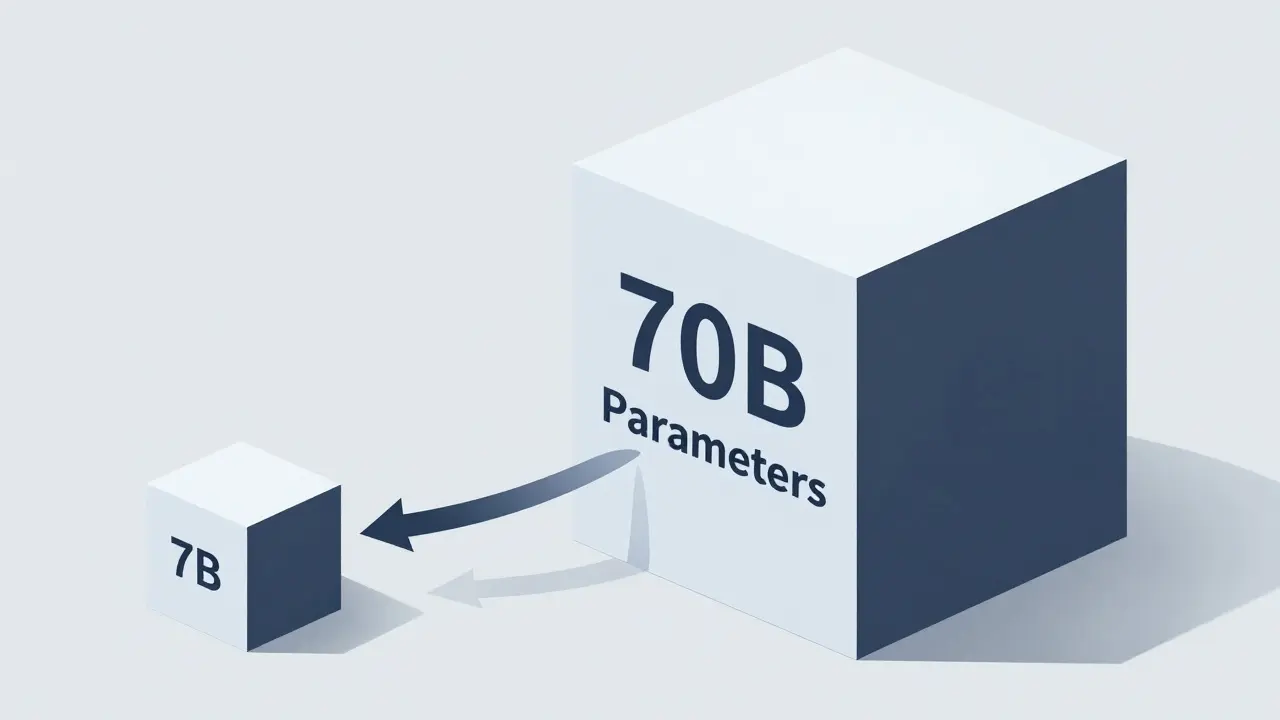
When you hear that a new large language model has 100 billion parameters, it’s easy to assume it’s just a bigger version of the last one. But that’s not the whole story. Scaling up LLMs isn’t like adding more RAM to your laptop-it’s a complex, non-linear process that changes how models learn, reason, and solve problems. The real question isn’t just if bigger models perform better, but how and when they do-and where the gains start to fade.
Scaling Isn’t Just About Size
Early research on models like GPT-3 showed something surprising: performance didn’t jump in fits and starts. Instead, it improved smoothly as models grew larger, trained on more data, and used more compute. This pattern became known as a scaling law-a mathematical relationship that predicts how test loss drops as you increase model size, data volume, or training time. It’s not magic. It’s physics-like: double the compute, and you get a predictable drop in error rate.
But here’s the twist: bigger models aren’t just more accurate. They’re more efficient. A 7B model might need 100GB of data to reach a certain accuracy. A 70B model? It can hit the same accuracy with just 10GB. That’s because larger models extract more meaning from each example. They learn faster. They generalize better. They don’t need to see the same thing 10 times-they get it after one or two.
The Efficiency Advantage
This efficiency doesn’t just help during training. It carries over to fine-tuning and even inference. When researchers tested the Qwen2.5 series-from 0.5B to 72B parameters-they found that larger models improved faster with reinforcement learning. They needed fewer training steps. They reached higher accuracy with less data. And they did it more consistently.
That’s because bigger models have more internal structure. Think of them as having more lanes on a highway. When you give them a problem, they can explore more paths at once. They don’t get stuck on dead ends. They can backtrack, try alternatives, and pick the best one-without needing extra data.
And here’s the kicker: in data-starved environments, repeating high-quality examples works better than adding low-quality ones. If you only have 5,000 math problems, don’t scrape 50,000 weak ones. Reuse the 5,000. Train harder. Let the model chew on them again and again. The bigger the model, the more it benefits from this.
Inference-Time Scaling: Bigger Isn’t Always Better
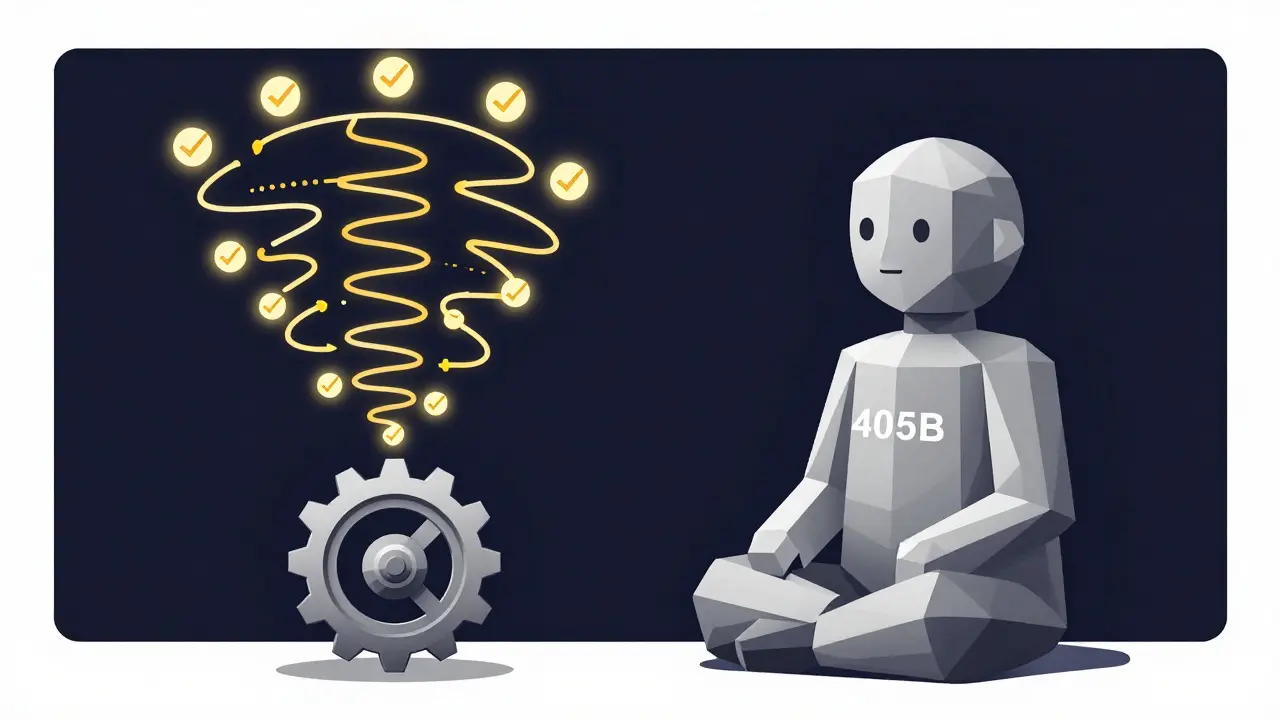
Now, here’s where things get weird. You might think a 405B model like Llama 3 will crush a 1B model. But what if the 1B model gets to use inference-time scaling? That means, during prediction, it doesn’t just spit out one answer. It generates 10, 20, even 50 possible answers-and then picks the best one using a Process Reward Model (PRM). A PRM scores each step of reasoning, not just the final answer. It’s like having a teacher who checks your work as you go.
Studies show that with this method, a 1B model can outperform a 405B model that just guesses once. Why? Because you’re not just scaling the model-you’re scaling the thinking process. It’s not about how big the brain is. It’s about how smartly it thinks.
This flips the old rule: more parameters = better performance. Now, it’s more thoughtful inference = better performance. The best strategy depends on your task. For simple questions, a small model with smart sampling wins. For complex ones, you might still need the big brain.
Mathematical Reasoning: Where Scaling Breaks Down
Math problems expose the limits of scaling. On easy problems, small models often beat big ones. Why? Because big models overthink. They generate long, convoluted reasoning chains that include mistakes. Small models just get it right the first time.
On medium-difficulty problems, big models shine. They break the problem into steps. They check their work. They use internal tools-like simulated calculators-to verify answers. This is where you see the real payoff of scale.
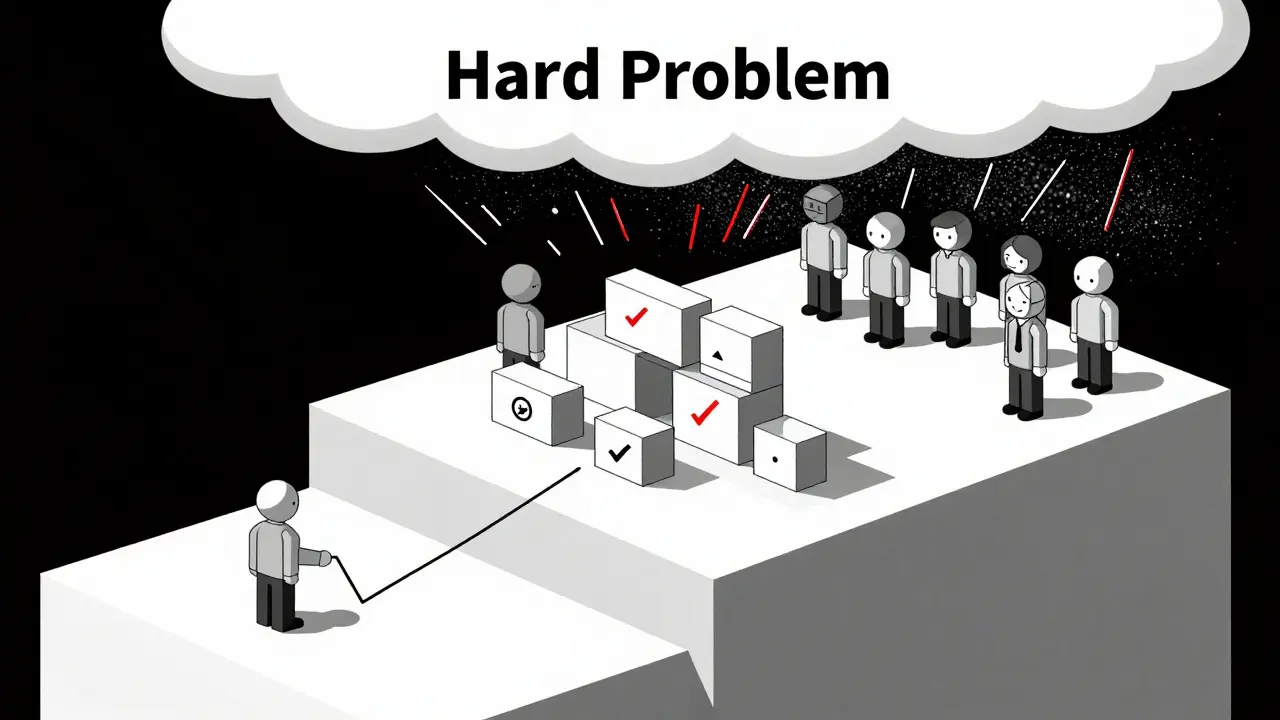
But on hard problems? Both collapse. Even the largest models hit a wall. They run out of steam. Their reasoning becomes noisy. They start hallucinating steps. This isn’t a bug-it’s a feature of how they’re trained. They’re optimized for fluency, not truth. And when the problem gets too complex, fluency wins over accuracy.
Researchers found three clear regimes:
- Low complexity: Small models win. They’re faster and more accurate.
- Medium complexity: Large models win. They reason step-by-step and verify.
- High complexity: Everyone loses. The model runs out of token budget and starts guessing.
This means scaling doesn’t help equally across all tasks. If your goal is to solve simple arithmetic, scaling up is a waste. If you need to prove a theorem? Then yes-go big.
Data Quality Matters More Than You Think
It’s tempting to think: more data = better model. But that’s only true if the data is clean. A model trained on 100GB of messy, duplicated, or low-quality text won’t outperform a 50GB model trained on curated, diverse, well-structured examples.
Research shows that for mathematical reasoning, the quality of training data-how well problems are labeled, how cleanly code is executed, how accurately solutions are verified-matters more than raw volume. A model that sees 1,000 perfect math problems with correct reasoning paths will outperform one that sees 10,000 noisy ones.
This is why the best models today aren’t just bigger-they’re trained on smarter data. They’re exposed to step-by-step solutions. They’re fine-tuned with code execution feedback. They learn not just what the answer is, but how to get there.
The Saturation Point
Scaling isn’t infinite. Every gain has diminishing returns. Going from 7B to 70B gives you a big jump. Going from 70B to 700B? The improvement is real-but much smaller. The curve flattens.
Why? Because models hit a kind of cognitive ceiling. They can’t meaningfully use more parameters. The extra capacity just sits idle. Or worse-it gets used for noise. The model starts memorizing patterns instead of learning principles.
This saturation point varies by task. For language understanding, you might hit it at 100B. For mathematical reasoning? Maybe 500B. For code generation? Even higher. The key is knowing where your task sits on the curve.
The Future: Tools, Not Just Tokens
The next leap in scaling won’t come from bigger models. It’ll come from smarter agents.
Imagine a model that doesn’t try to solve a math problem by itself. Instead, it says: “I need a calculator. Let me run this code.” Or: “I need to look up this theorem. Let me query a database.”
That’s what agentic systems do. They offload deterministic tasks to tools-calculators, databases, code interpreters-and focus their brainpower on decision-making. This shifts the scaling curve upward. Now, a 10B model with access to tools can outperform a 100B model that’s stuck doing everything internally.
Future models won’t just be large. They’ll be augmented. And that’s where the real efficiency gains will come from-not in parameters, but in partnerships between models and tools.
Do larger LLMs always perform better on all tasks?
No. Larger models perform better on complex reasoning, few-shot learning, and data-efficient training-but they can underperform on simple tasks where overthinking leads to errors. On very hard problems, even large models collapse. Performance depends on task difficulty, data quality, and how computation is used-both during training and inference.
Is training a bigger model always worth the cost?
Not always. The gains from scaling diminish after a certain point. For many applications, a 7B-30B model with high-quality data and smart inference techniques delivers 90% of the performance of a 100B+ model-at 10% of the cost. Only invest in massive models if your use case demands high-complexity reasoning, low-latency few-shot learning, or extreme data efficiency.
Can a small model outperform a large one?
Yes-if it uses inference-time scaling. A 1B model with a Process Reward Model that generates and selects from 20 candidate answers can outperform a 405B model that guesses once. Performance isn’t just about size. It’s about how you use computation at decision time.
Does more training data always improve performance?
No. Quality beats quantity. Repeating high-quality examples often yields better results than adding noisy, low-quality data. For mathematical reasoning, a model trained on 5,000 perfectly labeled problems with step-by-step reasoning can outperform one trained on 50,000 messy ones. Focus on precision, not volume.
What’s the future of scaling in LLMs?
The future isn’t just bigger models-it’s smarter systems. Agentic models that use external tools (calculators, databases, code executors) to offload deterministic tasks will achieve higher efficiency than models trying to do everything internally. Scaling will shift from parameters to partnerships: models that know when to think, and when to compute.
- Mar, 17 2026
- Collin Pace
- 7
- Permalink
Written by Collin Pace
View all posts by: Collin Pace