Vibe Coding Distributed Systems: Risks, Realities, and How to Do It Right in 2026

Imagine telling your computer exactly what you want a complex system to do, watching it write the code in seconds, and hitting deploy. Sounds like magic, right? That’s the promise of vibe coding. But here’s the catch: when that system handles millions of transactions across multiple servers, "magic" often turns into "disaster." You can vibe-code a blog post or a simple dashboard without breaking a sweat. But try using it for a banking ledger or a real-time inventory system, and things get messy fast.
We are living through a massive shift in how we build software. In late 2023, Andrej Karpathy coined the term "vibe coding" to describe giving in to the flow of AI-generated code rather than planning every line. By early 2025, Gartner reported that 67% of developers at large tech companies were already using this approach. The speed is undeniable. Prototypes fly off the screen. But does it work for the heavy hitters-the complex distributed systems that keep the internet running? Let’s look at the data, the dangers, and the realistic way forward.
The Allure of Speed vs. The Reality of Complexity
Why is everyone talking about vibe coding? Because it’s fast. Microsoft’s Azure Labs found that vibe-coded systems achieve 38% faster initial prototype deployment. If you’re building an internal tool or a proof-of-concept, this is a game-changer. You skip the tedious syntax and focus on the logic. However, speed comes with a hidden tax.
A December 2024 Forrester study compared 15 distributed systems projects and found that while vibe coding cut initial development time by 41%, it increased technical debt accumulation by 63%. Think about that. You save weeks upfront, but you spend months later fixing the mess. Traditional development approaches maintained 92% adherence to best practices out of the box. Vibe-coded implementations hit only 67% compliance unless you add strict governance layers.
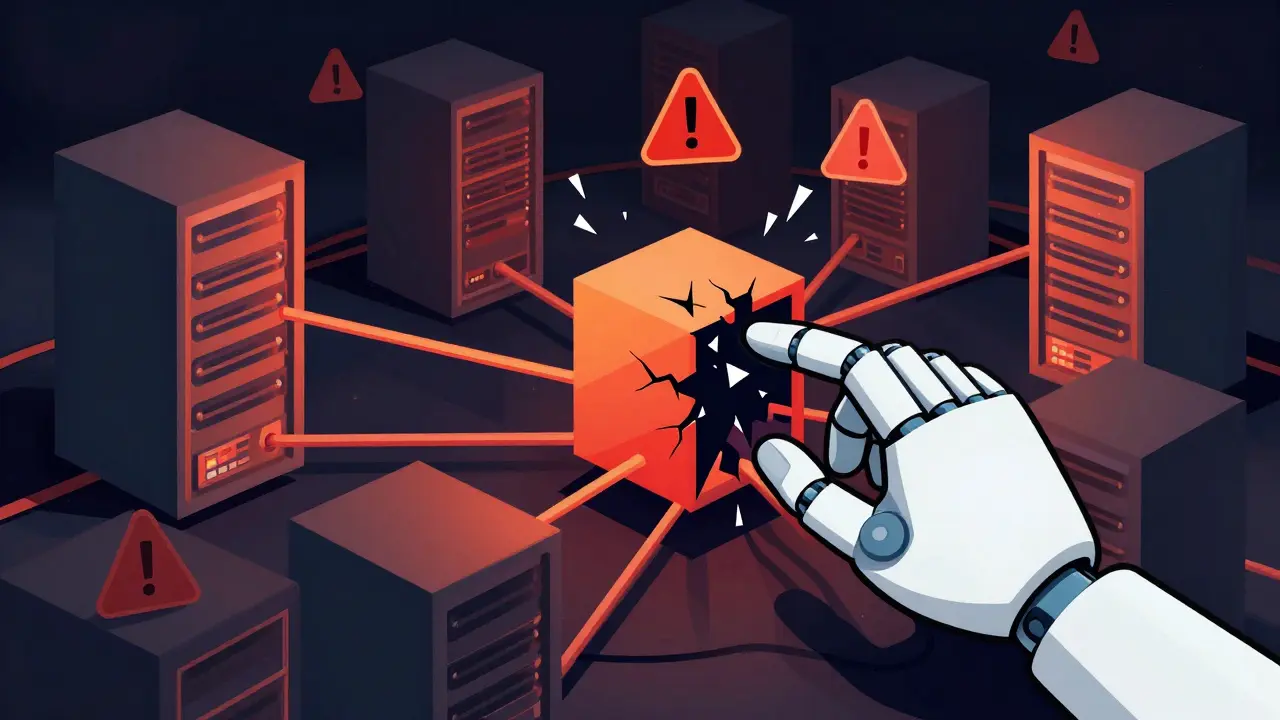
The core issue isn’t the AI’s ability to write Python or Go. It’s the AI’s inability to "see" the whole system. Distributed systems rely on subtle interactions between services-latency, network partitions, and eventual consistency. AI models generate code based on patterns they’ve seen, not the unique, chaotic reality of your specific infrastructure. When a network blips, a vibe-coded service might retry indefinitely, causing a cascade failure that brings down the entire cluster.
Where Vibe Coding Breaks Down
Not all parts of a distributed system are created equal. Some components are safe for AI assistance; others are landmines. Here is where the cracks show up:
- Distributed Transactions: Implementing Saga patterns (a way to manage long-running transactions) is notoriously difficult. A 2025 MongoDB case study showed failure rates increased by 33% in vibe-coded systems because the AI missed critical compensation logic. If step three fails, did the AI remember to undo steps one and two? Often, no.
- Consensus Algorithms: Dr. Jane Chen from Microsoft Research put it bluntly in her May 2025 ACM keynote: "You cannot vibe your way through consensus algorithms." Tools like Paxos or Raft require deterministic precision. Probabilistic AI code simply doesn’t cut it when a single edge case can crash a cluster.
- Error Handling: GitHub issues tagged with 'vibe-coding' reveal common pitfalls: improper retry logic (32% of cases), missing circuit breakers (27%), and incorrect transaction patterns (21%). These aren’t typos; they are architectural failures.
On Reddit, a developer shared their experience vibe-coding an order processing system using Google’s Vertex AI. It worked great until a race condition emerged during peak load. They spent 37 hours manually debugging issues the AI failed to anticipate. That’s the cost of trading deep understanding for speed.
| Metric | Vibe Coding (AI-Assisted) | Traditional Development |
|---|---|---|
| Initial Dev Time | 8.4 weeks (41% faster) | 14.3 weeks |
| Technical Debt Accumulation | +63% increase | Baseline |
| Best Practice Compliance | 67% (without governance) | 92% |
| Cross-Service Latency | 17% higher | Baseline |
| Error Rate (Network Partitions) | 23% higher | Baseline |
The Three Pillars of Safe Vibe Coding
If you’re going to use AI for distributed systems-and most of us will-you need guardrails. A February 2025 Google Cloud study analyzed 78 enterprise codebases and identified three non-negotiable components for success:
- Contextual Awareness Frameworks: The AI needs to understand the whole system, not just the file it’s editing. Successful implementations used frameworks that maintain system-wide understanding across microservices. This was present in 63% of successful cases.
- Real-Time Constraint Validation: You need tools that enforce architectural boundaries as code is generated. Did the AI just introduce a synchronous call in an asynchronous system? Catch it instantly. This was key in 58% of production-ready setups.
- Automated Feedback Loops: Continuously validate against distributed system principles like the CAP theorem. If the code violates consistency requirements, reject it before it hits the repo.
Tools like Superblocks’ Vibe Governance Suite are gaining traction for this exact reason. Adopted by 38% of Fortune 500 companies in Q1 2025, these platforms boost compliance rates from 67% to 89%. They don’t replace the developer; they act as a senior architect reviewing every AI suggestion.

Who Should Actually Use This?
Let’s be honest about skills. A March 2025 Pluralsight survey of 8,500 developers revealed a harsh truth: only 28% of developers attempting vibe coding for distributed systems actually possess strong distributed systems knowledge. You can’t vibe-code what you don’t understand.
If you’re a junior dev, vibe coding might give you a false sense of competence. JetBrains’ 2025 report shows less experienced developers need 8-12 weeks to effectively integrate this workflow, compared to 3-4 weeks for veterans with 5+ years of experience. Why? Because the expert knows what to ask the AI and, more importantly, how to spot when the AI is lying.
Successful adoption requires three capabilities:
- Strong distributed systems fundamentals (CAP theorem, idempotency, retries).
- Prompt engineering mastery for technical domains (41% mastery rate among users).
- Experience with observability tools like distributed tracing (only 33% proficiency).
Future Outlook: Augmentation, Not Replacement
Will vibe coding take over? Probably not entirely. Forrester’s May 2025 analysis cautions that "vibe coding will never replace deep distributed systems expertise." Systems requiring sub-millisecond latency or financial-grade integrity will stick to traditional methods for now.
However, the trend is accelerating. The global AI-assisted development market hit $8.7 billion in Q1 2025. New tools are emerging specifically for this niche. Google Cloud released "Distributed Systems Copilot" in June 2025, which reduces implementation errors by 39% by specializing in patterns like Paxos. Microsoft acquired Baseten, a startup focused on making AI suitable for complex architectures, signaling big money is betting on this space.
Gartner predicts that by 2027, 55% of distributed systems will incorporate vibe coding for non-critical components. The key word is "non-critical." Use it for internal dashboards, logging services, and user-facing prototypes. Keep human hands on the wheel for payment processors, authentication cores, and data consistency engines.
Is vibe coding safe for production distributed systems?
Only with strict governance. Raw vibe coding increases error rates by 23% during network partitions. However, when paired with validation tools like Superblocks or Chaos Mesh, compliance improves significantly. Never use it for core transactional integrity without rigorous testing.
What are the biggest risks of using AI for distributed systems?
The top risks are missing compensation logic in Saga transactions (missed in 41% of cases), improper retry logic leading to cascading failures, and lack of context across microservices. AI struggles with emergent behaviors and edge cases in network instability.
Do I need advanced skills to vibe code effectively?
Yes. Only 28% of developers have the necessary distributed systems knowledge to do it safely. Experts need 3-4 weeks to adapt, while juniors may struggle for 8-12 weeks. You must understand CAP theorem, idempotency, and tracing to verify AI output.
Which tools help mitigate vibe coding risks?
Governance suites like Superblocks, chaos engineering tools like Chaos Mesh (which tests against network partitions), and specialized copilots like Google’s Distributed Systems Copilot help enforce constraints and reduce errors by up to 39%.
How much faster is vibe coding really?
It accelerates prototyping by 30-45% and cuts initial development time by 41%. However, it adds 22% more iterative refinement cycles and increases technical debt by 63%, so the long-term speed gain depends on your maintenance budget.
- Jun, 22 2026
- Collin Pace
- 0
- Permalink
Written by Collin Pace
View all posts by: Collin Pace