Category: AI Infrastructure - Page 2
Infrastructure Requirements for Serving Large Language Models in Production

Learn the specific hardware, software, and architectural needs for deploying LLMs in production. Covers GPU specs, cloud vs. on-prem costs, and optimization tips for 2026.
- Aug 18, 2026
- Collin Pace
- 0
- Permalink
On-Prem and Private Cloud LLMs for Regulated Data Handling: A Guide

Explore how on-premise and private cloud LLMs help regulated industries handle sensitive data securely. Learn about compliance, infrastructure choices, and implementation strategies for HIPAA and GDPR.
- Aug 11, 2026
- Collin Pace
- 5
- Permalink
Streaming Responses in LLM APIs: Architecture and User Experience

Explore the architecture of streaming responses in LLM APIs. Learn how SSE improves user experience, compare OpenAI and Anthropic implementations, and avoid common frontend pitfalls.
- Aug 1, 2026
- Collin Pace
- 0
- Permalink
Production Guardrails for Compressed LLMs: Confidence and Abstention
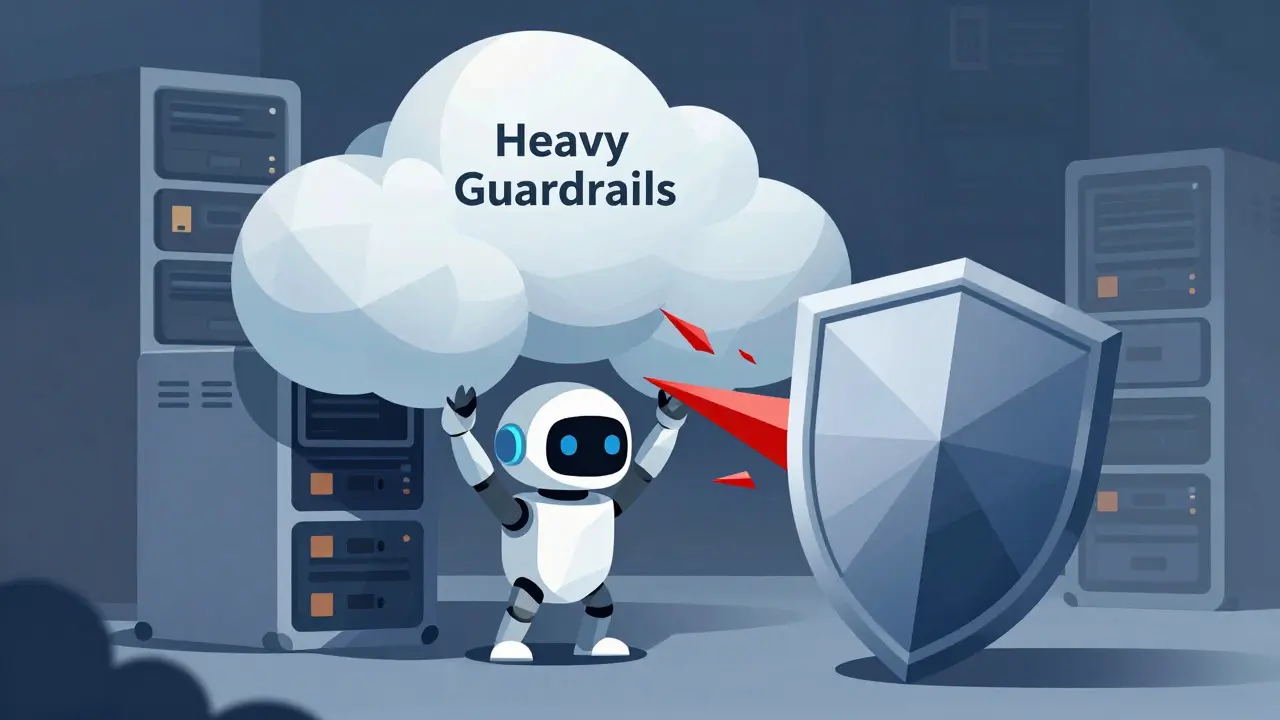
Learn how to secure compressed LLMs in production using Defensive M2S compression, tiered guardrailing, and confidence-based abstention to balance safety with low latency and cost.
- Jul 17, 2026
- Collin Pace
- 0
- Permalink
Safety-Aware Decoding for LLMs: How Inference-Time Guardrails Work in 2026

Explore how safety-aware decoding and inference-time guardrails protect LLMs from jailbreaks in 2026. Learn about SafeDecoding, SSD, and ShieldHead techniques.
- Jul 13, 2026
- Collin Pace
- 6
- Permalink
Cost-Aware Scheduling for Large Language Model Workloads: A Practical Guide
Learn how cost-aware scheduling optimizes LLM workloads by balancing SLOs and expenses. Explore frameworks like DeepServe++ and CATP-LLM to reduce GPU costs and improve latency.
- Jul 12, 2026
- Collin Pace
- 0
- Permalink
Traffic Shaping and A/B Testing for Large Language Model Releases: A Practical Guide

Learn how to safely deploy LLMs using traffic shaping and A/B testing. Explore canary releases, semantic routing, and infrastructure requirements for reliable AI operations.
- Jul 1, 2026
- Collin Pace
- 0
- Permalink
Observability and SRE Practices for Self-Hosted Large Language Models

Learn how to monitor and maintain self-hosted LLMs using SRE best practices. Covers essential metrics, Kubernetes strategies, and why autonomous AI debugging isn't ready yet.
- Jun 30, 2026
- Collin Pace
- 0
- Permalink
Target Architecture for Generative AI: Data, Models, and Orchestration Strategy

Build a robust generative AI architecture with our guide on data, models, and orchestration. Learn how to structure layers, reduce costs, and ensure security for enterprise success.
- Jun 23, 2026
- Collin Pace
- 0
- Permalink
RAG with Vector Databases: Embeddings, HNSW Indexing, and Filters

Learn how Retrieval-Augmented Generation (RAG) uses vector databases, embeddings, and HNSW indexing to reduce AI hallucinations and improve accuracy with real-time data.
- May 6, 2026
- Collin Pace
- 0
- Permalink
Building Linting and Formatting Pipelines for Vibe-Coded Projects

Learn how to build a rigorous linting and formatting pipeline to keep AI-generated code maintainable. Discover the 5-layer quality gate stack and tools like Biome.
- Apr 30, 2026
- Collin Pace
- 9
- Permalink
Adapters vs Full Fine-Tuning for LLMs: Cost, Speed, and Quality Comparison

Compare Adapters vs Full Fine-Tuning for LLMs. Learn how PEFT and LoRA reduce costs by 70%, save VRAM, and maintain 95-100% of model quality.
- Apr 23, 2026
- Collin Pace
- 10
- Permalink